
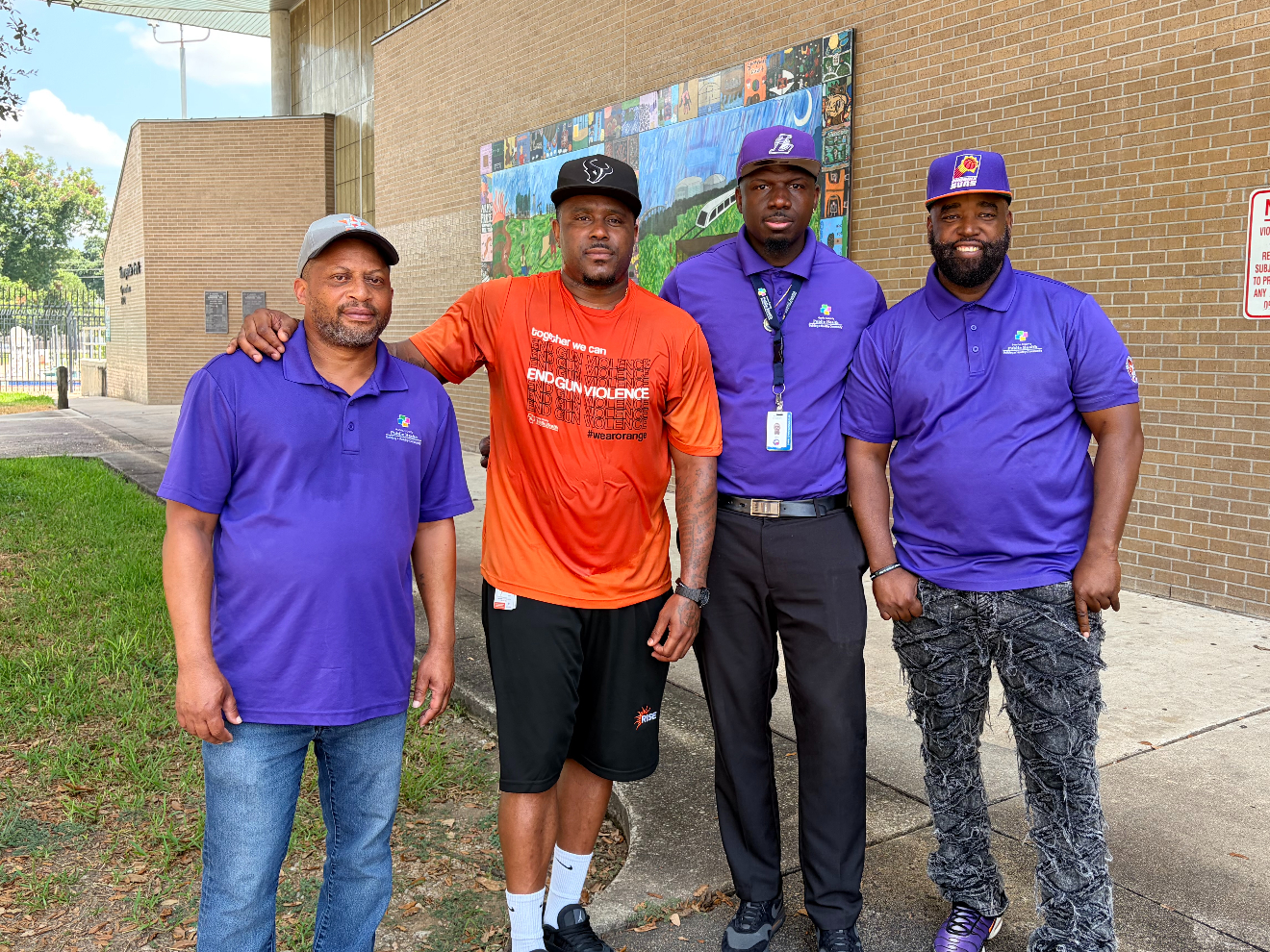
Larry Carrington sat in an armchair at Ben Taub Hospital next to a man who’d just been shot. Carrington didn’t know the man, but he knew the lifestyle. And he knew he’d got a small window to intervene before the man’s friends decide to settle the score.
“We gave our testimonies to him,” Carrington says. “We prayed for him and after we did all that, he was crying. I think we made a breakthrough that day. He didn’t call his homeboys to go retaliate.”
Not too long ago, it could have been Carrington gasping for breath and bleeding out from a gunshot wound in a hospital bed.
But after years of hustling on the streets of Houston’s South Park neighborhood, Carrington traded his weapons and dope for a purple polo shirt designating him as a “credible messenger” for Harris County Public Health’s RISE team.
The acronym stands for Relentless Interruptors Serving Everyone, and its outreach specialists conduct hospital interventions, community workshops, and neighborhood engagement to reduce cycles of gun violence and trauma.
Taxpayers have funded the RISE program to the tune of about $1.9 million annually since 2022, but most people don’t know it exists until they find themselves in a situation where they need it.
Commissioner Rodney Ellis came up with the idea of a violence interruption program when he was first elected to the court in 2016. He’d seen successful models in California, Maryland and Illinois, and his team worked with experts at the University of Chicago and the Health Alliance for Violence Intervention to come up with something that would work in Harris County.
Ellis plans to ask his fellow court members in September to spend an additional $4.5 million on top of the $10.8 million already budgeted for community safety programs to expand the outreach and put the initiatives under the umbrella of a new county department dedicated solely to crime prevention. Albuquerque, Durham and Seattle have created departments to oversee similar initiatives.
The funding dedicated to community safety programs represents about 1.5 percent of the county’s total law enforcement budget and goes toward the RISE team, a separate domestic violence intervention program, and the Holistic Assistance Response Team, through which unarmed crisis intervention specialists and EMTs respond to mental health incidents without involving law enforcement.
The additional funds would allow RISE and HART members to expand into more communities and respond to gun violence incidents and mental health crises 24/7.
“For too long, our public safety systems have been structured to respond after harm has already occurred,” Ellis says. “But if someone is experiencing a mental health crisis or a gun violence incident or is trying to escape abuse, responding after the fact simply is not enough.”
“People can’t be prosecuted out of poverty,” he added. “Mental health and substance use can’t be treated in a jail cell. Survivors deserve a path to safety before violence turns deadly.”
“It Broke Something Inside of Me”
Carrington, known as “LC” to his friends, sold a bag of dope for the first time in 1998 in South Park. He was 14 years old.
“I was sitting on an air conditioning unit at the apartment complex, just chilling, and one of the dope fiends came up and asked if I got something for 50 [dollars],” Carrington recalls. “I was like, damn. He’s got $50. How hard could it be?”
“When you grow up in an underprivileged area, you see the glitz and the glamour, the big homie who’s selling dope and he has the money, the car and the women. We just saw the fruits of it. When you don’t have anything, it seems like a pretty easy choice.”
Shortly after Carrington’s 18th birthday, he was sent to a Texas prison, and when he got out after 13 months, he went to the now-shuttered Crossroads charter school to finish his high school education.
He stayed out of trouble for a while and got a partial college basketball scholarship to Jarvis Christian University but when he could no longer afford tuition, he went back to his mother’s house in his old neighborhood and resumed selling drugs.
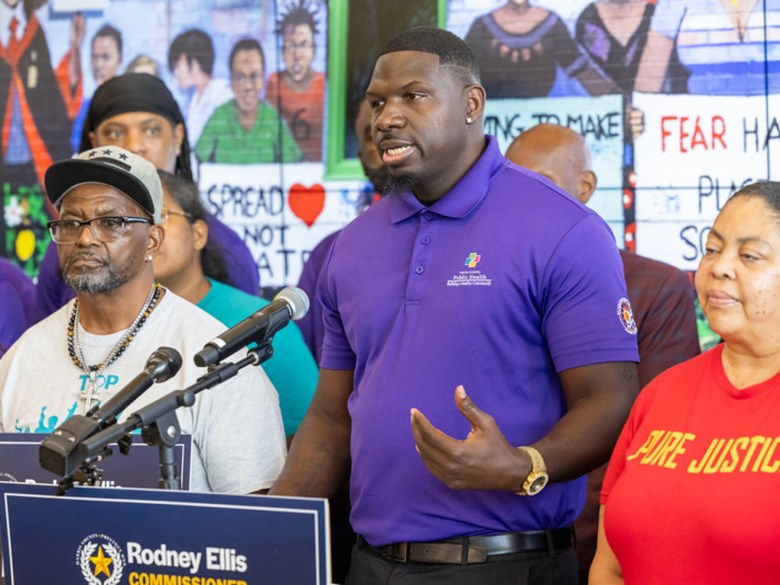 Larry Carrington used to sell drugs in Houston’s South Park neighborhood. Now he helps others find a better way of life. Credit: Office of Commissioner Rodney Ellis
In 2013, an apartment where Carrington lived with his 3-year-old twin boys was raided by the police.
“I was just sitting on the couch watching Martin,” Carrington says. “There was one big loud knock and then they came on in. They did all this whooping and hollering, like ‘Get on the ground!’ They grabbed me and pulled me outside. They woke up the boys and they had me outside but the door was open and I could see my kids sitting on the couch inside.”
Officers seized drugs, weapons and counterfeit money. “That moment broke something inside of me,” Carrington says. “I realized that if I went to prison, my kids wouldn’t have anyone to take care of them.”
Carrington’s pro bono lawyer managed to get him out of a second prison sentence, and after Carrington served just nine days in the county jail, he committed to doing right by his kids — who are now 16 and still live with him full-time — and the mother who raised him.
About two years ago, Carrington’s former Crossroads basketball coach Russ Bessard called him up and said he had a job for him. Carrington was working in a warehouse at the time and was interested. He’s been with RISE ever since.
“Russ knew that I had turned my life around and thought I could help other people do the same thing,” Carrington says.
Second Chances
The other programs in Ellis’ community safety package — HART and domestic violence intervention — were also created in 2022 and have been generally met with positive reception even as debates continue over whether taxpayer funds should go toward social services.
HART’s lead case manager Deja Griffin says the specialists on her team are able to build trust with people suffering from substance abuse and mental health issues because they pull up in purple and gray vehicles, rather than black and white cop cars.
RISE isn’t as well-known in Harris County, but Ellis says it’s every bit as necessary and effective as HART. The outreach specialists like Carrington have prevented at least 186 acts of violence through their hospital visits and work with youth and young adults at barbershops, after-school programs and community centers.
They also connect young people to job training and help them get a state ID if they don’t have a driver’s license “so they can get a job and get out of the streets,” Carrington says.
“I know from my own experience that if you hand somebody a way to put a gun down and a real chance at supporting themselves and their family, they’re going to take it,” he says. “I’m grateful for my second chance, and I know that RISE means there can be more stories like mine.”
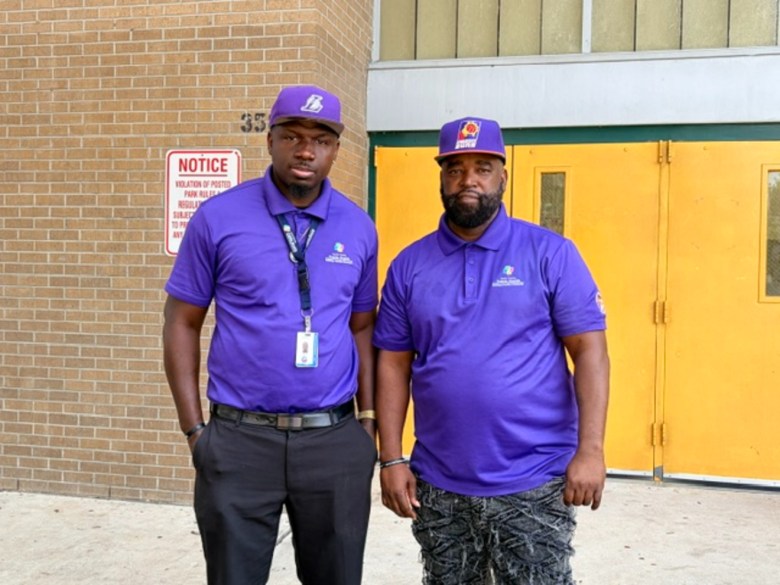 Larry Carrington, left, and Russ Bessard work for the south side RISE team out of Sunnyside Park. Credit: April Towery
Most of the specialists have a criminal history and do outreach in the neighborhoods they grew up in. “We come from the community. We know a lot of the people who have been shot or the shooters themselves, and if we don’t know them personally, I’m pretty sure we know one of their family members personally,” Carrington says.
A kid who’s starting to get into fights at school or is drawn to the gang life is more inclined to listen to a RISE team member than a pastor or parent, the outreach specialists agree, recalling a 15-year-old who met Carrington when school administrators asked the RISE team to step in.
“The moment I looked at him, I saw myself in him,” Carrington says. “He’d been getting into fights and got caught with a gun on campus. He was about to end up in the juvenile detention center.”
The teen told Carrington he loves guns and carries one for protection. “We told him straight up that we’ve been exactly where he’s been and if he continues down that road, we know exactly what is going to happen to him,” Carrington says. “We asked if we could pray with him.”
The young man told the RISE members he’d never prayed before. Carrington says, “I knew then that the situation he was in, it wasn’t his fault. He didn’t have anybody in his household. We became his village.”
The boy is now living with his father, attending a new school and staying out of trouble.
Carrington never had a close relationship with his own father, who split from his mom when Carrington was 3 years old, but he considered his mother a best friend, even while he was hustling. She died a little over a year ago and he wears a small necklace with her picture close to his heart. He says he likes to think that he’s honoring her by the work he does with RISE.
In every neighborhood where RISE operates, gun homicides have fallen faster than in Houston as a whole. In Cypress Station, family violence crimes are down 48 percent and aggravated robberies dropped 34 percent since 2023. The two RISE teams — one designated for the south side and one for the north side — have made more than 30,000 connections in the Houston and Harris County neighborhoods most affected by gun violence.
RISE members have also made more than 2,300 hospital visits to survivors of gunshots, stabbings and assaults. “It’s a lot cheaper to have someone like me sit with a person in crisis than it is to arrest or prosecute them,” Carrington says.
When Ellis goes before commissioners court during a budget amendment hearing on September 8, he’s likely to tell his colleagues that the community safety programs save lives. They also save time by freeing up law enforcement and EMS, and they save taxpayer dollars by reducing reliance on jails, courts and emergency rooms, Ellis says.
According to Ellis’ office, Harris County will spend roughly $1 billion on law enforcement and jail detention over the next fiscal year. One night in the county jail costs $105, and there are currently 8,775 inmates in Harris County detention. More than 1,000 are currently outsourced to other states due to overcrowding.
Ellis says the investment in community safety programs will pay for itself and save $5 million per year in detention costs.
Return on Investment
Bessard, the RISE program’s south side supervisor, grew up running around with a South Park gang and spent eight years behind bars before turning his life around and going to coach basketball at the Crossroads charter school. He handpicked his team of outreach specialists and refers to them as credible messengers.
“My grandmother told me that an ounce of prevention can be a pound of cure,” he says. “That’s why this work is so important. If we can plant seeds of prevention, of encouragement, of going to school, of taking care of your family, now that’s gangster.”
The south side crew has an office in the community center at Sunnyside Park. They gather on weekdays for a morning briefing and set up a game plan for the day, whether it be a pick-up basketball game with kids in the community center gym, visiting barbershops or checking in on a family in the hospital.
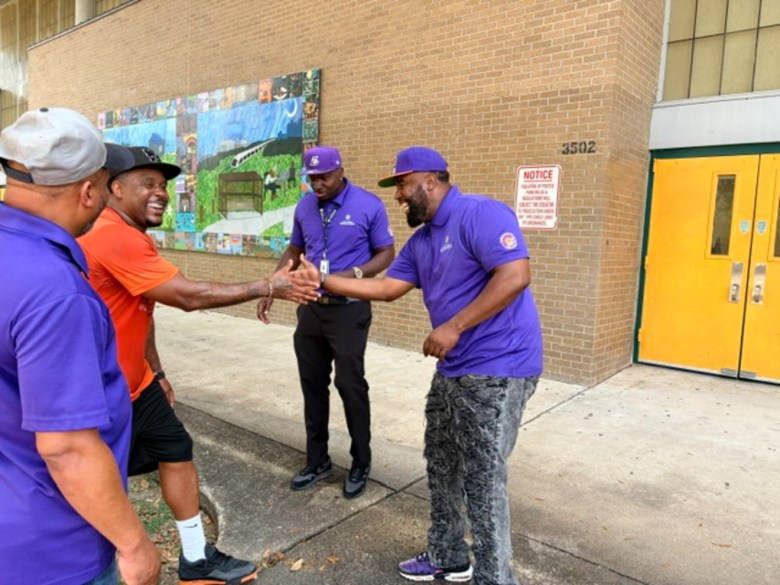 The RISE team’s “credible messengers” teach kids that there’s more to life than gangs and drugs. Credit: April Towery
Sometimes they go to lunch with HPD officers, constables and sheriff’s deputies. Their work is in partnership with law enforcement, Bessard says, and the local cops often invite them to incidents where they can help.
“We go into the schools, and they know us by our purple shirts,” Bessard says. “There’s an elementary school across the street that we go to. We can’t wait to get to know them until they get to middle school because they’re already listening to music that’s telling them that when you’re mad at somebody, you go shoot them.”
“We tell them they’re special and they can do special things. We’re no longer a part of the problem. We’re part of the solution. When we’re investing money, we’re not investing it into RISE; we’re investing it into the hearts of men in our community.”
Bessard says he’s seen the evidence that the program works, but it doesn’t hurt that a recently published 60-page report from Georgetown Law’s Center for Innovations in Community Safety substantiates that sentiment.
Mariela Ruiz-Angel, director of community safety at Georgetown Law, co-authored the report and says the HART and RISE programs prove that trained civilian responders and peer support specialists can safely address thousands of service calls each year that historically have defaulted to law enforcement.
“The goal is to break the cycle,” says Ruiz-Angel, who lives in Washington, D.C., and spoke remotely to Houston-area reporters at a recent press conference. “We don’t have to speculate as to whether these models have value. They do.”
The report found that programs like HART and RISE generate more in cost savings than they require in investment, that the costs saved from preventing violence and avoiding arrest, detention, and adjudication will cover the proposed investment.”
Carrington says he’s seen a return on investment not just in terms of dollars but by the lives that have been changed.
When reflecting on one of the teenagers he and his team helped, he says, “I believe without the relationships we built with him, he was headed to one of three places: the penitentiary, the hospital or the morgue. I do this work because I want to help clean up what I once helped mess up. I believe people can change if somebody’s willing to help them.”
Related