
Digital subscribers can listen to this article.
Subscribe today for unlimited access to Texas Monthly. Already a subscriber? Log in.
A dispute over coverage has put Texas Christian University and the Fort Worth Star-Telegram at odds—an unlikely turn for two institutions whose histories have long been intertwined. As a young Fort Worth was taking shape, TCU and the Star-Telegram were coming of age within it. The Star-Telegram published its first stories in 1909, after the Fort Worth Star’s merger with its rival, the Telegram. Early the next year, TCU’s Waco campus building was destroyed in a fire, leaving the university searching for a new home. Fort Worth quickly came calling, launching a citywide campaign to bring the campus to North Texas. It succeeded, and the still-fledgling Star-Telegram celebrated TCU’s impending arrival in an editorial, noting that in its newest educational institution, Fort Worth “is taking her surest and best course to greatness and fame.”
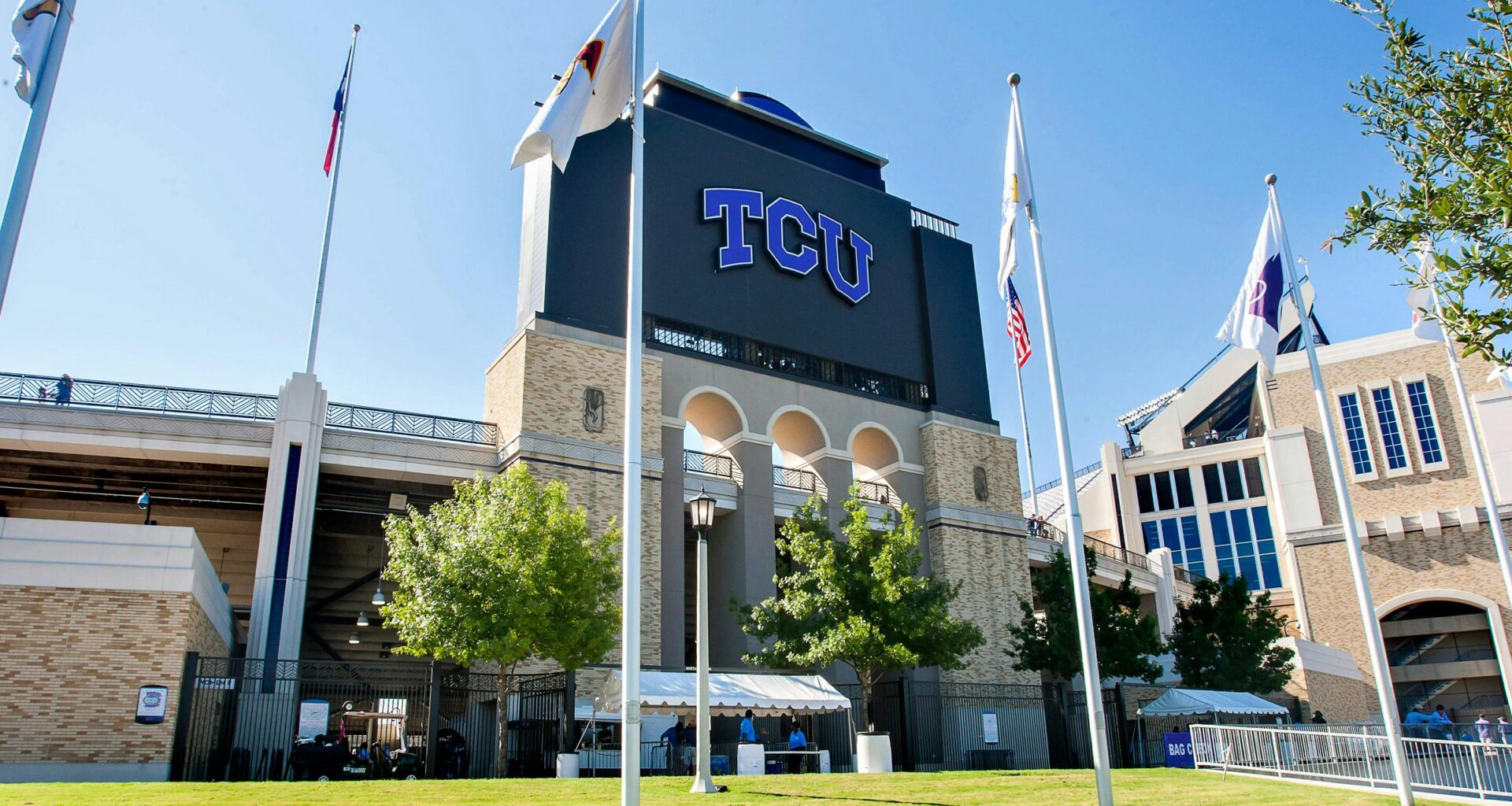
Over much of the twentieth century, the two institutions maintained a close relationship. In the late twenties, when TCU formed a committee to construct a new stadium for the now-competitive football team—after the Star-Telegram ran an aerial photo of 22,000 fans packed into the team’s stadium to emphasize the need for a larger space— the group selected Amon G. Carter, a cofounder and the longtime publisher of the Star-Telegram, to lead the initiative, calling him “the one and only man” who could pull off the effort. Carter founded the TCU Stadium Association, mobilized Fort Worth business leaders, and helped sell the bonds to finance the stadium. And in 1951, the university renamed it the Amon G. Carter Stadium.
Now, 75 years later, the Star-Telegram is barred from covering TCU sports at Amon G. Carter Stadium, and all Horned Frogs athletics, after a disagreement over the newspaper’s coverage.
It all started August 18, when TCU announced that Jacob Fields—a high-profile Louisiana Tech University transfer—would be departing the team for violation of its rules, without sharing any specifics. As these things usually go, the Star-Telegram was on the case. Using the university’s public crime log and details supplied by a source who claimed direct knowledge of the incident, the newspaper’s beat reporter, Steven Johnson, reported that Fields had been removed for a locker-room fight with an offensive player—though it didn’t explicitly identify the player. The anonymous source also told the Star-Telegram that Fields had “felt targeted by teammates with insults and threats,” and that despite reaching out multiple times to coaches, “there were no attempts to de-escalate the brewing tension, which ultimately led into the confrontation in the locker room.” A few days later, in a now-deleted Instagram video, wide receiver Dozie Ezukanma revealed he was the player Fields had assaulted, and he described the experience. (The Star-Telegram later reported that Ezukanma was hospitalized for three days with a brain bleed and concussion, among other injuries, after the incident.) With Ezukanma having publicly identified himself, the Star-Telegram published another story on August 21, including his name as part of its coverage of the incident.
The Star-Telegram published an updated account the same day, quoting someone “who was authorized to speak on behalf of Fields and his family.” That source disputed the notion that Fields had been bullied or mistreated. Then, on August 23, a spokesperson for TCU athletics told the Star-Telegram that the program was pulling all of the newspaper’s press credentials, which allow journalists to cover home and away games, because the coverage led to threats against the victim. TCU’s athletic director, Mike Buddie, doubled down in a statement on August 25. “The inclusion of the misinformation advanced a narrative that endangered a student-athlete and resulted in threats to him and his family,” Buddie said.
In a statement to Texas Monthly, TCU athletics spokesperson Kyle Neaves said the credentials were pulled not because the Star-Telegram reported on the assault but because of how the newspaper initially characterized what led to it. Neaves said the paper’s source lacked “direct firsthand knowledge of the locker-room incident and has since been discredited.” When the Star-Telegram reached out to TCU for its initial story, Coach Sonny Dykes had declined to comment, and a spokesperson told the reporter that the program had no comment on the matter.
Neaves also told Texas Monthly that the newspaper had been warned before and after publication that its account was inaccurate. But it’s unclear in what capacity this was relayed to the Star-Telegram.
Johnson, who didn’t respond to an interview request, said he would travel to Dublin, Ireland, to cover TCU’s opener against North Carolina despite the credential loss. “As for the situation,” Johnson tweeted, “I don’t have much to say aside from I look forward to continue covering TCU and believe the Frogs have a chance to be pretty good this year.” (TCU lost to North Carolina 15–10.)
In the week since TCU pulled the Star-Telegram’s credentials, sports reporters from across the U.S. have rallied behind the century-old newspaper. Shehan Jeyarajah, the president of the Football Writers Association of America, the national organization representing college-football journalists, called for Johnson’s credentials to be “reinstated immediately.” Tim MacMahon of ESPN asked, “Who knew Horned Frogs have such thin skin?” Andrew Marchand, a senior writer at The Athletic, wrote that TCU’s decision “seems embarrassing.” ESPN senior writer Dan Wetzel called TCU’s decision “wild,” adding, “The Star-Telegram is the only traditional media outlet that regularly covers TCU . . . and has for decades and decades.”
A quick look through the Star-Telegram archives evidences its historic commitment to TCU sports coverage. One online collection includes a Star-Telegram photographer’s 1938 photo of Davey O’Brien, the football player who won TCU its first Heisman Trophy and led the Horned Frogs to an undefeated season and its second national championship. The newspaper’s sports reporters followed the football team throughout the 1951 season, from flights to California to its training for the Cotton Bowl. A September 1973 photo shows Star-Telegram sportswriter Jim Trinkle talking with two TCU football players; another shot later that month documents a University of Texas at Arlington quarterback throwing over one of TCU’s defensive linemen, with the caption noting that the Frogs would ultimately win 49–13.
The coverage went beyond the team’s successes. In 1985, the Star-Telegram broke major revelations about the origins and scale of an illegal $7,500-a-month slush fund for players allegedly proposed by the previous head coach of the football team. The same day the story went live, a major football booster who had helped fund the effort resigned from his position as trustee. Still, the relationship between the two institutions remained professional.
Now, after more than a century of chronicling TCU’s championships, scandals, coaches, and players, the newspaper finds itself barred from the press box at Amon G. Carter Stadium. For now, the newspaper that Carter once led is no longer welcome inside.
Read Next