
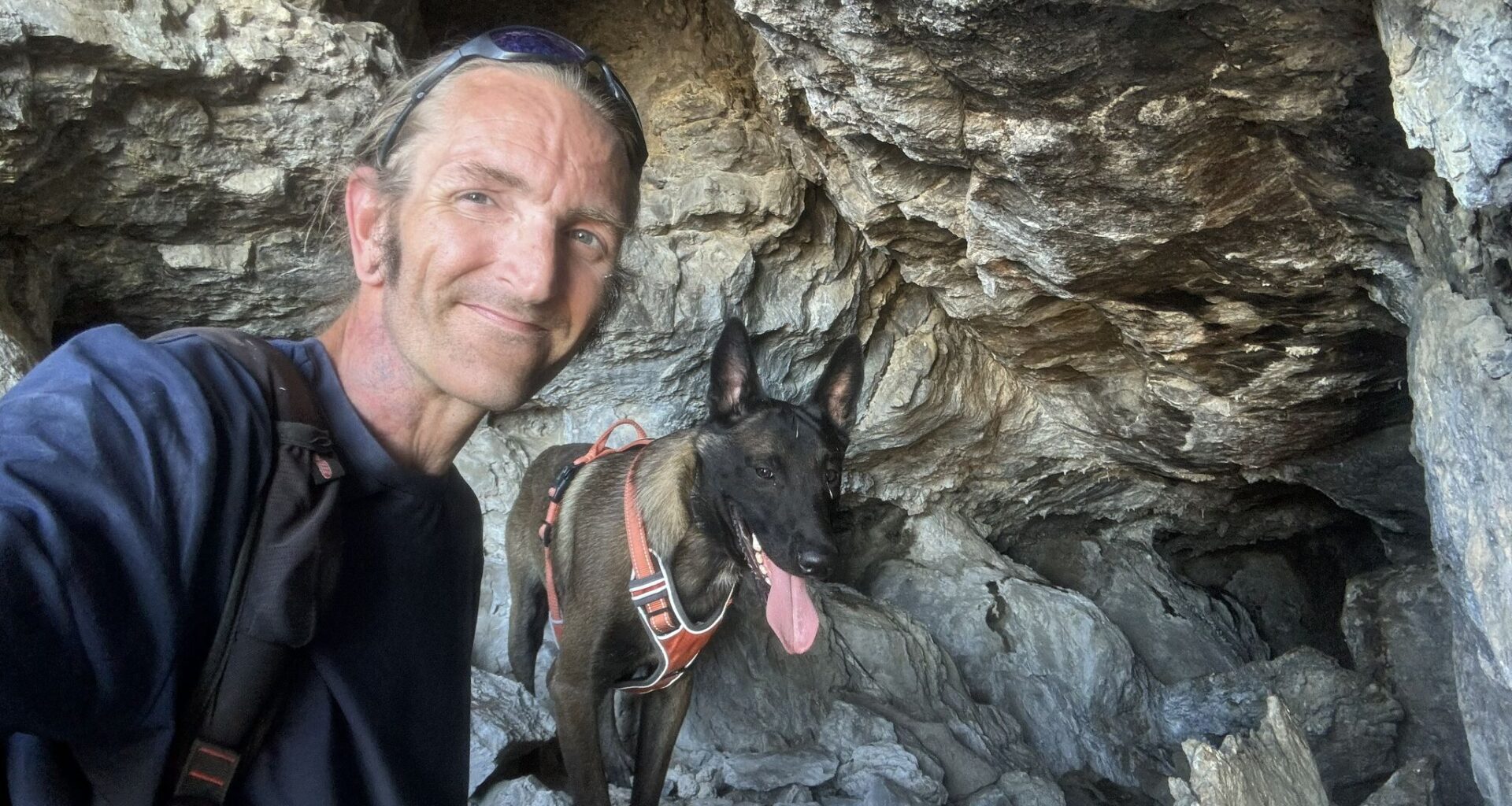
Shane Lilly and his dog, Major, a Belgian Malinois, pose on a hike. (Photo courtesy of Shane Lilly)
Shane Lilly
On a cloudy Monday afternoon in March 2025, Shane Lilly said he was walking down Felix Avenue with Major, his 65-pound Belgian Malinois, when a white pickup truck struck the dog and sped away.

Major’s back left leg was bleeding. Lilly said he panicked and left the dog on a porch while he ran to retrieve his phone from a tent where the pair had been staying.
Article continues below this ad
While Lilly was gone, a woman who stopped to help tried to lift Major into a car so she could take him to a veterinarian. The injured dog bit her, according to police records and interviews.
That bite began a legal fight that reached the Texas Supreme Court. The court declined to revive the case, leaving in place an order to euthanize Major, who has spent nearly 17 months isolated at an Austin animal shelter while Lilly pursued appeals.
The unusual case exposes a system in which dog-bite proceedings can stretch on without a clear deadline, owners who cannot afford lawyers are not guaranteed legal representation and judges have limited room to consider whether a dog was provoked or could be safely rehabilitated.
Major has spent more than 500 days in Kennel 600, a row of isolated enclosures for dogs involved in court cases or quarantined after bites. He can hear staff cleaning nearby kennels, but a guillotine-style wall prevents any physical interaction. He does not walk the shelter’s trails or visit the dog park a few yards away.
Article continues below this ad
Dogs typically remain in such conditions for about 30 days, according to Austin Animal Services data. Major has been there since March 31, 2025.
“This is not a healthy way to keep a dog at all,” animal services spokesperson Elizabeth Ferrer said.
Kennel 600 at Austin Animal Services, Aug. 27, 2026.
Sara Diggins/Austin American-Statesman
Rebekha Montie, a manager who oversees the city’s animal protection officers, said the legal responsibility falls on the owner in cases like Major’s — but “sometimes the animals do pay the price.”
Article continues below this ad
Lilly agrees that he is responsible.
“What’s happening is not fair to him,” Lilly said. “I’m the reason he got put in an extreme situation. I would gladly take any punishment they could give me to have him back.”
A working dog
Lilly had wanted a dog since a 2012 attack in Katy left him with a traumatic brain injury, he said. The injury forced him to leave his cybersecurity job for several years and relearn how to speak and play guitar. It also left him feeling vulnerable and wanting a dog for protection.
Article continues below this ad
In April 2023, Lilly was matched with a tan Belgian Malinois puppy named “Moe” — one of three males in a litter named after “The Three Stooges.”
He bought the dog from Lone Star Elite K9s for $15,000: $3,000 for the puppy and $12,000 for a six-month program to train family-protection dogs.Lilly brought the puppy back for training in October but pulled him out after a few weeks. Lilly said he feared for his safety, believed something might have happened to Major and called breeder Justin Evans in the middle of the night to arrange an early pickup.
Major, a Belgian Malinois, poses for a photo in Las Vegas, Nevada. (Photo courtesy of Shane Lilly)
Shane Lilly
Lilly said he wanted Major to be a service animal and mistakenly believed protection could qualify a dog as a service animal. Evans said Lilly never asked for a service animal and would have been told no if he had.
Article continues below this ad
Even without professional training, Lilly registered Major through U.S. Service Animals after paying a small fee. The dog received a certificate and a black vest that said, “DO NOT PET.” He was not wearing that vest when the bite took place, though Lilly said Major wore an unmarked orange vest.
Major, a Belgian Malinois, is seen in a black service dog vest at a rest stop in Washington. (Photo courtesy of Shane Lilly)
Shane Lilly
The pair lived out of Lilly’s car and traveled around the country. In videos Lilly shared, Major appears energetic and responsive to commands. Lilly said he trained the dog to help him keep his balance and open doors and used fake plastic guns and knives to teach him how to respond to attackers.
“He’s my baby, I love him so much,” Lilly said.
Article continues below this ad
The bite
The travels ended in late 2024 when Lilly’s car was repossessed, he said. He and Major returned to Austin, briefly rented a home on Felix Avenue and were evicted for not paying rent. They then slept in a tent that Lilly moved around the city. At one site near a greenbelt, he built a makeshift yard from sticks and branches so Major could not escape.
The pair also rode the bus. Lilly said Major sometimes growled and snapped at passengers, so he ordered a muzzle online in March 2025.
Lilly said he and Major were walking toward the Felix Avenue house when the truck hit the dog. After Major limped to the porch, Lilly ran to retrieve his phone from the tent, about 30 minutes away.
Julissa Alvarez was driving on Montopolis Drive when she saw another woman trying to lure Major into a car, according to a police report. She stopped to help.
Article continues below this ad
“We really didn’t know what to do and Major was obviously scared and hurt,” Alvarez said.
According to the police report, Alvarez tried to pick Major up from behind. He bit both of her arms, leaving gashes that paramedics estimated would require 10 to 12 stitches. Photos entered into evidence show puncture wounds and missing skin.
A photo of Julissa Alvarez’s injuries was entered into the court record. (Photo courtesy of Travis County Court Clerk)
Travis County Court Clerk
Montie said officers found Major sitting in the front yard “just waiting.” An animal protection officer used a catch pole to put him in a vehicle, then took him to the shelter for a rabies quarantine.
Article continues below this ad
Lilly returned to find blood on the porch and a note directing him to call police. He went to the shelter, saw Major and arranged for the dog to remain there for treatment, agreeing to pay medical costs and $54 a day for housing.
The next day, lead investigator Elayna Grove told him she had sought a warrant to seize Major. Grove described the attack as “provoked” in the warrant but said there was probable cause to seize the dog because the bite caused serious bodily injury.
A municipal judge signed the warrant April 9, 2025. It ordered Major to remain confined at the shelter.
Fighting to keep Major alive
Lilly’s first court hearing was set for April 15. He prepared to represent himself in municipal court because legal representation is not guaranteed in civil cases that do not carry the possibility of jail time.
Article continues below this ad
Kevin Dietz, deputy director of Texas Legal Services Center, said legal aid groups generally do not take municipal-court cases. Texas law provides court-appointed lawyers in only limited civil matters, including mental-health confinement and termination of parental rights, he said.
“People cannot afford lawyers, and there are basically two of us in the state of Texas that do animal law,” said Don Feare, a Fort Worth attorney who handles dog-bite cases.
Alvarez did not appear at the hearing. She later told the Statesman she did not want to testify against Major because she did not believe the bite was the dog’s fault.
Judge Stephen Vigorito ordered Major euthanized no sooner than April 26, 2025. He allowed Lilly one more visit and reduced the shelter bill from $1,442 to $200 because Lilly was indigent.
Article continues below this ad
Lilly appealed. At a county-court trial three months later, Alvarez again did not appear.
The evidence concerning her injuries differed between the two proceedings: Photos of her injuries were admitted in municipal court, but medical records were not, according to the municipal judge and court documents. The county-court judge later admitted Alvarez’s medical record into evidence.
Lilly claims he objected to the record’s admission, but court documents show the judge considered it in reaffirming the euthanasia order. Medical records generally are considered hearsay unless an exception applies and the proper foundation is established.
Feare said if he had been representing Lilly, he would have objected to the discussion of Alvarez’s injuries at the hearing.
Article continues below this ad
“If you don’t have an injured party, you don’t have a case,” Feare said. “You can’t prove that up.”
The next day, the judge reaffirmed the euthanasia order, saying Major had caused serious bodily injury by “attacking, biting and mauling” Alvarez.
Lilly appealed again and sought pro bono representation from the State Bar of Texas, but was denied because of limited resources. Representing himself, he argued that earlier courts had erred by proceeding without Alvarez and had failed to consider what he described as Major’s role as a service animal or alternatives such as rehabilitation and advanced obedience training.
Rehabilitation is possible for some dogs after an attack, Montie and Evans said. But shelter staff testified that Major remained “a particularly aggressive dog” even after his injuries healed. And, as the court noted, Major had already been through a training program — one Lilly ended early — when “this bite occurred nonetheless.” The court determined that more training was unlikely to help.
The Texas Supreme Court denied a motion to rehear the case on Aug. 14, leaving the euthanasia order in place.
Article continues below this ad
Montie said it is not unusual for a dog that has bitten someone and caused serious bodily injury to be ordered euthanized. What makes Major’s case unusual, she said, is how long the animal remained at the shelter while Lilly appealed.
“We haven’t had any other animals recently that have gone up as high in appeals,” she said.
A long wait
Lilly said he has been told to choose a date to say goodbye at the shelter. Major remains in Kennel 600, where staff members say he is “emotionally deteriorating.”
Article continues below this ad
Montie said the dog receives enrichment, including treats, and is well cared for. Lilly said he pays to have raw food, duck feet and peanut-butter cookies delivered each month.
Major is now the longest-serving dog in Kennel 600 and, according to animal services data, has spent more time there than any dog ordered euthanized since the city began collecting that data last year.
Austin Animal Services, Aug. 27, 2026.
Sara Diggins/Austin American-Statesman
Because animals are considered property — and evidence — in these cases, the shelter is obligated to keep them safe, Ferrer said. Still, she added, “it just hurts your heart to hear about the 600s.”
Article continues below this ad
Montie said lawmakers could consider adding a deadline to the appeals process. Feare said he doubts anyone wants to reopen the statute, but he and Lilly would like to see more room for judges to consider provocation.
A burglar who is bitten while breaking into a home might present one clear example, Feare said.
“Why should he have to die if he was provoked to bite someone?” Lilly said.
Article continues below this ad
Whatever happens to Major, experts agree that prolonged isolation is harmful.
“It’s a sad situation. If you want to turn a dog bad, leave it in a shelter for a year,” Feare said. “If that was a human, how long do you think that would last? They’re not punishing the owner, they’re punishing the dog.”