
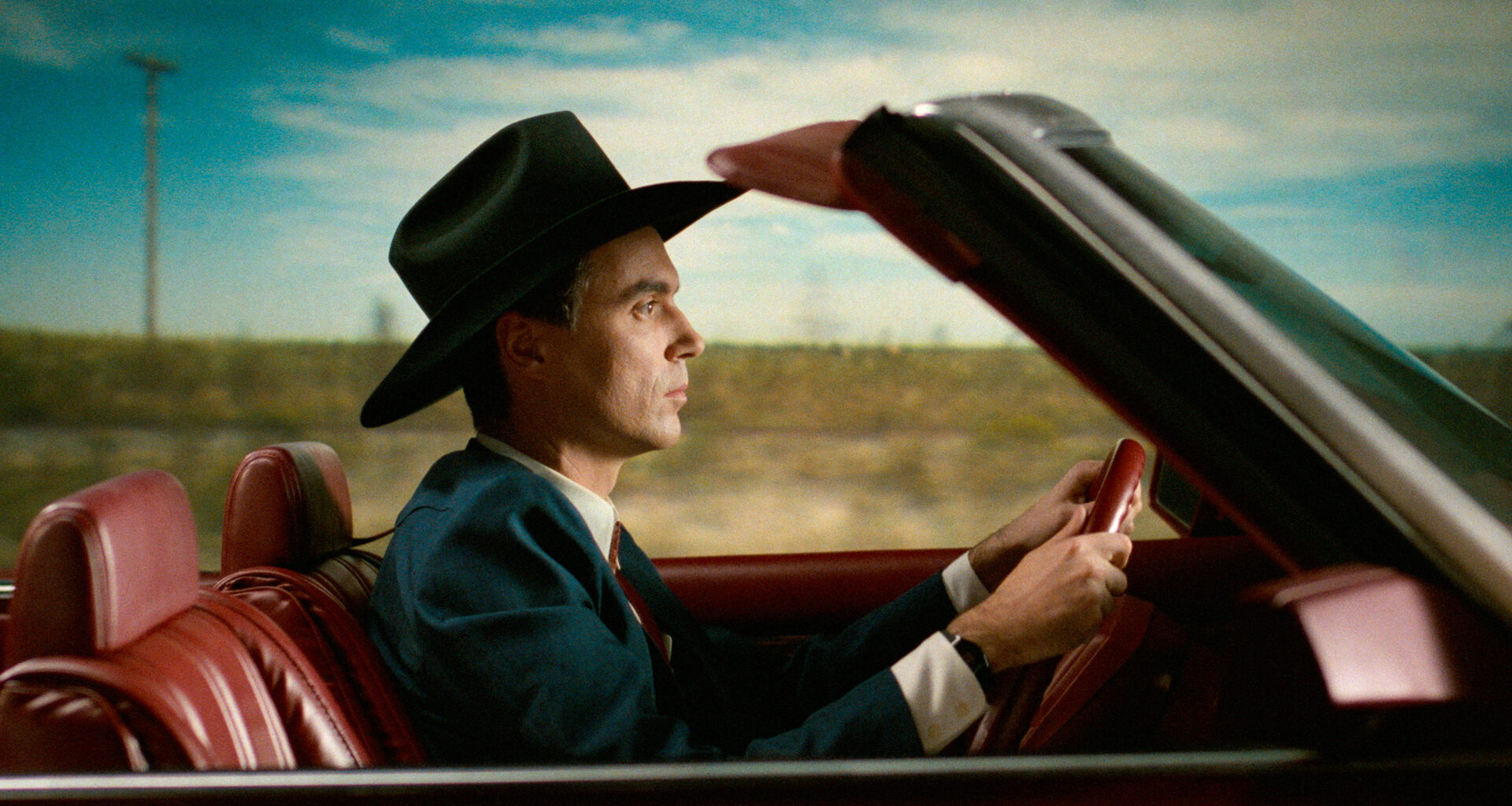
David Byrne in a scene from his film, True Stories (1986).
Warner Bros.
As the great local documentary filmmaker Bart Weiss has noted, Dallas has been defined more by television than movies. It’s through the small screen that the world has come to know Dallas, first through coverage of the Kennedy assassination, and later from the eponymous prime-time soap and the Cowboys and their famous cheerleaders. Television has shaped America’s view of Dallas (and perhaps Dallas’ view of Dallas) as a place of big personalities with big ambitions and big hair.

Dallas has also been the subject of a good number of films — documentaries, dramas, comedies, action thrillers — each projecting its own ideas about the city, its people and its physical contours. For all their diversity, these films share certain themes, among them the city’s history of violence, its culture of conformity and its unique and weirdly appealing character.
If there was a golden age of Dallas cinema, it was the 1980s, when a series of films portrayed the city in vastly different lights — as a place of genial consumption, of offbeat charm and disturbing injustice. Alas, it has been some time since Dallas delivered a film classic. Many of the best films that take on Dallas were filmed elsewhere, and are therefore excluded from the following list. Billy Lynn’s Long Halftime Walk, Ang Lee’s 2016 interpretation of the Ben Fountain novel, conveys the jingoistic Americanism of Dallas football culture, but it wasn’t filmed here. Neither was Dallas Buyers Club (2013), with Matthew McConaughey as a gay man grappling with AIDS. North Dallas 40 (1979), a fictionalized account of the Tom Landry-era Cowboys, is a classic of 1970s anti-authoritarianism, but it, too, was not filmed here.
Article continues below this ad
The following 10 films were shot in Dallas, and together comprise an essential picture of the city through its history.
A poster for the 1947 film Juke Joint.
Sack Amusement Enterprises
Juke Joint (1947)
Starring and directed by Spencer Williams, who would achieve mainstream fame as Andy on the Amos ‘n’ Andy television show, this race film — produced for Black audiences and played in Black theaters — tells the story of a con man and his dim sidekick who arrive in Dallas and set up shop as boarders with a local family. High jinks ensue when the two take an interest in the family’s attractive daughter. Great cinema it is not, but it does offer a glimpse into the daily life of the city’s Black community, with scenes filmed on location at the Rose Room nightclub in Deep Ellum.
Walter Cronkite, narrator of Dallas at the Crossroads.
AP
Dallas at the Crossroads (1961)
In an effort to avoid the anti-Black violence that accompanied court-ordered school desegregation in other southern cities (notably, Little Rock and New Orleans), the Dallas Citizens Council produced this film, narrated by Walter Cronkite, urging the city’s white residents to obey the law and maintain the peace. Opening with the birth of a child, it portrays the city as a place of idealized American values. A series of civic eminences (the mayor, a judge, business and labor leaders, the police chief), all of them white, urge Dallasites not to do anything that would sully the city’s reputation. The film’s writer was a young David Ritz, a Dallas native who would become a noted author and ghostwriter of music biographies. His subjects have included Ray Charles, B.B. King and Willie Nelson.
Article continues below this ad
Abraham Zapruder, who filmed the Kennedy assassination.
Dallas Morning News
The Zapruder film (1963)
The most famous 26.6 seconds in cinematic history captures Dallas at its most catastrophic moment, when a sunny, pleasant afternoon at Dealey Plaza turned into a civic and national trauma. The Kennedy assassination has been the subject of numerous films since, most famously Oliver Stone’s tendentious JFK (1991). The best, and most chilling, is Executive Action (1973), a speculative reconstruction with Burt Lancaster orchestrating a complex plot leading to the president’s murder. Also notable are a pair of short films shot in Dealey Plaza: art group Ant Farm’s The Eternal Frame, a 1975 reenactment of the assassination as media spectacle, and Erykah Badu’s “Window Seat,” a 2010 music video in which the Dallas native progressively removes her clothing and is then shot by an unseen gunman.
Faye Dunaway as Bonnie Parker and Warren Beatty as Clyde Barrow.
Warner Bros.
Bonnie and Clyde (1967)
Director Arthur Penn’s Oscar winner is the story of its titular couple’s Depression-era crime spree across North Texas and beyond. Shot on location at sites around the region (Pilot Point, Ponder, Waxahachie), it effectively conveys the hardscrabble life in the small towns of Dallas and its suburbs during the 1930s — a landscape of dirt roads, ramshackle houses and lonely service stations. Somehow, Penn (with a major assist from stars Warren Beatty and Faye Dunaway)‚ makes it all seem downright glamorous.
Article continues below this ad
The Neiman Marcus downtown flagship.
Tom Fox/Dallas Morning News
The Store (1983)
The monogrammed NM door handles of the Neiman Marcus downtown flagship will soon close for the final time, but we will always have Frederick Wiseman’s documentary about the daily life of the store at its fashionable peak. In his characteristic cinema verité style, Wiseman takes viewers inside the Dallas palace of consumption during the critical shopping period between Thanksgiving and Christmas. His subjects — executives, clerks, West Texas tycoons, window shoppers and well-heeled patrons — do all the talking, culminating with a speech from the store’s leader and civic eminence, Stanley Marcus.
John Goodman as Louis Fyne in True Stories.
Warner Bros.
True Stories (1986)
Directed and narrated by Talking Heads frontman David Byrne, who spends much of the film wearing a 10-gallon hat seated behind the wheel of a cherry red Chrysler convertible, True Stories is a paean to the quirky inhabitants and everyday beauty of the North Texas landscape: its tract houses, honky tonks, shopping malls (NorthPark features prominently), metal storage buildings, highway overpasses and immense blue sky. Byrne filters the kitschy charm and high-key palette of John Waters through the lens of Learning from Las Vegas, the celebration of American vernacular by architects Denise Scott Brown and Robert Venturi, to create a moving portrait of the region. “There’s something special about people like us,” croons Louis Fyne, a lovelorn would-be country-singer played by John Goodman, a sentiment that might as well be the film’s mantra.
Article continues below this ad
Dallas City Hall stacked upon itself in RoboCop.
Orion Pictures Corp.
RoboCop (1987)
Paul Verhoeven’s Orwellian action film ostensibly takes place in Detroit, and some scenes were shot there, but there’s no mistaking its primary location: downtown Dallas. The film plays on the politically driven fears of urban crime in the 1980s, and on the increasing privatization of American culture. It is set in a dystopian near-future, with the city’s policing turned over to an amoral corporation, Omni Consumer Products (OCP), headquartered at Dallas City Hall. I.M. Pei’s brooding beauty was not quite brooding enough for the filmmakers, who used matte painting to increase its height by stacking a version of the building on top of itself. Other notable icons making cameos are Fountain Place and Reunion Tower. Fans of dystopian sci-fi action films will also enjoy Logan’s Run (1976), much of which is set in the sadly demolished Dallas Apparel Mart, designed by innovative local architects Pratt, Box and Henderson.
Errol Morris, director of The Thin Blue Line.
Miramax Films
The Thin Blue Line (1988)
Arguably the greatest film about Dallas, Errol Morris’ docudrama examines how a ne’er-do-well drifter, Randall Dale Adams, was wrongfully convicted and sentenced to death for the killing of a police officer. Morris jumps between interviews with the various parties of the case (Adams, attorneys, witnesses, the actual killer) and eerie reenactments of the crime. Images of dark roads, seedy motels and floodlit convenience stores are interspersed with moody if sometimes anachronistic shots of the Dallas skyline. The film led to the overturning of Adams’ conviction and his eventual release from prison.
Article continues below this ad
A scene from Wes Anderson’s Bottle Rocket.
Columbia Tri-Star Pictures
Bottle Rocket (1996)
All of the stylistic signatures (or, for haters, affectations) that characterize the films of Wes Anderson (centered frames, diorama-like settings, neato-typography) are present in incipient form in his first feature, a charming comic caper set in and around Dallas, and starring native sons Luke and Owen Wilson (and, in a smaller role, their sibling Andrew). The film offers a rare look inside Frank Lloyd Wright’s 1958 Gillin House in Preston Hollow, one of its principal locations. It concludes with a hilariously failed heist that is a tribute to the industrial architecture of Deep Ellum.
Stephen Root as Milton Waddams in Office Space.
20th Centruy Fox
Office Space (1999)
This workplace comedy cult classic from Mike Judge (creator of Beavis and Butt-Head) opens in a traffic jam on LBJ Freeway. What could be more Dallas than that? In contrast to True Stories and Bottle Rocket, which celebrate the quirky weirdness of North Texas and its inhabitants, or at least some of them, Office Space lampoons the banality of the region’s corporate culture, with its generic office parks, Dilbert cubicles, landscaped parking lots and strip-mall chain restaurants. Burn it all down? That’s the solution arrived at by a beleaguered office nerd (played by the brilliant character actor Stephen Root). King of the Hill, another of Judge’s animated TV series, is a somewhat more charitable exploration of life in North Texas.
Article continues below this ad
What’s your favorite film about or set in Dallas?
Dallas has been the subject of a good number of films — documentaries, dramas, comedies, action thrillers — each projecting its own ideas about the city, its people and its physical contours.