
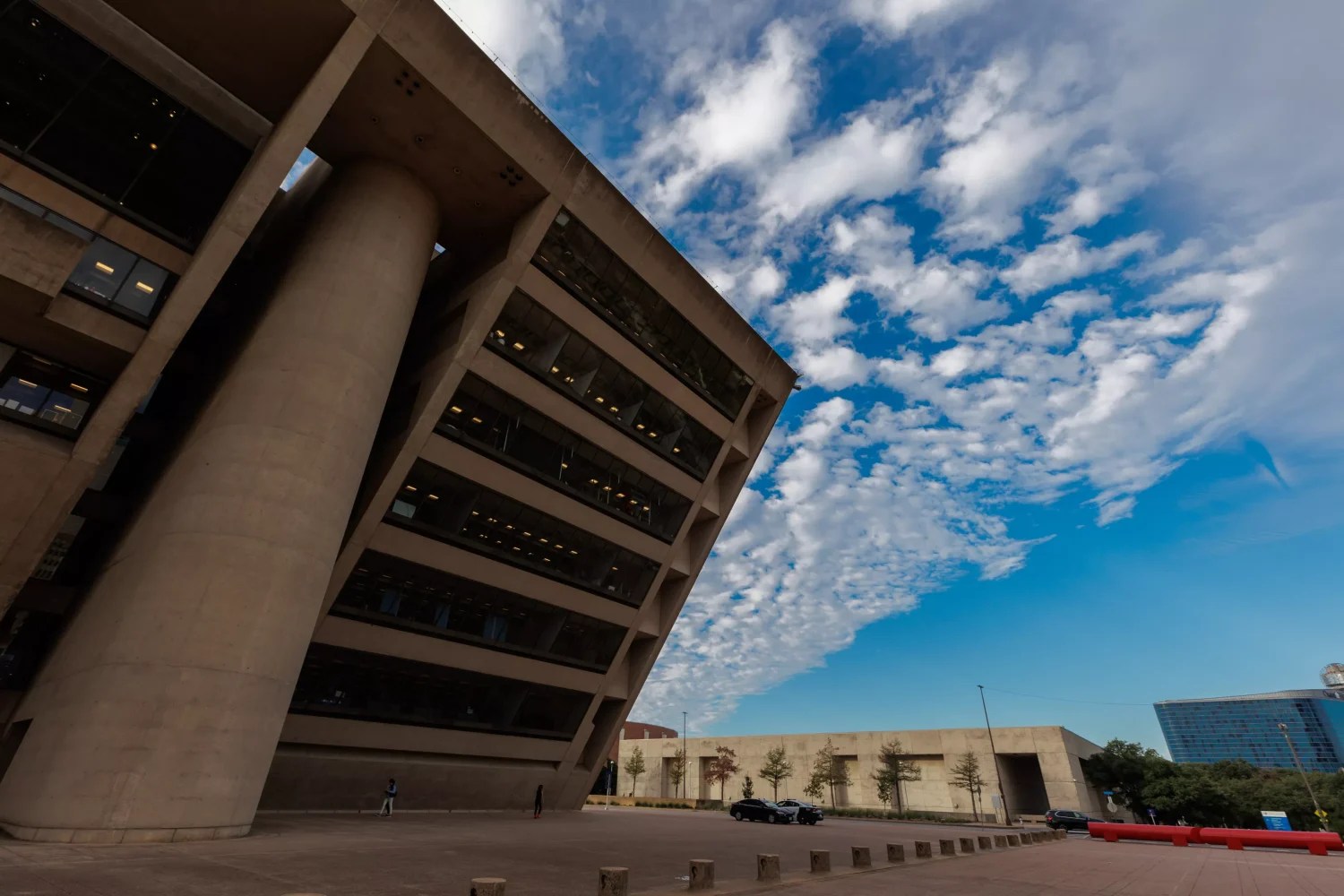
Historian and author Dr. Michael Phillips, SMU Professor Dr. Rick Halperin and Hadi Jawad, co-founder and president of Human Rights Dallas, submitted the op-ed below on Dallas City Hall’s position as an important historical landmark.
Should largely absentee Mayor Eric Johnson and his City Council allies succeed in their plan to ditch Dallas’s acclaimed City Hall, they might not only trigger the demolition of an architectural landmark. In the process, they might also destroy a public square where history was made, injustices addressed, and the powerful warned against foolhardiness.
Vacating the seat of city government designed by the world-renowned architect I.M. Pei and abandoning the building to developers who possibly want to destroy it and replace it with a casino would also represent yet one more chapter in Dallas’s sorry record of erasing the history of non-white people and the major role they played in building this city.
Rather than being potentially reduced to environmentally toxic wreckage, City Hall should receive protection as an historic site by both the state and the city council.
Sign up for the This Week’s Top Stories newsletter to get the latest stories delivered to your inbox
THANK YOU!
You’re all set.
CLOSE
A former Dallas mayor (and alleged Ku Klux Klan member) R.L. Thornton once said, “Dallas doesn’t give a damn about history; it only cares about the future.” Elites certainly have buried the city’s long and vibrant heritage of protest, an erasure echoed in the most popular history of Dallas, local journalist Jim Schutze’s “The Accommodation: The Politics of Race in an American City.”
Dallas, however, was never just a city of meek accommodators but also one of fierce and brave dissenters. This is a record we must preserve, and saving City Hall is part of that effort. That history of resistance also gives strength to those who want to prevent Johnson and his supporters from doing irreparable harm to downtown.
Dallas women toiling in the city’s garment industry during the Great Depression staged a strike for higher wages, ruthlessly suppressed by police in 1935. In 1937, employees at the Dallas Ford Motor plant tried to organize a local of the United Auto Workers. Ford hired company goons who kidnapped fifty union supporters and used blackjacks and rubber hoses to beat them. They blinded one worker and killed another in 1937, as documented in the excellent history of the local labor movement by historian Patricia Evridge Hill, “Dallas: The Making of a Modern City.”
In 1956, Juanita Craft, the Dallas NAACP’s youth adviser, led pickets outside the State Fair of Texas, mocking the hypocrisy of so-called Negro Achievement Day, the only day African Americans were allowed to attend. Craft and her youthful cohorts ridiculed this grudging concession to the Black community as “Negro Appeasement Day.”
On multiple occasions, Dallas high school students led walkouts and classroom boycotts against injustice. On September 14, 1971, following desegregation orders, African American students refused to attend classes at Thomas Jefferson High School. As Dallas Morning News columnist Robert Wilonsky reported, the students objected to taking classes where “the school mascot was the Rebel, the school song was ‘Dixie,’ and cheerleaders waved the Confederate flag.”
Beginning in the mid-1960s, leaders for the Dallas LGBTQ+ community played a lead role in the fight to repeal the state’s repressive sodomy laws, as M. Rhys Dotson argues in “The Dallas Way: Gay Rights in a Conservative City.”
In 1979, Juanita Ellis (“a tenacious Dallas housewife,” as the Fort Worth Weekly described her) helped educate, train, and organize demonstrators who on June 10 of that year climbed the fence surrounding the Comanche Peak nuclear power plant in Glen Rose, Texas, triggering arrests during the first anti-nuclear-power protest in Texas.
Suppressing memories of such protests encourages the public to believe that Dallas has always passively accepted elite dominance. This manufactured forgetfulness also denies modern activists useful role models from the past as they confront the foolhardy plans of today’s purported leaders. Consciously or not, the plan to sell City Hall to rapacious developers with zero respect for history serves a similar purpose.
Many of the city’s most significant protests unfolded in front of Pei’s architectural masterpiece.
A July 28, 1973, March for Justice drew 1,000 who cried for accountability after the murder of 12-year-old Santos Rodriguez by a Dallas police officer, Darrell Cain. That demonstration started at Kennedy Plaza but concluded at City Hall. In spite of violence that broke out, Albert Valtierra of the Dallas Mexican Historical League told KERA in 2013 that the demonstration “galvanized our community.” The Santos Rodriguez march inspired political engagement in the Latinx community for all subsequent generations.
 Protesters demonstrated outside of Dallas City Hall in January 2026.
In 1989, the Supreme Court vastly expanded the definition of free speech because of protests that unfolded during the 1984 Republican National Convention in Dallas. An August 18 Rally for Peace and Justice at the Kennedy Memorial Plaza drew at least 1,200 picketers in spite of temperatures that soared to 104 degrees.
History changed, however, on August 22 when members of the Youth International Party, or Yippies, marched through downtown department stores, including Neiman-Marcus, where they chanted “Eat the Rich.” During what they called the “Corporate War Chest Tour,” the Yippies staged a sit-in at a bank, dumping red paint on the floor they said symbolized the bloodshed caused by the Reagan administration’s support for anti-leftist guerrillas in Central America.
The Yippies were finally arrested when they ended their parade by taking a dip in the reflecting pool in front of City Hall. Ninety-nine were arrested, most charged with disorderly conduct, a class C misdemeanor punishable by a $200 fine.
Amid that melee, Gregory Lee Johnson, a member of the Revolutionary Communist Party, poured kerosene on an American flag that another demonstrator had grabbed from a nearby flagpole. Johnson set the flag on fire. The other protestors chanted, “Red, white and blue, we spit on you, you stand for plunder, you will go under.” Dallas police charged Johnson with violating a state law that banned desecration of “venerated objects” like the flag. He was sentenced to six months in prison and a $2,000 fine.
Famed civil rights attorney William Kunstler represented Johnson during the lengthy appeals process. Kunstler argued that flag burning represented political speech protected by the First Amendment. The case reached the Supreme Court, which ruled in Johnson’s favor in a 5-4 decision on June 21, 1989.
As a result, the Texas law banning flag burning and similar statutes in 47 other states were overturned. Since then, numerous efforts have been made to pass a constitutional amendment banning flag burning, mostly by Republicans (including President Donald Trump), but also by some Democrats such as then-New York Senator Hillary Clinton. All have failed. For better or worse, burning the flag remains constitutionally protected speech because of events that unfolded in front of Dallas City Hall.
On February 15, 2003, the Dallas Peace Center rallied 3,500 to 4,000 people who marched starting at the Cathedral Guadalupe down Ross Avenue, with a stop at Dallas City Hall. They held signs like “Who Would Jesus Bomb?” as they sought to prevent the disastrous U.S. invasion of Iraq that would begin on March 20 of that year. That represented perhaps the largest anti-war demonstration in Dallas history.
Those significant moments of resistance still pale compared to the 2006 “Mega March” for immigrant rights held on April 9, 2006. On that day, an estimated half-million came out on Dallas’s streets to oppose a bill proposed in the United States House that would have made unlawful entry into the United States a felony.
Once again, teenagers and college students initiated the action, marching at City Hall a few days earlier. The April 9 march also culminated at City Hall. There, according to the New York Times, “politicians encouraged people to register to vote. Patriotic songs like ‘God Bless America’ and ‘This Land is Your Land’ as well as Mexican music blared on the loudspeakers.”
On April 9, 2017, about 3,200 participated in a smaller but still significant march for immigrant rights that once again concluded at City Hall.
That mass dissent happened slightly more than four months before another crowd of 3,000 gathered at the same location to demand the removal of the city’s Confederate monuments. The “Rally Against White Supremacy” on August 19, 2017, changed history, persuading a reluctant City Council to vote 13-1 for the removal of a massive equestrian statue of Robert E. Lee in Oak Lawn a mere 18 days later.
In short, Dallas City Hall is important not only because of its stature as a work of art.
Its nearly 5-acre plaza offers a unique space for the public to gather, join forces, and tell those in power to stop and reconsider before making possibly irreparable mistakes. Such opportunities for the people of Dallas to express themselves in force will become impossible if the council decides to relocate to a rented high-rise. Whether that’s a conscious motivation or just an unintended consequence, the impact on local activism will be devastating if City Hall is abandoned.
City Hall should be considered a national free-speech heritage site, a place where ordinary people decried police abuses, condemned unprovoked foreign wars, fought for civil rights, and asked a city to confront its racist past. Rather than being reduced to rubble, City Hall should be adorned with plaques that educate visitors about its role in the nation’s history of free expression.
Destroying City Hall would also mark another instance of Dallas obliterating sites intimately associated with the history of its non-white population.
In the 1940s, Dallas wiped out State-Thomas, a neighborhood built by the African American middle class, to make room for an expanded Central Expressway. Work crews bulldozed much of what had been Little Mexico to accommodate construction of the North Dallas Tollway. The city seems to be demolishing by neglect Deep Ellum, a neighborhood critical to the history of blues music. The abandonment of the I.M. Pei building would be a loss for Dallas as a whole. But that betrayal will be felt most acutely by the city’s Asian American community, which has embraced the Chinese American architect as a hero.
Dallas City Hall is much more than a building. It is an inheritance that reminds us that this city, contrary to self-defeating legends, is a place where ordinary people fought to make their community more democratic, more humane, and more inclusive. To lose this connection with a vibrant past would be inexcusable.