
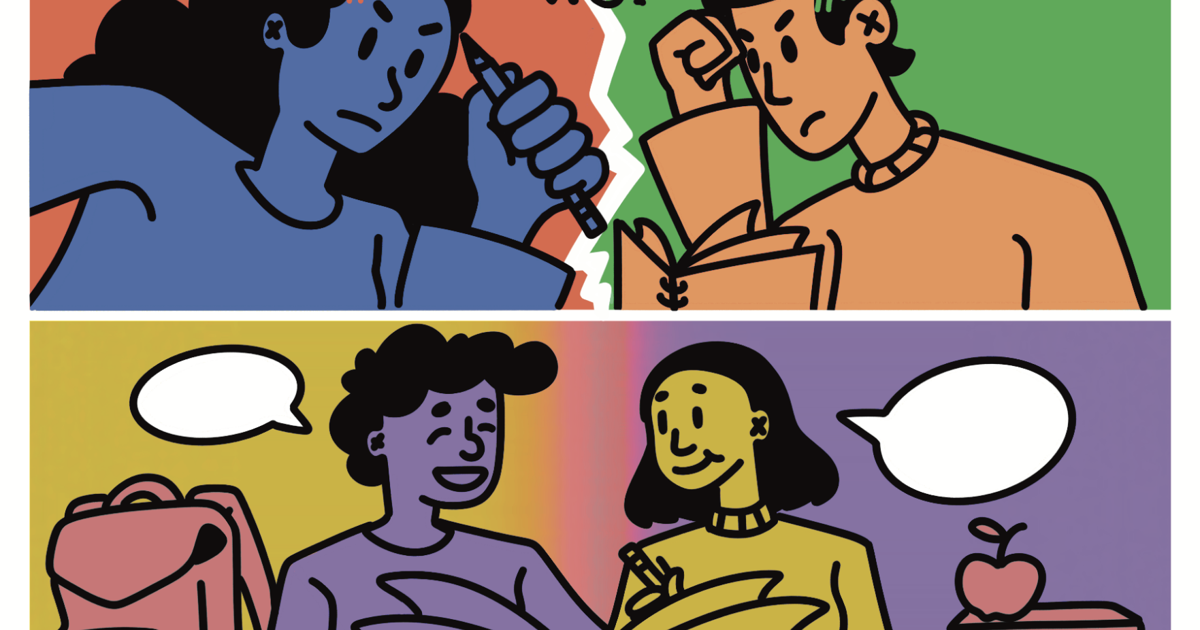

Students sometimes find group work daunting or a waste of time and expect the worst outcome with such projects. They may prefer to avoid it and complete individual work instead.
The Shorthorn Editorial Board believes collaboration is an integral part of growth, helping prepare students for the job market by fostering soft skills needed for a successful career.
Even with the added benefits of working with others, some students may hesitate due to the thought of competing with their peers.
Collin Stephenson, UTA research success librarian, said this can stem from competing for academic standings in high school and the idea that a higher GPA means greater success in the future.
“We’ve built competition into the education experience on that front that can sometimes carry over into the rest of our lives,” Stephenson said.
GPA requirements for scholarships, honors and student jobs may continue to foster this idea.
At a Glance
The Issue: Students might see academic success and excellence as a competition, making them less willing to engage in group work.
We Think: Finding balance between pursuing academic success and building interpersonal skills is integral to career success.
Take Action: Students should look to practice teamwork and build the soft skills required for the workforce.
Though grades and GPA hold weight in school, they tend to matter less when entering the job market.
When expected to work in groups, students might focus on the potential negative outcomes, like their partners not carrying their weight and the idea of their grades depending on someone else’s work.
Stephenson said those fears can make collaborative work difficult, but they shouldn’t hold students back.
“Even when there is that tension with group work, that tension is still part of the growth process,” he said.
Stephenson also said that today information is readily available at students’ fingertips. So much information is impossible for students to carry on their own, and no single student can hold all the skills that many projects require, he said.
“Teamwork: An Open Access Practical Guide,” a book published by UTA’s Mavs Open Press, names the wide range of knowledge, skills and abilities that people bring to a collaborative project as one of many benefits.
Further benefits of teamwork listed in the guide included coping with complex ideas, greater motivation and commitment, and a greater sum of knowledge, which can help people broaden their skillsets and intellects.
“We all have to work together if we want the best possible outcome, and that doesn’t matter what field you’re in,” Stephenson said.
According to a 2026 National Association of Colleges and Employers job outlook survey of employers, GPA screenings have significantly decreased, from 73.3% in 2019 to 42.1% in 2026.
Stephenson said employers are more likely to hire someone that has experience working well with others, problem-solving skills and innovative thinking, which can be gained through collaborative projects.
According to the U.S. Department of Labor, several soft skills are viewed as important to work readiness:
Professionalism or work ethicOral and written communicationTeamwork and collaboration skillsCritical thinking or problem-solving skills
Most, if not all, of these skills can be gained through group work, according to Cornell University’s Center for Teaching Innovation, a center dedicated to evidence-based teaching practices.
Being collaborative means being social, something that should not be a new concept to students.
“It’s just so core to the human experience that we have to embrace it and learn how to do it in a healthy way,” Stephenson said.
Part of being social is communication. This communication can help mitigate some of the fears students may have about group work.
“Have a boundaries conversation with people as ‘arriving at a shared set of expectations for how the group behaves.’ It’s a very mature thing to do,” Stephenson said.
Despite fears of peers not holding up their end of a project or of losing a competitive edge, the skills and experience gained from collaborative work can better prepare students for success.
Students should consider the value of balancing interpersonal and intrapersonal skills and work toward becoming well-rounded before entering the workforce.
The Shorthorn Editorial Board is made up of opinion editor Noah Little, managing editor Leslie Orozco, news editor James Ward, engagement editor Sairam Marupudi, design editor Ryleigh Hood, copy editors Adwita Kunte and Isabella Moreno, photographer General Mason Starks, and news reporters Gabrielle Jankowski and Xioany Collazo. Hood and Moreno were not present for this discussion.