
For many first-generation students, starting college means traveling into unfamiliar territory without a roadmap. From figuring out financial aid to balancing coursework and jobs, it can be a challenge.
However, initiatives like the Navigate program are making the transition from high school to college a lot easier with expanded resources and holistic support for students. The new program, which completed its first year in May with nearly 260 participants, is designed to support first-year students from economically disadvantaged backgrounds who are in the first generation of their families to attend college.
The program offers some financial incentives, but the key component of the innovative support program is one-on-one customized mentorship from a team of dedicated success coaches who guide students through their first year. The students also participate in various learning modules and activities on topics that include study skills, financial literacy, and time and stress management.
Navigate is supported by a $7.2 million grant from the U.S. Department of Education’s Postsecondary Student Success Grant Program. The multiyear grant was awarded to UT San Antonio in fall 2024. The initiative is led by principal investigator Mark Appleford, associate vice provost for undergraduate studies, and co-principal investigators Tammy Wyatt, senior vice provost for student success, Amy Buechler-Steubing, associate vice provost for strategic initiatives and learning innovation and Barbara Smith, executive director for transfer and transition student services.
“Our first year of Navigate has shown us that student success isn’t just about learning modules or financial rewards — it’s about developing relationships and a support ecosystem that students can rely on,” Wyatt said. “As a designated FirstGen Forward Network Leader, our institution is dedicated to helping first-generation students thrive. Looking to Navigate’s second year and beyond, we hope to expand this ecosystem so we can support even more first-gen students as they reach their goals.”
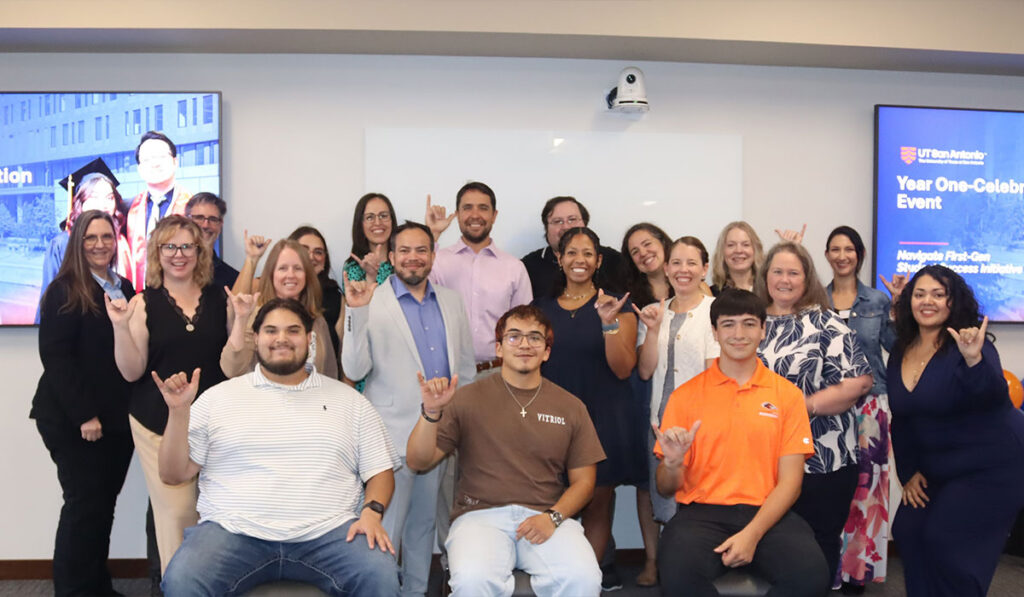 UT San Antonio students, success coaches and the Navigate administrative team come together to celebrate the program’s first year.Improving outcomes through confidence and belonging
According to Education Northwest, an education research nonprofit organization, and the university’s Office of Institutional Research and Analysis, students in the Navigate program showed a 13% improvement in GPA and earned 2.5 more course credit hours compared to students who were eligible for Navigate but did not enroll in the program.
Navigate participants also demonstrated a 7% higher semester-to-semester retention rate than Navigate-eligible students who did not participate in the program, and a 3.2% higher persistence rate compared to all UT San Antonio students.
Additionally, more than 90% of Navigate students surveyed agreed that the program helped them identify their personal strengths, confidently choose a major, and develop self-confidence and a sense of belonging at UT San Antonio.
“This program is working to bridge the persistent achievement and access gaps that too often appear among first-gen student populations,” Appleford said. “By combining personalized coaching, intentional learning modules and financial support, the Navigate model is proving that a holistic approach can better support students during their college journey, both academically and personally.”
A personal coach to help overcome challenges
Each student in the Navigate program is paired with a success coach who they meet with regularly throughout their first year at UT San Antonio. Success coaches — who complete foundational training using the InsideTrack framework — assist students with goal setting, balancing school, work and life responsibilities, and introducing them to essential campus resources.
For Sanaia Fifer, a biology major who completed the Navigate program, starting her college career with a success coach in her corner provided a much-needed source of encouragement, accountability and support.
“Having a success coach gave me so much peace of mind,” Fifer said. “I’m the first to graduate high school and I’m the first to even go to college in my family. It was good to have my coach on my side and help me branch out.”
“I have full confidence that I’m going to graduate because of the work my coach put in to help me,” Fifer added.
Learning pathways and financial incentives
The Navigate program includes various interactive learning activities in three focus areas: career and personal discovery; academic success; and managing life. The online modules allow students to build both study and life skills that benefit them in and out of the classroom.
“The learning pathways introduced a lot of new ideas like study strategies and managing life and work. There’s a lot of wellness modules to help you manage stress, especially during exams,” said Jack Jaime, a Navigate participant studying kinesiology. “And the one that I really liked was managing debt. Being able to learn about that was really a big help.”
In addition to learning pathways and individualized coaching, Navigate provides stipends for students who stay engaged with the program throughout the year. Those who complete all program requirements, such as meeting with their coach and completing other activities, earn a completion bonus at the end of the academic year. They are also eligible for an additional retention grant that can be applied toward tuition for their second year of college.
In total, Navigate awarded $260,000 in direct student support during the 2025-26 academic year.
“These incentives can ease some of the financial pressures of the first year of college, whether that’s helping with books, rent or gas money to get to campus,” said Jesse Lopez, senior program manager for Navigate. “That can make all the difference for some of these students, allowing them to fully focus on school.”
Approximately 44% of undergraduate students at UT San Antonio identify as first-generation. By leveraging data to increase student engagement, retention and persistence, the Navigate program is contributing to UT San Antonio’s larger goal of being a national model for student success.
Navigate has begun sending invitations to eligible students to enroll in year two of the program for the 2026-27 academic year.