
Mavis Belisle protested President Ronald Reagan’s policies outside the 1984 Republican National Convention in Dallas. Forty-two years later, she is preparing to return to the streets, this time to protest President Donald Trump.
Next week, Trump and Republicans will gather at the American Airlines Center for the party’s first midterm convention. Demonstrators plan to challenge his administration and its policies, much as they did in when Reagan accepted the GOP’s nomination for a second term.
“The America that I grew up in hardly exists anymore, but it doesn’t make me want to give up,” Belisle said. “I’m ready to be back out there next week.”
The issues that brought protesters to Dallas in 1984 included Reagan’s military buildup and policies in Central America, poverty, unemployment, homelessness, corporate power, government contracting and gay rights.
This year’s demonstrators are organizing around immigration, war, civil rights, economic hardship and concentrated political power.
The language and targets have changed. But the question of whether government is serving ordinary people has not.
A lifetime of organizing
Belisle, 82, an Oak Cliff resident, has spent decades protesting.

Mavis Belisle, 82, a peace and environmental activist who protested at the 1984 Republican National Convention in Dallas, poses for a portrait Sept. 1 at the J. Erik Jonsson Central Library downtown. She plans to demonstrate again when the GOP returns next week. (María Ramos Pacheco/The Dallas Morning News)
She helped lead one of the largest acts of civil disobedience in Texas history at the Comanche Peak nuclear plant near Glen Rose. She later became executive director of the Peace Farm, a nonprofit focused on nuclear weapons and hazardous waste.
In 1984, she recruited and trained demonstrators as a member of the Dallas March and Rally Committee.
She rallied against Reagan’s military policies and the defense budget, which she believed contributed to poverty and economic inequality.
Organizers worked out of a small office on Ervay Street, not far from the city convention center. The cramped space became a hub for organizing peacekeepers.
“By being present at the same time and place that the Republican Party was, we could show those alternatives,” Belisle said.
She spent long, hot days that August moving between rallies, marches and a nearby tent city.
The encampment had little shade, inadequate water and only temporary toilets. At one point, Belisle was told to return to the organization’s office when police started arresting demonstrators. She spent the day making phone calls to raise bail money.
Familiar struggles
This year’s protest takes place during a midterm election cycle shaped by social media, national coalitions and concerns about immigration enforcement.
But many of today’s grievances are familiar to Belisle.
Today’s organizers want to lower housing and food costs, stop aggressive immigration enforcement and hold the government accountable.
Like in 1984, protesters are bringing an anti-war message to the Republican convention.
Money spent on U.S. military action abroad, including in Iran, Israel and Palestine, comes at the expense of people struggling at home, said 35-year-old Jo Hargis, who is a member of the DFW Anti-War Committee.
Similar to Belisle decades earlier, Hargis has organized protests outside a Garland munitions plant and opposed partnerships linking the facility with local schools and colleges.

Jo Hargis of Denton (left) Jo Hargis leads chants Aug. 7, 2023, during a protest against Gov. Greg Abbott’s signing of the Save Women’s Sports Act at Texas Woman’s University in Denton. (Liesbeth Powers/Special Contributor)
The government must be pressured before it responds to ordinary people, Hargis said.
“We have power when we come together and exert our will,” Hargis said.
War, civil rights
In 1984, the Association of Community Organizations for Reform, or ACORN, held a national convention and created “Reagan Ranch,” a tent city near the Republican gathering to highlight poverty, homelessness and the experiences of low-income communities.
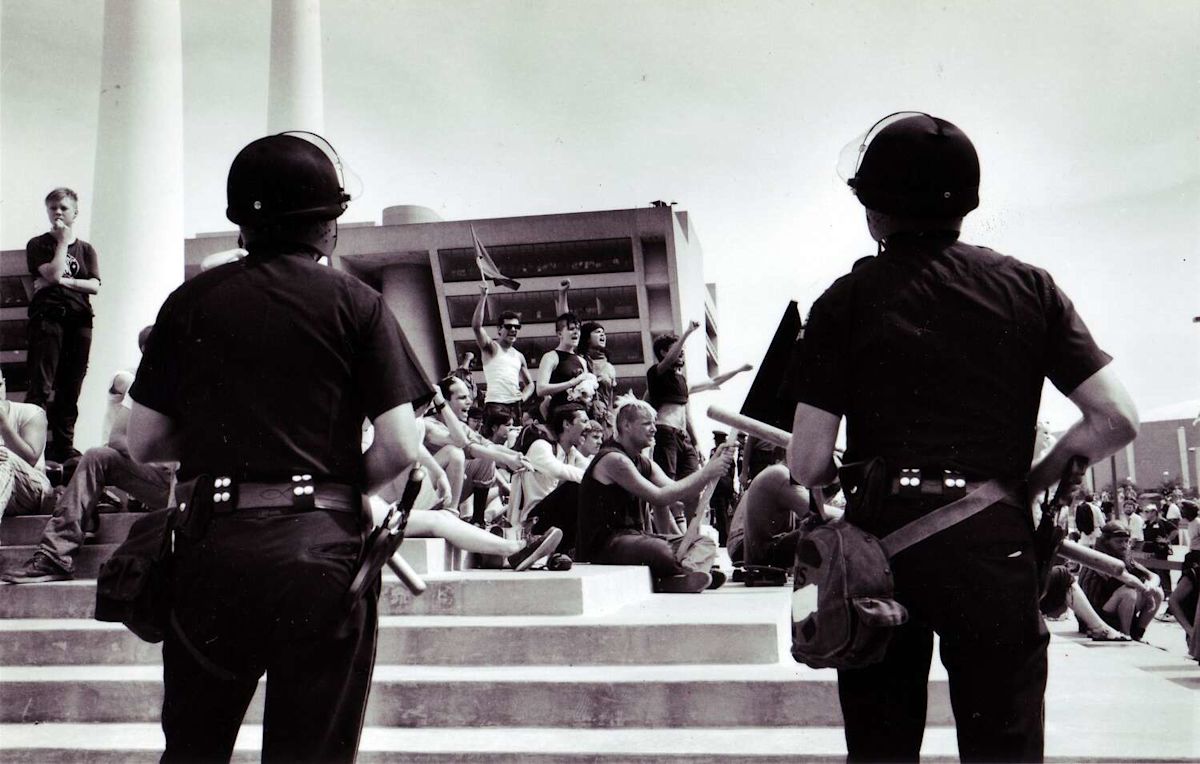
The Yippies organized more confrontational actions, while peace activists, gay-rights groups, anti-nuclear organizers and others opposed Reagan’s military buildup, policies in Central America and corporate power. About 1,500 people representing different causes marched during the convention.

Police stand guard as protesters gather Aug. 22, 1984, on the steps outside City Hall. (Ed Hille – Staff Photog.)
The protests included marches, rallies and “die-ins” outside corporate buildings.
The most visible confrontation came Aug. 22, when Gregory Lee Johnson burned an American flag outside City Hall. Police arrested Johnson and dozens of other demonstrators. His conviction eventually reached the U.S. Supreme Court, which ruled in 1989 that flag burning was protected political speech.
One issue at a time
Belisle doesn’t regret taking part in the 1984 protests, which she said were largely peaceful, despite the tension and some arrests. She recalls only one serious injury .
She continues to encourage people to register to vote and participates in peace events and other organizing efforts. She said cooperation across liberal movements depends on people recognizing, honoring and working together.
Belisle knows this year’s march may not change the government immediately.
“You can change things, if not a whole lot, at least a little bit better, in little pieces at a time,” Belisle said.
After more than four decades of protests, she still believes in showing up.
Subscribe
This article originally published at Dallas activist who protested Reagan in 1984 returns to challenge Trump.