
A caver dropped into a hole in the limestone of Comal County, Texas, put his face into the underground stream at the bottom, and found the streambed paved with bones.
John Young photographed what he could see and sent the images to John Moretti, a palaeontologist at the University of Texas at Austin, expecting an identification and possibly a polite thank you. Moretti asked to come and look himself. What followed, written up in a paper published in Quaternary Research, is the first palaeontological study ever made of a Texas water cave.
Fossil hunting with a snorkel
Bender’s Cave sits on private land and is reached by abseiling eleven metres down a narrow sinkhole shaft, then crawling along a low passage until it meets flowing water. Between March 2023 and November 2024, Moretti and Young went back six times, divided the stream passage into 21 sampling zones, and worked along it in wetsuits and dive masks.
Collection method: reach down, pick it up.
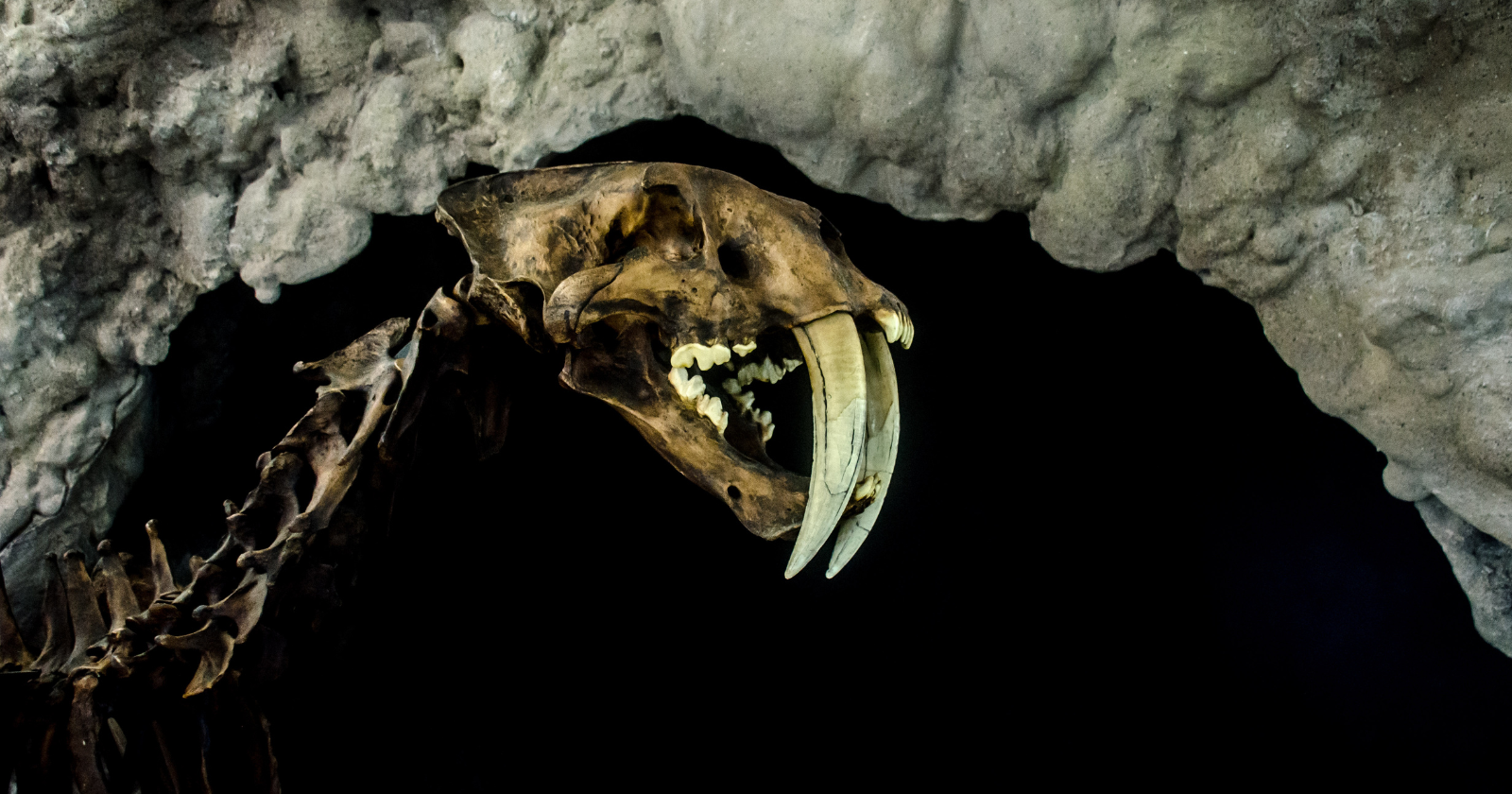
Most of the haul was familiar: milk teeth from mammoth calves, teeth from bison and horse, and a foot bone from the extinct camel Camelops hesternus. Two animals turned up that are rare in regional caves, Jefferson’s ground sloth (present as claws and a tooth) and a mastodon (known here from a single molar fragment). A blade-like premolar, a piece of skull and a neck vertebra came from Homotherium serum, the scimitar-toothed cat, a sabre-tooth built for running rather than ambush.
Moretti told Texas Standard that in most caves you dig through dirt for a long time before anything turns up, whereas here the fossils simply lie on the bottom where they’ve rested for millennia.
Two animals nobody expected
Then came a shoulder blade from a giant tortoise of the genus Hesperotestudo, and one five-sided plate of body armour from Holmesina septentrionalis, a pampathere. Pampatheres were armadillo relatives grown to the size of a lion, weighing around 200 kilograms, and as Popular Science notes, they had walked north out of South America millions of years earlier. Neither species had ever been recorded on the Edwards Plateau.
That absence was not for want of looking. Seventeen other late Pleistocene sites across the plateau have been excavated since the 1950s, and together they describe a cool, dry, open grassland, habitat that matches none of what turned up in Bender’s Cave. Giant tortoises are cold-blooded and need warmth, pampatheres favoured warm, damp country, and ground sloths and mastodons were browsers, an ecology that implies trees.
A warm window, or a very mixed bag
So how old is Bender’s Cave, really? Moretti ran a statistical comparison of 43 Texas fossil sites, and Bender’s Cave clustered with warm-period sites near Dallas and the Gulf Coast instead of with its neighbours on the plateau. His reading is that the assemblage may date to a warm interval well before the last glacial maximum, possibly the last interglacial, roughly 130,000 to 71,000 years ago.
Proving that is the hard part. Two bone samples sent for radiocarbon dating had no collagen left in them. A third, dated on bone mineral instead, returned an age of about 17,000 years, but it carried enough modern carbon to suggest contamination from the cave’s calcite-rich groundwater, and the authors treat the result as uninterpretable.
They are equally careful about the boring explanation. Fossils sitting loose on a streambed are a lag deposit, swept in and reshuffled by floods, so they need not be the same age as each other at all. Evidence that the cave mixes things up lies nearby: a twentieth-century rubbish pit at the top of the system has scattered glass, metal and sawn farm animal remains downstream among the Pleistocene material.
That’s one paper describing one hypothesis, and even its own title hedges: the fossils “may include evidence” of that warmer world.
What happens next
David Ledesma of St Edward’s University, who had no part in the study, makes a simple point in comments to Sci.News: even a region documented for decades can still turn up something new. Radiocarbon has hit a wall here, so the team is turning to uranium-series dating of the calcite crusts grown around the fossils, plus a combined uranium and electron spin resonance technique applied to mammal teeth. Moretti is thinking about the same possibility on a larger scale, telling the Jackson School of Geosciences that a genuinely interglacial site would open a window onto a landscape nobody has observed in this part of Texas.
Central Texas has plenty of water caves. Cavers have mentioned the fossils in these caves for decades, the same way you might mention a pothole on your street. None of them had ever been examined by a palaeontologist, which makes the lion-sized armadillo only the second most remarkable thing here.