
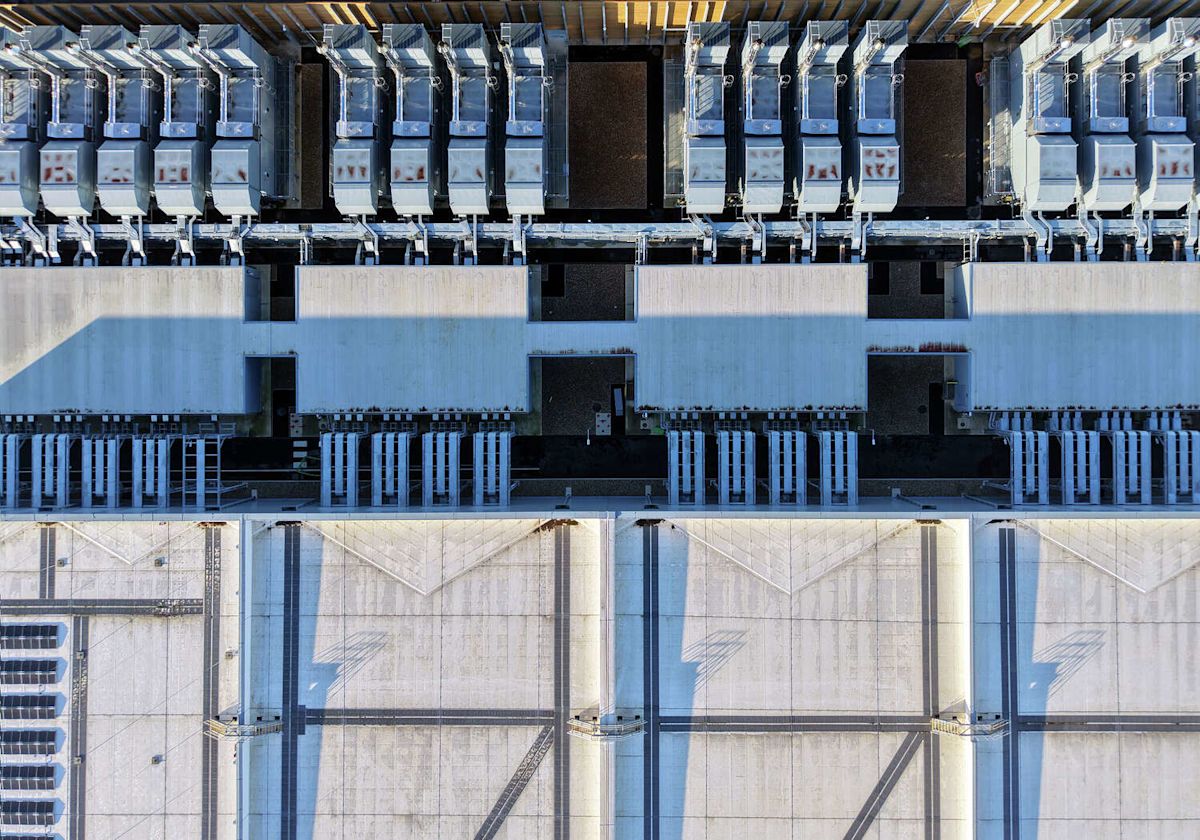
As a major hyperscale data center project moves forward in Central Texas, and residents amplify their concerns, municipal officials in the area are advancing new rules for similar future developments.
Rowan Digital Infrastructure, a Colorado-based hyperscale data-center developer, is proposing a three-phase, six-building campus in Temple, about 70 miles north of Austin. The overall buildout would represent a $4.2 billion investment, according to the Austin Business Journal.
As Temple positions itself as a growing data center hub in Texas and beyond, here’s what could be coming despite local pushback-and how the city’s rules could soon change.

A map of Rowan’s proposed three-phase development in Temple. (Temple City Council)
RELATED: Can Texas’ identity outlast the data center takeover?
A three-phase, six-building project
Rowan is proposing a three-phase, six-building project in Temple.
“All of these buildings, all of this proposed investment is located within Synergy Southeast Industrial Park,” Temple City Manager Brynn Myers said at a Sept. 3 city council meeting.
Phase one is planned east of Bob White Road, Phase two west of Loop 363 and Phase 3 south of the BKB/Panda power plant. The industrial park is near the city’s landfill and East Service Center.
“The company has made a capital investment commitment to $700 million per abatement phase and the creation of 40 full-time jobs,” Myers said.
Rowan agreed to pay for construction of the city’s Synergy aquifer-storage-and-recovery well and committed to fund 45 percent-or about $32 million-of the city’s $71.1 million South Temple Water Infrastructure Capital Program. City staff said Rowan would not own the well, aquifer, water or water rights.

The Temple City Council met on Sept. 3 to review project details for Rowan’s three-phase, six-building proposal. The council also reviewed proposed restrictions for upcoming data center projects. (Temple City Council)
With a closed-loop cooling system, the campus would require a one-time fill of 1.5 million gallons per building, which would recirculate for at least 10 years. After, Rowan is projected to consume a total of 32,000 gallons daily, with a peak of 78,000 gallons-a number the city says is less than one percent of total daily water used by city customers.
“I know one of the concerns that the community has expressed is what will be the impact on the City of Temple’s water resources,” Myers said. “Temple is in a strong long-term water position … we’re currently utilizing about half of the annual water supply rights that we have.”
The Temple City Council advanced several actions tied to Rowan’s proposed data-center campus, including the annexation of about 316 acres, conditional rezoning and the creation and expansion of tax-abatement reinvestment zones. An amendment to Rowan’s tax-abatement agreement, along with phase-specific development, infrastructure and utility agreements, is expected to return to the council.
New rules for upcoming developments
The city also approved new rules for future data centers on first reading. The rules would:
Replace the existing “small” and “large” categories with “accessory” and “principal” data centers.
Require principal data centers in industrial areas to receive a conditional-use permit.
Keep principal data centers at least 200 feet from single-family homes, with additional buffering possible.
Require noise plans, sound testing and fixes for violations.
Require traffic studies and developer-funded road improvements when needed.
Limit lighting and require landscaping and screening around equipment.
Require water-efficient cooling systems.
Allow the city to hire independent technical reviewers, paid for by the developer.
Require utility agreements covering water, wastewater, monitoring and infrastructure.
Rowan’s project also advanced with separate conditions, including 50-foot landscaped buffers near homes, noise testing, access coordination and a utility agreement.

Temple resident Chris Bosties speaks during the Sept. 3 Temple City Council meeting. (Temple City Council)
‘You are literally killing us’: Residents voice opposition
Roughly a dozen residents voiced opposition to Rowan’s expansion or raised concerns about how the project could affect their quality of life.
“We will literally have three of these hyperscale data centers going in within five miles of us, including the one next door,” Temple resident Chris Bosties said, adding that his family lives on a farm dating back to the 1870s. “By approving these you are literally killing us. You’re driving us out of our homes and shutting us down which is the opposite of what the city should be doing.”
Other residents raised concerns about the project’s potential effects on Temple’s water supply, neighborhoods, noise levels, taxes and infrastructure.
“These data centers, they do great things for increasing our progress in technology, but we don’t know enough about them yet. We really don’t,” Temple resident Caleb Burch said. “What I’m scared about is although progress is great, progress should not come above people.”
Some residents questioned whether the proposed data-center restrictions would be strong enough to protect the community.
“It pains me to see how much work went into this when we all know that this policy is completely worthless,” resident Joe Royer said. “This is never going to apply because all of these large data centers go through specially negotiated planned-development agreements, which is a clear loophole in our building code right now.”
More News
Schools | ‘Sexist’ dress-code fight erupts at Houston-area middle school
Rants | Texas Republican goes off on AI, data centers, immigration and elites
Politics | Ted Cruz, Dan Patrick talk Texas ‘crazies’ before 2026 election
| $9.5M of drugs found in trailer at Texas border crossing
For the latest and best from Chron, sign up for our daily newsletter here.
This article originally published at Massive data center project advances as Central Texas city changes rules.