
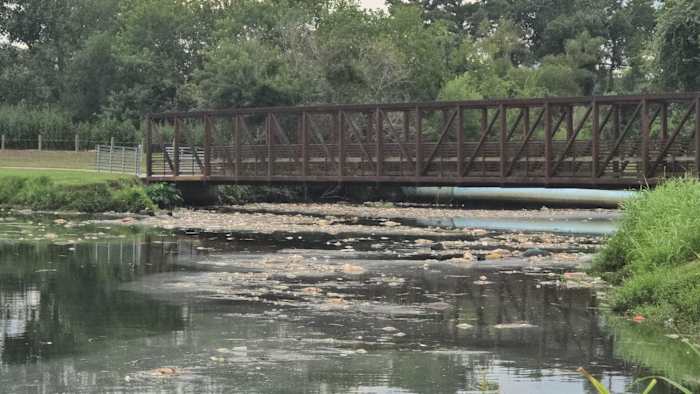
HOUSTON – Recent rainfall likely contributed to the large number of dead fish floating in Brays Bayou this weekend, according to the Texas Parks and Wildlife Department.
TPWD said the incident appears to be a natural event that occurs almost annually in bayous around the Houston area. The agency’s Kills and Spills Team said stormwater runoff can carry additional nutrients into waterways, contributing to algae growth.
Algae produce oxygen during daylight hours through photosynthesis but consume dissolved oxygen overnight. That can cause oxygen levels to drop sharply, particularly in the early morning when fish kills are often observed.
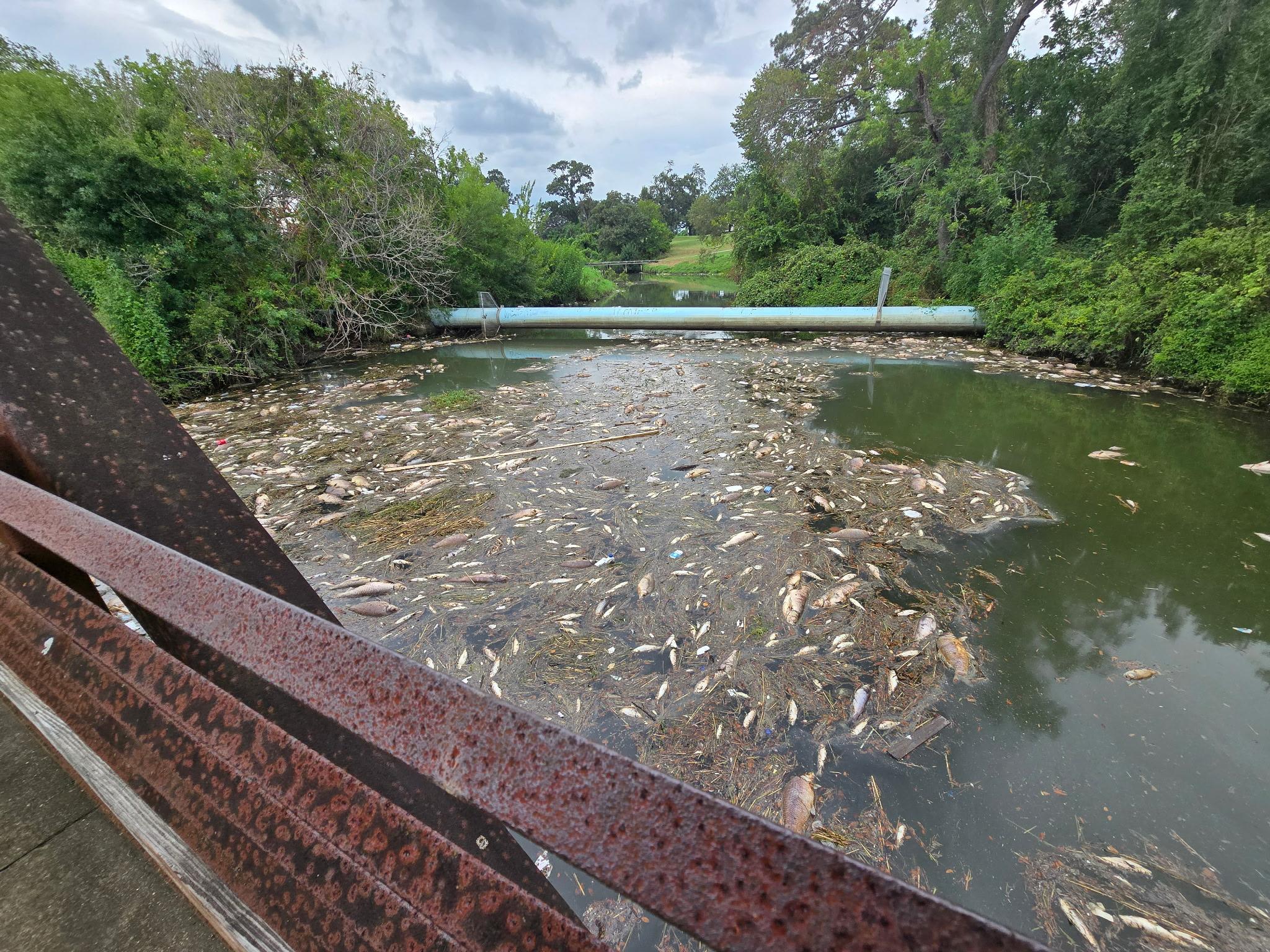 Groups of dead fish floating in Brays Bayou (Van Ray / KPRC 2 Click2Houston)
Low wind and water flow—conditions that are common during the summer—can also cause water in bayous to form layers with different oxygen levels, officials said. Fish may gather in areas with more oxygen, but a sudden influx of stormwater can mix those layers and temporarily reduce oxygen levels throughout the water column.
TPWD described the event as a possible “turnover” event, a phenomenon more commonly associated with lakes and ponds but also possible in bayous and streams when water flow is low.
While low dissolved oxygen fish kills are more common during the summer because of higher temperatures and reduced wind and rain, stormwater-related turnover events can happen at any time of year.
TPWD said fish kills can also be caused by fish-specific diseases or pollution, including illegal dumping or unauthorized discharges. However, the agency said there is currently no reason to believe either occurred in this case.
The agency received a report Friday from a concerned resident about dead fish in Brays Bayou near the University of Houston-Medical Branch area. TPWD officials are conducting a site visit and testing standard water-quality indicators to help confirm the cause.
“Based on the information provided to TPWD, this appears to be a natural event caused by an increase in stormwater that resulted in low dissolved oxygen levels in the bayou,” the agency said.
TPWD also urged people to use caution around the waterway. Brays Bayou is part of the Buffalo Bayou Tidal watershed, which is monitored by the Texas Commission on Environmental Quality. The watershed is listed as impaired because of dioxins, PCBs and bacteria.
The Houston-Galveston Area Council has also identified elevated bacteria and nutrient levels as concerns for Brays Bayou. TPWD recommends that people check current fish-consumption advisories before fishing or eating fish from the area.
Start Here, Houston
More Stories Like This In Our Email Newsletter
Copyright 2026 by KPRC Click2Houston – All rights reserved.