
At least five
more Central Texas cities have moved to end or pause their use of Flock Safety’s automated license plate reader cameras in recent weeks, adding momentum to a backlash against the company – and the surveillance technology it sells – that has spread from local privacy advocates to the governor’s office.
The latest wave began Aug. 25 in Pflugerville, where the City Council voted to cancel the city’s contract with Flock after a resident requested logs showing which outside law enforcement agencies had searched the city’s data.

A protest sign is seen next to Flock camera pole with the camera removed on East Crystal Falls Parkway in Leander on Friday, Sept. 4, 2026, after the city canceled its contract with Flock Safety, which provides automatic license plate reader technology. (Jay Janner/Austin American-Statesman)
The following week, after Gov. Greg Abbott ordered state agencies to stop spending money on Flock cameras, officials in Bastrop, Elgin, Manor and Leander moved to sever ties with the company.

Flock Safety makes license plate scanning cameras used by police departments. But the state says Flock Safety has been operating in Texas as a private security business without a license. (Provided by Flock Safety)
In Austin, officials had already decided to part ways with Flock. But leaders have also not ruled out contracting with another vendor-or rejected license-plate-reader technology altogether. The City Council approved new surveillance-technology protections in April, but in the months since, Police Chief Lisa Davis has not publicly said whether the Police Department will recommend another system. Any new agreement would require council approval.
Meanwhile, Austin police continue to receive license-plate data from other agencies, even though the Police Department does not directly access an automated license plate reader database.
As other Texas cities move away from Flock, Austin is confronting whether to replace its cameras, regulate its indirect access to the data or abandon the technology altogether.
The unresolved question has divided Austin’s elected officials but only three Austin City Council members told the American-Statesman they opposed the use of license-plate-reader technology altogether. Six members, along with Mayor Kirk Watson, said
they were open to a different system with tighter controls. (Two other council members did not respond.)
“This isn’t an all-or-nothing conversation,” Watson said in a written statement. “Technology can be used in law enforcement to assist in protecting the public and, at the same time, protect the privacy of our people and avoid unintended negative consequences.”
Council members are sure to face continued resistance from civil liberties groups who argue that changing vendors would not resolve the broader problem of creating searchable records of people’s movements.
What Austin ended – and what remains
A Texas Department of Public Safety license plate reader camera manufactured by Flock Safety stands near the Ann and Roy Butler Hike-and-Bike Trail along West Cesar Chavez Street in Austin on Wednesday, Feb. 25, 2026. A protest sign attached to the pole reads, “DPS is watching you.” (Jay Janner/Austin American-Statesman)
Austin launched its Flock license plate reader pilot in 2023, installing 40 fixed cameras and nearly 500 vehicle-mounted cameras. The cameras photograph passing vehicles and use artificial intelligence to identify license plates, vehicle makes, models, colors and other distinguishing features, creating a searchable record of where vehicles have been seen.
Police officials said the system helped locate stolen vehicles, missing people and crime suspects – including a vehicle connected to a weekend-long shooting spree that began in Austin and ended in Manor in May.
But a city audit found that 10% to 20% of searches conducted by Austin officers lacked a clear reason or case number. Residents and council members also questioned how long the data was retained and whether it could be shared with outside agencies.
Amid those concerns, City Manager T.C. Broadnax declined to bring a renewal of Austin’s Flock contract to the City Council in June 2025. The pilot expired, and the Police Department turned off its license plate readers the following month.
But the Police Department has not stopped receiving license-plate-reader information.
Assistant Police Chief JJ Schmidt said Austin officers do not directly access an automated license plate reader database. During a joint investigation, however, a partner agency with lawful access to such a database may share relevant information with Austin investigators.
The department does not have written agreements with other agencies regulating shared license-plate reader use and it does not maintain records of those interactions, Schmidt said.
As a result, it is unclear how often Austin officers have accessed license plate scans, which agencies provided the data or what investigations it supported.
That arrangement is raising questions about how much control Austin has over information collected outside the city and whether the city’s new surveillance rules apply to data obtained through another agency.
“Technology is a critical tool that helps solve cases, identify suspects and keep our community safe,” Schmidt said. “We need to use our technology resources available to support effective investigations and protect our community.”
Michael Bullock, president of the Austin Police Association, said license plate readers remain a valuable investigative tool, regardless of which company provides them. The technology can help police locate stolen vehicles, missing people and suspects in violent crimes, he said.
“We are absolutely supportive of the technology, and reasonable guardrails have never been a problem,” Bullock said.
Attempts to regulate
A Flock camera is seen with the cameras covered on east Pfennig Lane in Pflugerville on Thursday, Aug. 27, 2026. (Mikala Compton/Austin American-Statesman)
In April, council members passed the TRUST Act – short for the Transparent and Responsible Use of Surveillance Technology – requiring City Council approval, a public privacy assessment and a written use policy before the city acquires or expands its use of surveillance technology. The ordinance also requires annual reporting on how the technology is used and whether it is effective.
But the measure’s two co-authors, Council Members Mike Siegel and Chito Vela, are split on the future of license plate readers in Austin.
Siegel told the Statesman in an interview that the Police Department
should not be using the technology at all and that the department’s continued access to license plate reader data through other agencies underscores a broader challenge: how to regulate advanced policing technology when the city does not own or operate the system collecting the information.
He noted that technologies that can record, analyze and share information about people’s movements require strict limits, regardless of the vendor or agency that controls the database.
“I’m really disappointed that our city’s Police Department is complicit in violating people’s privacy and liberty rights using other agencies’ tools,” Siegel said.
Council Members Vanessa Fuentes and Zo Qadri told the Statesman they also oppose any kind of automated license plate reader program.
But
Vela said he still sees a role for the technology in emergencies and serious criminal investigations. He would support using license plate readers to locate a stolen vehicle or one connected to a recent shooting.
But Vela said Austin should pursue a shorter retention period than the seven days allowed under the city’s former policy. Keeping records that can be used to track someone’s daily movements, he said, creates a serious civil liberties concern.
“I don’t want to say we can never use ALPRs, but the retention of the data is problematic,” Vela said.
The Texas Department of Public Safety also has installed license plate readers throughout Austin, though it is unclear how Abbott’s recent order will affect those existing cameras. A DPS spokesperson said the agency has paused installation of any additional automated license plate readers across Texas.
DPS uses the technology to help investigators locate suspects and missing people, recover stolen property and develop timelines in criminal investigations, the spokesperson said.
Flock did not respond to a request for comment.
The limits of changing vendors
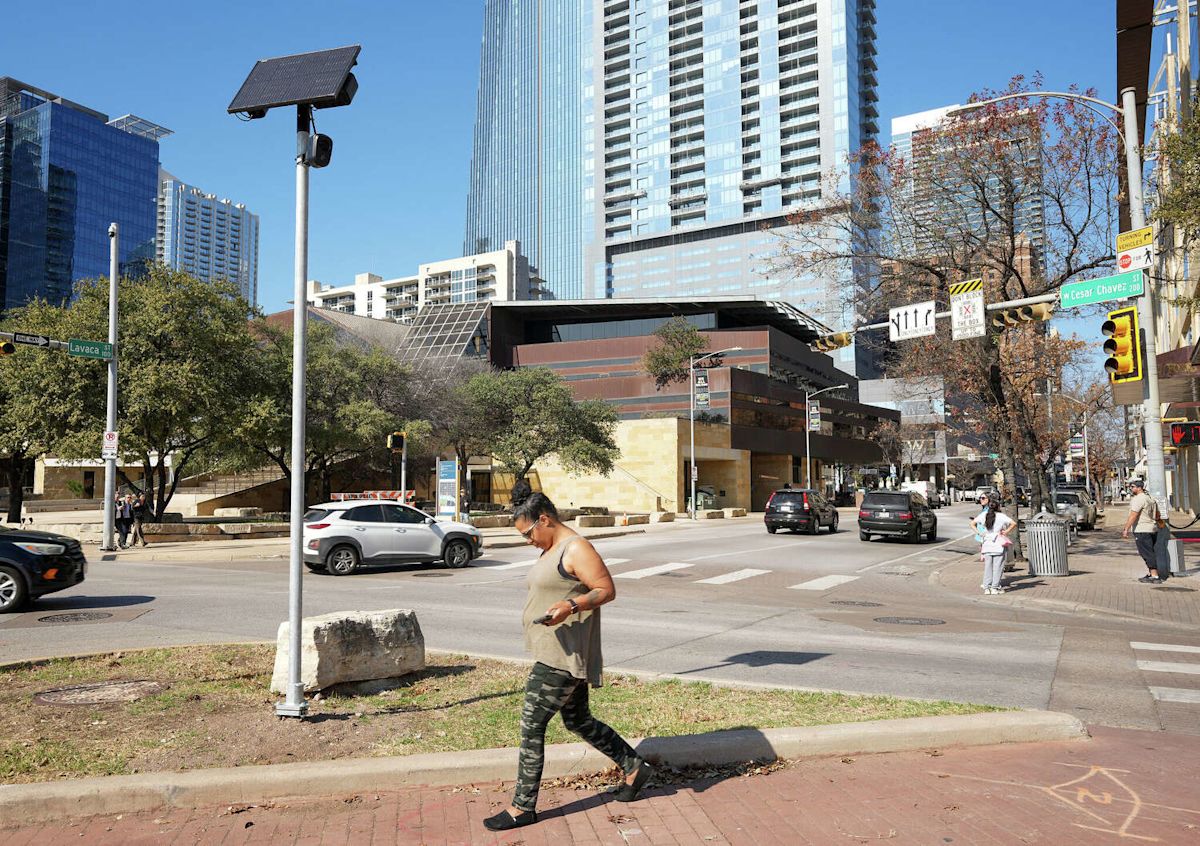
A surveillance camera is seen in the median of West Cesar Chavez Street at Lavaca Street next to Austin City Hall on Wednesday, Feb. 11, 2026. (Jay Janner/Austin American-Statesman)
Like Watson, Council Members Ryan Alter, Marc Duchen, Paige Ellis and Krista Laine told the Statesman the city could consider narrower surveillance tools, even if it does not return to Flock. (Council Members Natasha Harper-Madison and José Velásquez did not respond to the Statesman’s inquiries.)
Ellis said she wants Flock completely out of Austin but would consider a system from another company if it avoided cloud-based data sharing and kept information under the control of Austin departments. Searches, she said, should be limited to specific investigations or public spaces where violent crimes have occurred.
“If we want our officers to be able to solve more crimes, if the information is already collected, I don’t see why we shouldn’t be able to use it to help solve crimes in our jurisdiction,” Ellis said.
Laine said cameras being considered for city parks could provide an early test of the TRUST Act’s rules. Parks officials have explored cameras that could operate in locations without existing power sources.
Alter, who is running for re-election, said residents he has encountered while campaigning are not asking the city to bring back license plate readers. He said he would support live security camera feeds in parks where officials know there are problems such as break-ins, camping or drug use.
But he would not support technology that uses artificial intelligence to analyze people or stores information about their movements indefinitely.
“Flock has proven themselves to be completely untrustworthy,” he said. “For us to utilize LPRs, we would have to find a company that clears a very high bar in terms of civil liberty protections.”
Mackenzie Rhine, a board member of Austin’s chapter of the Electronic Frontier Foundation and member of the No ALPRs Austin coalition, said those distinctions do not eliminate the underlying concerns.
Rhine said switching from Flock to another company would not resolve the problem because competing products still collect large amounts of data and can allow police to reconstruct people’s movements.
“Every surveillance company I’ve seen has the same profit model: exploit people’s data for more money,” Rhine said.
Recent cases in Texas have added to those concerns.
In Lufkin, a police officer faces 100 felony charges after investigators accused him of using Flock data to monitor an ex-girlfriend, her relatives and others who were not connected to criminal investigations. He allegedly searched his former partner’s license plate more than 10,000 times.
In Pflugerville, public records showed that nearly 1.6 million searches involving the city’s cameras were conducted by 459 outside organizations, prompting officials to question whether the system’s data-sharing safeguards worked as they had been told.
Nick Hudson, senior manager of policy and advocacy at the ACLU of Texas, said Flock is among the most troubling license plate reader companies in the country because “privacy compromising standards are built into their business model.”
Hudson pointed to language in some of Flock’s agreements with governmental entities that allow the company to share license plate scans with law enforcement officials, government officials and, in some cases, non-governmental third parties.
But he said the broader problem involves government surveillance systems that use artificial intelligence and retain sensitive location records.
“People have woken up to the fact that the problem with these companies is they are trading privacy for profits,” Hudson said.
Hudson said Austin should not reactivate its cameras or seek another license plate reader system because retaining those records over time allows the government to construct an intimate picture of people’s lives.
A growing backlash across Texas
A Texas Department of Public Safety license plate reader camera manufactured by Flock Safety stands near the Ann and Roy Butler Hike-and-Bike Trail along West Cesar Chavez Street in Austin on Wednesday, Feb. 25, 2026. A protest sign attached to the pole reads, “DPS is watching you.” (Jay Janner/Austin American-Statesman)
The backlash against Flock has grown as more details emerge about the number of cameras operating across Texas and how the systems share information.
The Texas Tribune reported that a $1 annual fee added to Texans’ auto insurance policies in 2023 to combat catalytic converter theft helped fund at least 3,200 Flock cameras across the state. Nearly 1,200 more cameras are being installed by DPS.
Abbott subsequently ordered state agencies to pause using state money to fund the systems. DPS did not respond to questions about whether Abbott’s order would require the agency to disable its Austin Flock cameras. The agency told the Tribune that it would continue using the readers for “legitimate public safety efforts.”
A recent statewide poll suggests the cameras may be losing public support across party lines. In a poll of 1,167 Texans conducted Aug. 24-26, nearly 64% opposed local governments’ use of automatic license plate reader cameras, including 51% who strongly opposed them. About 28% supported the cameras, while 8% were unsure.
Mark Cunningham, director of Overton Insights, which conducted the poll with the Texas Public Policy Foundation, said the poll measured attitudes toward automatic license plate readers generally, not just Flock.
“There isn’t a ton of difference in the vendors,” Cunningham said. “We polled the concept.”
Cunningham said opposition was apparent across racial and political groups, although Republicans were more supportive than Democrats. Black respondents were least supportive, followed by Hispanic respondents, he said.
“It is a clear issue that everyone agrees on,” Cunningham said. “Any place you’ve seen this polled, it’s just losing support.”
This article originally published at Central Texas cities are rejecting license plate readers. What will Austin do?.