
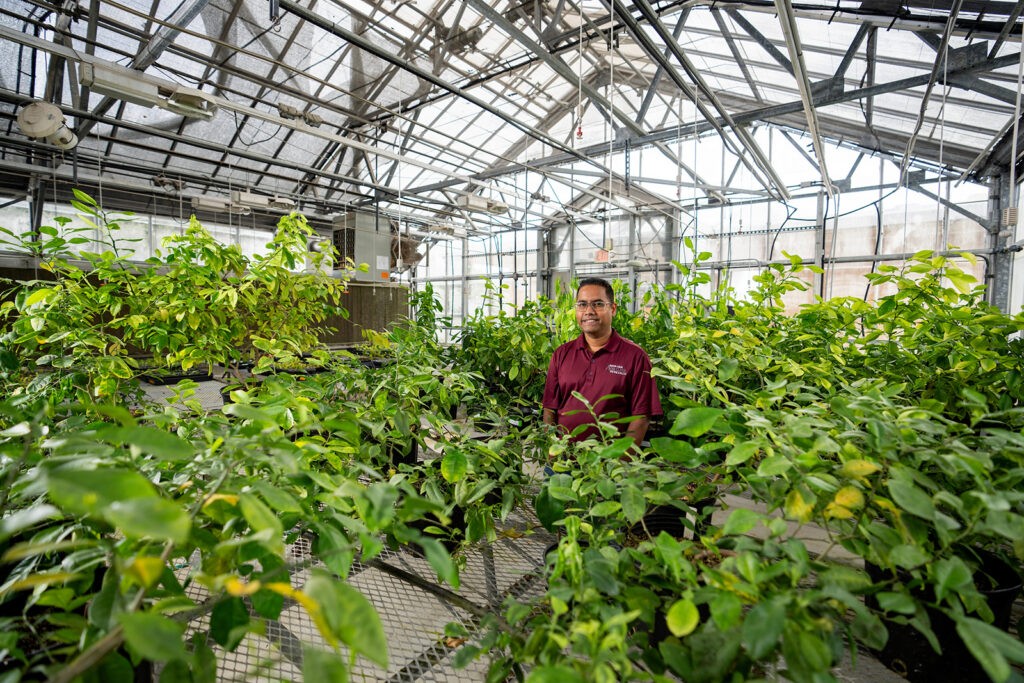
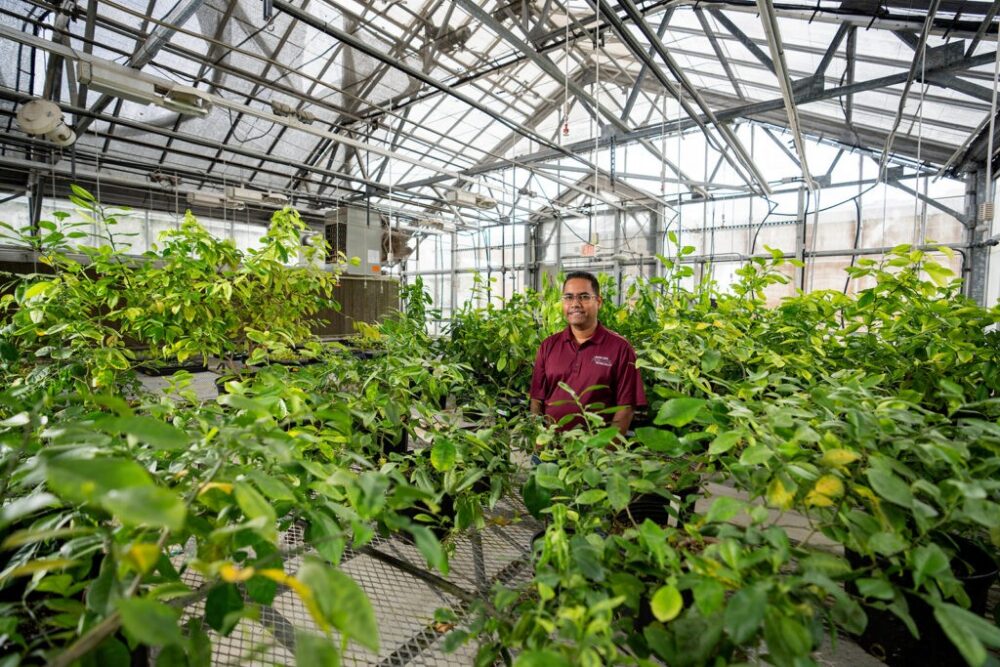
Sam Craft/Texas A&M AgriLife
Kranthi K. Mandadi, Ph.D., worked with collaborators for more than a decade of research toward commercial availability of a newly registered citrus greening treatment.
For the last several years, a bacterial infection has been devastating many of the coastal states in the United States, including Florida, Georgia, and even Texas. There is no cure, and it can often be fatal. The victims are citrus fruit trees.
The disease, called citrus greening, is spread by a tiny insect called the Asian citrus psyllid, according to the U.S. Department of Agriculture. Though it’s not a threat to humans or animals, citrus greening has devastated millions of acres of citrus crops across the world. Greening can lead to poorly colored, lopsided, and bitter fruit, which can only be sold for juicing. Once infected with the virus, most trees die in a matter of years.
“The citrus greening disease has devastated the industry in Florida, for example, much more than Texas,” Kranthi Mandadi, director of Texas A&M’s AgriLife research center in Weslaco, said. “So bad that they lost 90% of their orange juice production and other citrus production over the last 15 years because of this disease and some other factors like environmental causes too.”
Sign up for the Hello, Houston! daily newsletter to get local reports like this delivered directly to your inbox.
Now, the U.S. Environmental Protection Agency (EPA) has given approval to a product designed to target citrus greening. The breakthrough research, conducted by Mandadi and other researchers, came from spinach.
Spinach, like other plants as well as animals, contains antimicrobial peptides that work as part of their immune response, known as defensins. Mandadi’s team found that spinach defensins can protect citrus trees from citrus greening.
“Our product in this case — the peptide from a spinach — can kill the bacteria within these trees, the affected trees,” Mandadi said in an interview with Houston Public Media. “And thus you can manage the disease, prevent the losses that the growers face because of this bacteria, and that’s the discovery.”
Their results were published in the National Library of Medicine in February 2025. As Mandadi told it, gathering data for research and development took more than a decade in total to bring the product to EPA clearance.
Silvec Biologies, a Maryland-based agricultural biotechnology company, was licensed to obtain EPA registration and commercialize the treatment. In July, the EPA cleared the way for the therapy to enter the market.
Silvec’s product utilizes RNA-based therapy to, in its own words, vaccinate plants to breed antimicrobial defensins naturally.
“We are excited to build on 15 years of pioneering work by Southern Gardens Citrus [a subsidiary of U.S. Sugar], the University of Florida, and Texas A&M and look forward to beginning to partner with growers in late 2026 through the Florida Citrus Research and Field Trial [CRAFT] program,” Rafael Simon, co-founder and CEO of Silvec, said in a press release after the EPA approval.
As Mandadi said, the treatment is not so much a silver bullet for farmers as much as a “tool in their toolkit.” But to reach the point of EPA approval — Mandadi’s first — was the fruit of many people’s labor.
“I’m basically the lead on this in the last ten years,” he said, “But before me, we had my collaborators. And even now, some of them retired, some of them passed away. It’s amazing to see it go through years before finally fruition-ing.”