

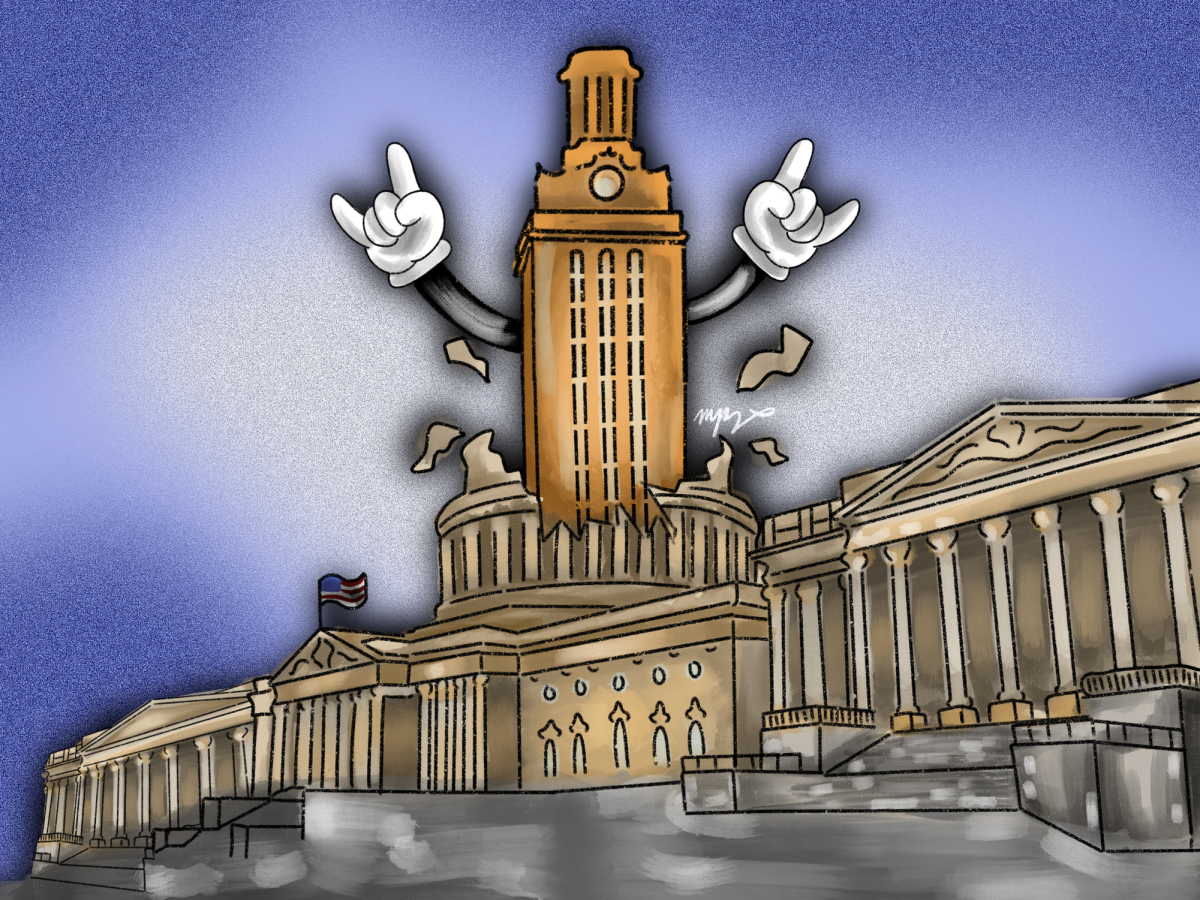
Police lined the streets, government buildings stood firm against the gray May sky, people in suits walked confidently with phones pressed to their ears in conversations I could only catch pieces of. As the cornerstone of influence not only in the United States, but the world, Washington, D.C. seemed to move with order and ease — or at least, that’s how it appeared if one didn’t turn on the news.
The headlines on my phone mirrored conversations happening citywide. From President Donald Trump’s visit to China to Jerome Powell nearing the end of his eight-year term as chair of the Federal Reserve, politics and my everyday life seemed to merge into one for the first time. I walked past buildings where the people in those headlines worked, ate pizza near places where policy was negotiated and participated in conversations about issues affecting millions of people.
That feeling followed me into a congressional hearing held by the House Committee on Education and the Workforce. Members of Congress from across the country filled the leveled seats of the authoritative room as U.S. Education Secretary Linda McMahon stood before us in her pink suit. Nameplates lined the desks, microphones switched on and off and questions bounced as national debates over education unfolded only feet from me.
I had expected Washington to give me a greater understanding of the power concentrated on the national stage. Instead, it made me question the political structures shaping my own state.
From elementary school closures across Austin to curriculum changes at UT, who has the power to decide what it means to be a student in Texas.
Unlike private institutions, public universities like UT exist within a governmental structure that gives the state significant authority over their funding, governance and operations. Traditionally, one of the state’s greatest sources of influence has been its “power of the purse.” Through the appropriations process, state lawmakers determine how much state funding public universities receive, giving the legislature influence over its institutions. Recently, Texas leaders ordered state agencies to cut spending by 3% — directly impacting higher education programs.
However, that influence has extended beyond funding in recent legislative sessions. In 2025, Gov. Greg Abbott signed Senate Bill 37 into law — reshaping governance, curriculum oversight and faculty structures of public universities in Texas. At UT, seven academic units within the College of Liberal Arts were combined into two: the Department of Social and Cultural Analysis and the Department of European and Eurasian Studies. Two years earlier, the state passed Senate Bill 17, prohibiting diversity, equity and inclusion offices, programs and mandatory training at all public colleges and universities across the state — closing spaces such as the Gender and Sexuality Center and Multicultural Engagement Center.
“Beyond the power of the purse, the legislature recently has been exercising some additional oversight,” said Randy Erben, adjunct professor at UT Law. “Some would say it’s unlearned. Some would say it’s onerous. But there’s no question that they have taken more of an interest in the governance, in the operations, in the curriculum of the public universities in recent years.”
The path from the ballot box to the classroom is not direct, as policy moves through the legislature, governor, Board of Regents, UT System and University administration. Yet, the laws passed and officials elected within that structure immediately affect students.
In the midst of Texas lawmakers taking an increasingly active role in higher public education, education policy is more relevant now than ever. As another election approaches, immigration, health care and the economy will inevitably dominate political conversations — education deserves a place among them.
An election does not fundamentally rewrite the relationship between Texas and its public universities, but it changes who exercises the power embedded within that relationship and what they choose to do with it.
Conversations in Washington are heard everywhere, and state politics can appear less significant in comparison, even when the policies themselves are unfolding just south of the UT tower. The November election offers reason to pay closer attention to not only the politics dominating our screens but the powers attached to the offices closer to home.
The committee hearing showed me how political power doesn’t lie solely within Washington’s monuments and government buildings. It’s present in the voices of those elected to represent their constituents across the country. From the stories of the students in California to the teachers of Connecticut, each representative carries the communities that entrusted them with a voice on the national stage. The power of a vote lies, in part, in understanding the power of the office it elects and the voice that representative carries to our nation’s capitol. Ultimately, Washington taught me to look beyond Washington.
Vazquez is an English and journalism junior from Monterrey, Mexico.