
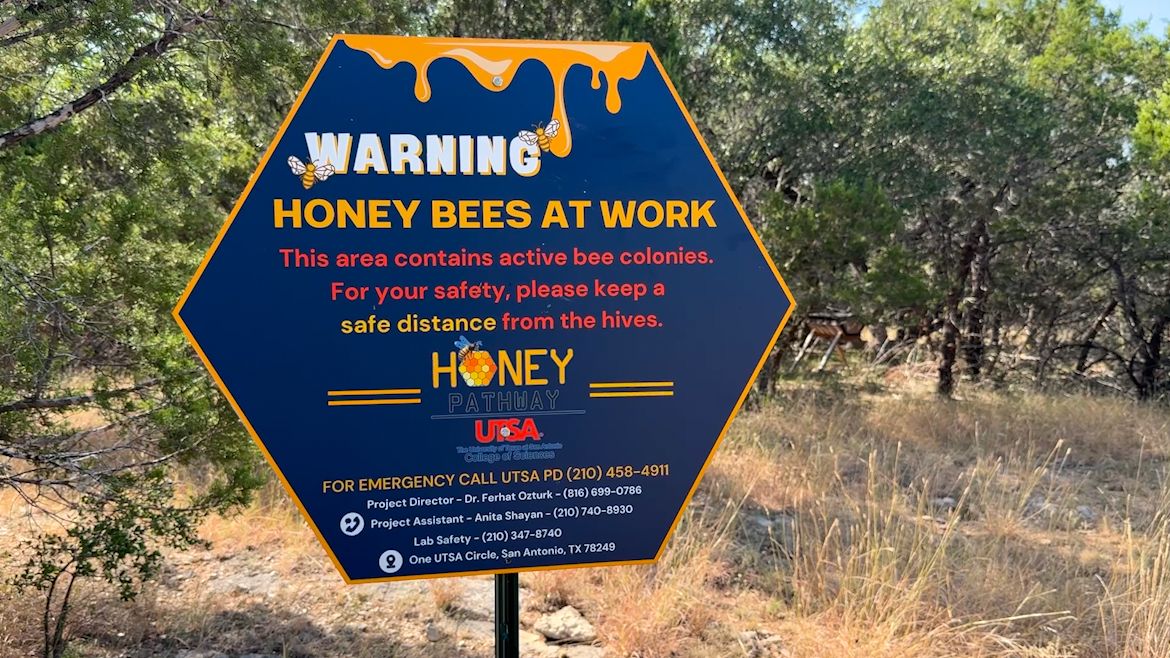
SAN ANTONIO — Bees are busy working on campus at the University of Texas at San Antonio. Researchers at UT San Antonio are taking a closer look at honey to determine the medical benefits of the sweet substance.
For more than a decade, biology professor Dr. Ferhat Ozturk has gotten up close and personal with these bees and their honey.
“They are collecting nectar and pollen at this time of the year. I fell in love with the honey first. After being a honey scientist first, then beekeeper later,” said Ozturk.
Through the HONEY Pathway program, he’s studying the uses of honey as medicine.
“I fell in love with honey because honey is the ultimate wound healer for thousands of years, used by every civilization on earth,” he said.
Funded by a nearly $3 million grant from the U.S. Department of Agriculture — HONEY Pathway promotes urban beekeeping, while also exploring honey’s potential in health care.
“We only have one or two known honeys in the world to be used for medical,” Ozturk said. “And there’s a high demand, low supplies for those honeys.”
Students have analyzed more than 500 honey samples for research.
“Got to see a different part of science I don’t typically get to see,” said sophomore chemistry major Zoey Bautista.
“I like a lot of people have only heard honey is good for a sore throat, so to hear it had so many more capabilities was so exciting,” she said.
Honey can be helpful treating burns, wounds and for gut health. Ozturk says the goal is to see if Texas honeys can compete with the medicinal honey already on the market.
“Discover a sustainable honey source that can be used in the U.S. for our patients in the burn clinic and the wound clinics,” Ozturk said.
With 16 active hives in the campus apiary, he hopes students take this hands-on experience into their future careers.
“Most of my students are pre-health professionals,” Ozturk said. “So, we will have lots of medical doctors, dentists, pharmacologists who know the value of honey as medicine.”