
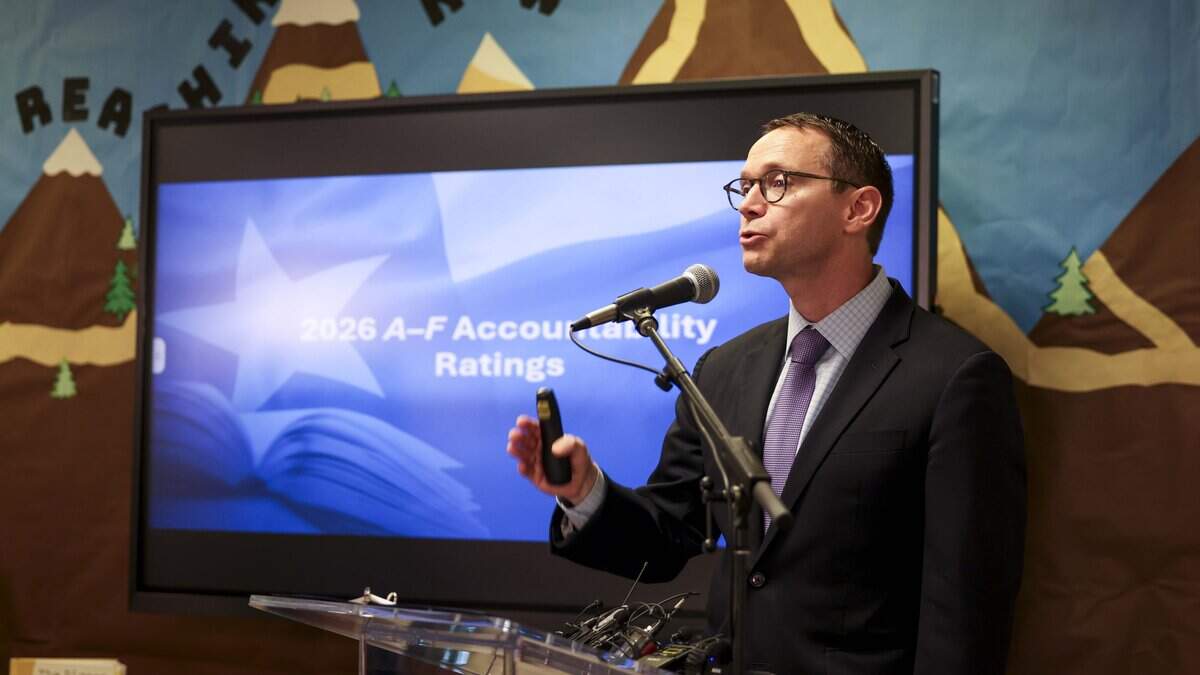
With several public school districts in North Texas and across the state on the cusp of state takeovers, Texas Education Agency Commissioner Mike Morath has increasingly encouraged them to turn to third-party organizations to run struggling campuses and avoid state intervention.
Texas public districts are subject to a TEA takeover if one of their campuses receives five consecutive F grades in the state’s annual A-F Accountability rating system. That gives Morath the ability to name a new superintendent and replace the school board with a Board of Managers, a process that has already played out at both Fort Worth ISD and Lake Worth ISD in the last calendar year.
But a Texas law passed nearly a decade ago could put takeovers on hold — and an increased number of districts in North Texas are using it to maintain control of their campuses.
Senate Bill 1882 made it legal for districts to partner with external groups to manage struggling campuses. By doing so, campuses get a two-year exemption from state takeovers, meaning a campus can get up to seven F ratings in a row and still not be subject to a takeover.
Everman ISD is the latest Tarrant County district to turn to a third party organization to dodge a takeover. Last month the district announced it was partnering with Third Future Schools, a nonprofit educational management organization, to run two of its schools. One of the schools just received a fourth F grade.
In a press conference last month, Morath said more districts should turn to third-party organizations, like Everman did.
“What I think some school districts are thinking through is, are there partners that might have specialized or a higher degree of expertise in some areas of curriculum, instructional support, those sorts of things?” Morath said. “I think some districts are doing this. They may be doing this because of accountability issues, but like, if it’s a good idea for kids, you should do it. You should do it today. Period. You shouldn’t wait.”
But both parents and education experts have raised concerns about third-party organizations running public campuses, questioning their effectiveness and whether it would be worse in the long run to relieve independent districts of authority over some of their schools.
Have third-party organizations improved campuses they’re operating?
According to TEA, there are 95 campuses in the state that are currently operated by a third-party organization. Seven of those are in Fort Worth ISD, with most being operated by Texas Wesleyan University’s Leadership Academy Network. Everman ISD’s two campuses that are third-party run, Charles Baxter Junior High and Townley Elementary, are operated by Third Future Schools, which was founded by Houston ISD’s state-appointed Superintendent Mike Miles.
TEA has previously stated that roughly 70% of all partnerships with third-party organizations have shown some level of academic growth, or maintained acceptable performance. But some organizations have failed to show positive results. Earlier this year, TEA denied Austin ISD’s request to partner with the Texas Council for International Studies, saying the organization runs several D and F rated campuses that have failed to show improvement. TCIS runs 16 campuses in Longview, Edgewood and San Antonio ISDs.
A study on Senate Bill 1882 conducted by the University of Houston’s College of Education found that teachers at third-party operated campuses have an average of 6.2 years of experience, roughly half the statewide average. It also found that campuses operated by turnaround organizations tend to be composed of larger proportions of Black and Hispanic students compared to statewide averages.
The study also found that campuses operated by turnaround organizations tend to perform lower on the Accountability Rating System, and STAAR performance is also lower than comparable peer campuses with similar demographics. However, growth on STAAR exams is similar to that of peer campuses, the study found.
The overall effectiveness of third-party turnaround organizations has been highly disputed across the country. At a Tennessee third-party-run achievement school district in Memphis, a Vanderbilt University study found virtually no gains or improvement. Similar studies conducted on turnaround organizations in Detroit and Newark, New Jersey, also found little to no improvement.
Third Future Schools, which operates schools across Colorado, Texas and Louisiana, is also now operating two campuses in Everman ISD. It has been a mixed bag for the organization when it comes to producing improved student outcomes.
Several schools operated by Third Future in Colorado have reported gains since partnering with the organization. Coperni 3 in Colorado Springs, which is run by Third Future, now ranks within the top 25% of Colorado public schools academically. It was previously one of the worst performing public schools in the state. In Odessa, Texas, Ector College Prep’s TEA Accountability score has risen from a 58 to an 86 since Third Future took over.
But a partnership between Third Future and Beaumont ISD ended because the organization asked the state for more per student funding. When TEA declined, the partnership ended.
What do third-party organizations do differently than public school leadership?
When Everman ISD turned to Third Future to run two of its struggling campuses earlier this year, it posted a webpage explaining that the schools would adopt a curriculum that will better emphasize helping students think critically, problem solve, and apply learning across all subject areas.
It also said the campuses will now have a more comprehensive plan for special education and student support, which will include following all current IEPs and providing additional targeted interventions to students who need it. Students performing below grade level will receive more small-group intervention and reteaching. Additional support will also be offered to students until they demonstrate mastery of a subject.
The goal of Third Future and other similar third-party turnaround organizations is to aggressively accelerate academic improvement. That includes changing instructional models, curriculum, teaching strategies, and in some cases, hiring different teachers.
Rachel White, an associate professor in the department of educational leadership and policy at the University of Texas at Austin, believes there is not enough qualitative evidence showing how third-party organizations create change since Senate Bill 1882 is still relatively new.
While White acknowledged Third Future-run campuses in districts like Austin, Midland and Ector County have shown single-year gains, she’s still unsure whether turnaround organizations can create more accelerated improvement than local leadership can.
“I don’t know that we have a lot of examples of how teaching looks different in these classrooms,” White said. “We don’t know how support for students with disabilities will look different, how behavior management looks different. I do know with 1882 that they get extra per student funding, so it’s unclear to me whether or not a locally run district, if they got extra funding, if they would be able to do similar things that these organizations are doing under the 1882 law.”
What’s more concerning isn’t the fact that local districts are turning over control of campuses, it’s who they’re turning over control to, White said.
Mike Miles, who founded Third Future Schools, resigned as CEO after TEA tapped him as superintendent of Houston ISD as part of its takeover of the district. Lake Worth ISD’s state-appointed superintendent, Ena Meyers, also previously worked for Third Future, as did Beaumont ISD’s state-appointed leader, Sandi Massey.
“What concerns me isn’t just one contract with a third party,” White said. “It’s that Third Future is a single model, and this single model with a small network is being installed at district after district by a state agency that is also ordering takeovers. I think that sort of concentration, to me, maybe deserves some scrutiny.
“I also think about how these 1882 partnerships optimize one thing, which is improving accountability ratings. To me, that is a narrow process for a good education.”
Related Stories from Fort Worth Star-Telegram

Fort Worth Star-Telegram
Samuel O’Neal is the K-12 Education Reporter at the Fort Worth Star-Telegram, covering public schools and policy that impacts them. He previously worked as a staff writer at the Philadelphia Inquirer and is a graduate of Temple University.