
Digital subscribers can listen to this article.
Subscribe today for unlimited access to Texas Monthly. Already a subscriber? Log in.
Like any crime scene, my Corpus Christi yard makes for an ugly sight. Dry grass crunches underfoot and fissures have split the soil. All that seems to thrive are stubborn mats of spotted-spurge weeds and insidious, prickly sandburs. Drought brought city-mandated watering restrictions that have murdered my lawn, as well as most of the others on my block.
Altogether, I’ve spent nearly a decade in the area. I was here briefly in the mid-nineties, working as a reporter for the city’s daily newspaper. And I chose to return in 2018, leaving the trauma of full-time employment in Dallas for a cheaper, beachier climate better suited for a freelance writer. Drought, or the risk of it, has been present every year I’ve lived here. But rain always eventually fell, and whatever public worry there was about the water supply would ebb. Life went on.
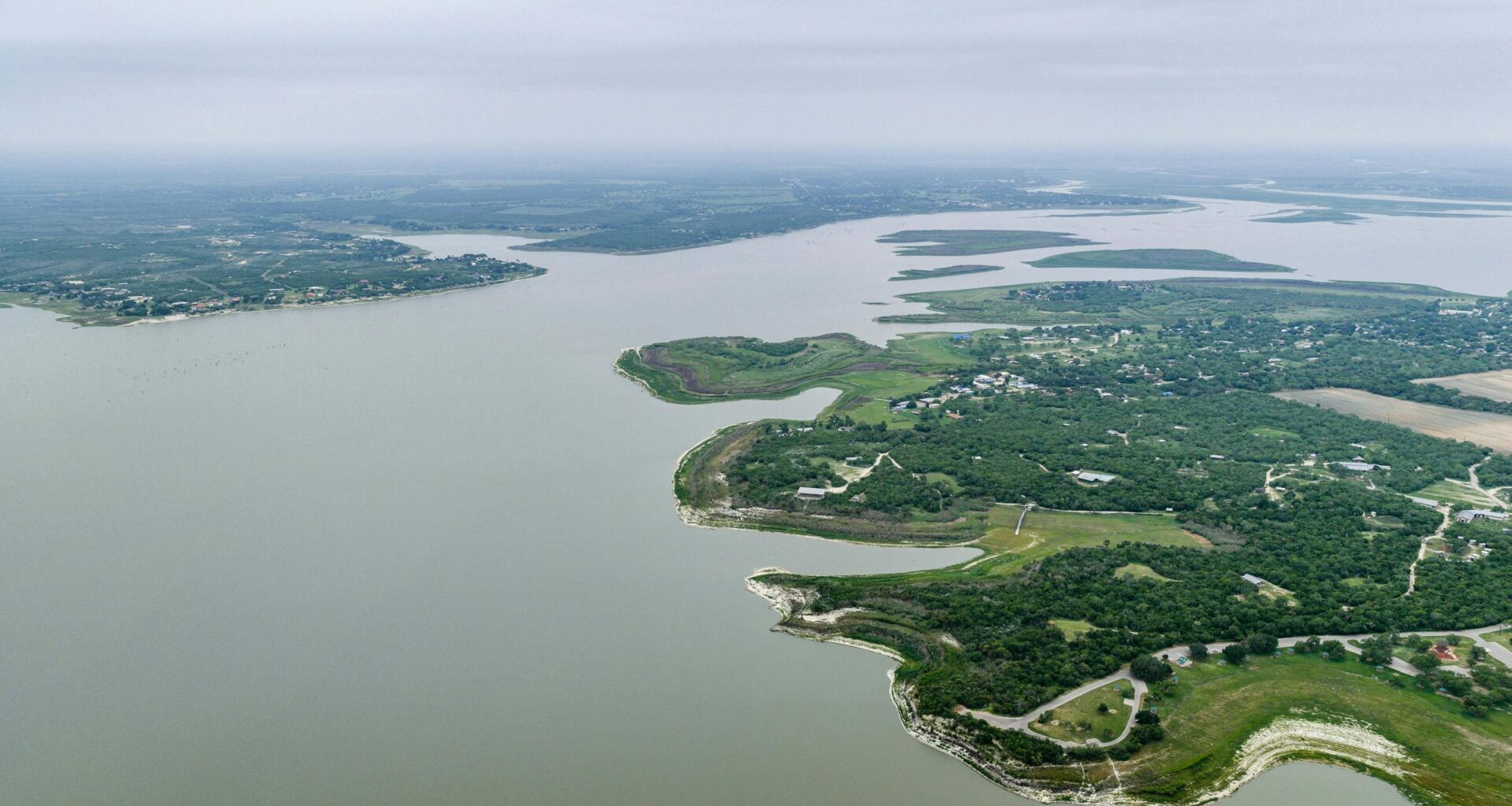
Then, early this year, the present crisis became impossible to ignore. The combined level of the city’s two mainstay reservoirs, Choke Canyon and Lake Corpus Christi, was just 10 percent and dropping. Water department models predicted that the daily demand would soon exceed the amount it could deliver, triggering mandatory cutbacks by all users. By November, the city was projected to face a shortfall of 60 million gallons a day, roughly four to five times the daily use of Corpus’s 300,0000 residents.
Scary headlines broadcast the situation nationally. Inside Climate News declared “a Texas City Careens Toward a Water-Shortage Catastrophe.” The New York Times called Corpus a “cautionary tale.” The coverage suggested residents were at imminent risk of turning on their taps and getting only dust. The truth is less apocalyptic, if still decidedly worrisome.
For those who live elsewhere and wonder why they should care, consider that the Port of Corpus Christi, the engine of the city’s economy, is the nation’s largest energy export terminal—shipping oil and liquified natural gas to customers across the globe. City-imposed water restrictions could affect production at local refineries, which could contribute to already high prices at the pump and a surge in jet or diesel fuel prices that would affect commercial cargo rates. The economic effects could prove far-reaching. What happens in South Texas doesn’t always stay down here.
Fortunately, heavy summer rains kicked the potential shortfall down the road. New projections give the city until 2028. But the flaws in Corpus Christi’s water system have been revealed, like the cracks in a pier’s legs unearthed by a drying lake. The drought persists, and unless city leaders take drastic action, the emergency is still coming. While this won’t transform the Coastal Bend into an anarchic Mad Max–style wasteland, it is casting a shadow over the area’s rising prospects as a national economic hub.
The decades-long saga of how Corpus Christi got itself into this situation is the story of a slow-burn disaster, of unheeded warnings and misplaced faith—and of a relentless pursuit of growth without the wherewithal to meet the demands that growth brought. It could also serve as a warning to other Texas communities about overcommitting their water supplies to thirsty new industrial users, such as data centers.
Just last week, the city council held a vote that leaves the crisis unresolved. Even now, with the bill coming due, the path forward remains unclear.
“. . . I just hope it will rain . . .”
Mayor Luther Jones listened politely as a blind trumpeter named Dan Falcon played the national anthem. A southerly wind whipped past, stirring dust and muting the performance. The gusts didn’t dampen Jones’s mood. June 8, 1982, was a historic day for Corpus Christi. Hundreds had gathered at this dedication for a reservoir that would address the city’s future water needs, and he was the host.
Serving as a dramatic backdrop to Falcon were the seven fifty-foot-wide gates of the newly completed Choke Canyon Dam. The day’s ceremony would culminate with the closing of the gates for the first time, blocking the flow of the Frio River. The city had relied entirely on Lake Corpus Christi since 1958. After twelve years of planning and construction, Corpus would now have an additional supply nearly three times bigger than its existing reservoir.
Seating for five hundred had been set up on the dry spillway, and two hundred others in attendance had to stand. A barbecue lunch was served under a tent festooned with red, white, and blue bunting. “Now I just hope it will rain when we get through eating,” Jones told the crowd, fighting the wind. “To start providing our water supply to the year 2020.”
The sky didn’t oblige for five months, then only delivered a paltry two inches that hardly reached the ailing reservoirs. Then conditions really dried up. By 1984, the slowly filling Choke Canyon and ailing Lake Corpus Christi were at a mere fraction of their combined capacity.
The city declared a Level 1 Drought Emergency, which imposed mandatory 25 percent cuts on homes and businesses. Residential rationing was policed by water-department officials checking meters and issuing tickets. Landscape companies laid off workers because all lawn watering was banned. The city council paid a company to seed clouds over the reservoirs.
That didn’t work. Nor did the restrictions on residents and small businesses make much of a difference. According to a study by the American Water Works Association, what tipped the scales was the cutbacks imposed on refineries and chemical plants, which consequently invested in new equipment to conserve and recycle water.
A deluge in October 1984 and robust rainfall the following spring rehydrated South Texas, filling Lake Corpus Christi and Choke Canyon. Confidence in these reservoirs was reinforced by state officials, who seemingly refused to heed any lesson from the crisis. “Incongruous as it may seem with the situation in 1984, Corpus Christi doesn’t really have a foreseeable water supply problem,” Jerry Higgins, an official with the Texas Department of Water Resources, told the Corpus Christi Caller in 1985. “There’s just been a lack of rainfall.”
Water planners in Austin had a habit of ignoring the periodic dry spells and assumed that both reservoirs would maintain healthy levels most of the time. “Lake Corpus Christi and Choke Canyon, if it ever fills, should be enough to meet Corpus Christi’s needs through 2030,” Higgins told the paper.
But Paul Montagna, the endowed chair for hydroecology at the Harte Research Institute, in Corpus Christi, and a forty-year veteran of South Texas water research, told me that there was a major problem with counting on those reservoirs. “Most of that watershed is in the Wild Horse Desert,” he said. “There’ll be times when the watershed’s full. There’ll be times when it’s going to be pretty darn low. It was never going to be a super reliable water source.”
“We can’t sell this city . . .”
Corpus wouldn’t be what it is today—a globally important export hub, with a population of more than 300,000—if it weren’t for the oil-and-gas industry.
On September 14, 1919, the area was gutted by a deadly hurricane, inspiring civic leaders to remake their laconic beach and fishing community into a deepwater port. All they needed was a shipping channel. The federal government paid for the construction of one between the Gulf of Mexico and downtown Corpus’s bayfront. After the channel opened in 1926, the surrounding landscape came to be dominated by fields of oil storage tanks, fire-belching flare stacks, sprawling refineries, and petrochemical plants that glitter on the horizon at night.
It was just those sorts of industrial users that mid-nineties Mayor Mary Rhodes had in mind when she said, “We can’t sell this city to anyone if we don’t have water.” Rhodes proposed a pipeline extending more than one hundred miles, from Lake Texana, near Edna, southwest to Corpus Christi. Opponents decried the public’s paying for industrial water use, and in 1993, voters rejected the quarter-of-a-penny sales tax that would have funded the pipeline. No project “was needed more and has taken more abuse,” she once told the Corpus Christi Caller-Times.
 In the nineties, Mayor Mary Rhodes championed the pipeline that provides much of the city’s water today.Caller-Times/USA Today Network via Imagn
Then, three years later, the region was struck by another severe drought. Choke Canyon and Lake Corpus Christi dropped to a combined reported 30 percent capacity. This aided Rhodes in rallying sympathetic members of the city council, the Port of Corpus Christi Authority, and the Nueces River Authority to push the $132 million pipeline project forward. NRA bonds financed the project—backed by city funds, with no public vote required. Today the pipeline supplies about 70 percent of the city system’s water.
Rhodes never saw the project realized. In the spring of 1997, she was diagnosed with aggressive breast cancer and died soon after, at age 49. The Mary Rhodes Memorial Pipeline was dedicated the following year and ended Corpus’s water woes, or so it seemed. “We have more water than any city in Texas today,” then city manager David Garcia told the Caller-Times, in 2000. “We’re definitely in the best shape of any community in South Texas today. We have an abundance of water.”
But economic opportunity again pushed the city to secure an even greater supply just ten years later. An oil-and-gas drilling boom was underway in the nearby Eagle Ford Shale formation. More than one thousand new permits were issued in 2010 alone, leading to the production of roughly 60,000 barrels a day by December. Corpus stood to benefit from the growing action. Companies would want to process that crude into gasoline, diesel fuel, and other products at a deepwater port from which they could also cheaply ship their goods.
So the city council approved the construction of a 42-mile extension of the MRM Pipeline to carry tens of millions of gallons of water a day from the Colorado River near Bay City to Lake Texana, and from there to Corpus. After the extension was completed in 2016, the 46 million additional daily gallons it provided made it easier to ignore that Lake Corpus Christi and Choke Canyon continued to become less reliable, never fully recovering after dry spells.
“The city kind of rested on its laurels,” said James Dodson, Corpus Christi’s water director during the pivotal Rhodes years. “There was an interim period when they thought everything was kosher, and they didn’t need to do much more. In the water business, you can’t do that. You’ve got to always be looking at the next development, the next source, the next project.”
“We’ve got an endless supply.”
When Congress lifted a forty-year-old ban on crude oil exports, in December 2015, the Coastal Bend was in the catbird seat. “The Port just exploded in terms of volume and the need for the shipping,” former Corpus Christi mayor Joe McComb told me. “The demand was there, the refineries were here, the capacity was here, the oil companies were here. Very few times in history are you at the right place at the right time, and Corpus Christi just happened to be.”
The city broke ground on a taller bridge over the shipping channel in 2016 and planned to deepen the waterway, all to accommodate future supertankers. It also finally took action to diversify the water supply. The plan centered on a single new technology never before tried in Texas: seawater desalination.
Using reverse osmosis to remove salt from seawater seemed like a logical way to meet Corpus’s long-term water needs, given the city’s coastal location. The feasibility of desalination had been evaluated again and again since the eighties, only to be regarded as too expensive to pursue. But with the technology improving and its cost per gallon dropping in the 2010s, desal began to gain traction among local leaders.
The city had begun seriously considering desal a year before the lifting of the ban, but McComb said the effort picked up steam after he was elected mayor in May 2017. “We wanted a dependable, uninterruptible water supply, and the good Lord put it right at our doorstep,” he told me. “He’s given people the minds and the knowledge to come up with the technology to make it economically feasible to take advantage of this gift.”
Drought conditions eased statewide that year, but Choke Canyon Dam had remained less than 50 percent full since 2013. The Texas Water Development Board ponied up money for the city to launch its desalination project, a $2.8 million loan. City officials envisioned abundance enough to share. “I’m not being facetious—one of these days we’re going to use those pipelines to ship water all over the state of Texas,” McComb told the Caller-Times in November 2017. “We’ve got an endless supply.”
So confident was the city council in this future that it promised an ethylene cracker and plastics plant in neighboring San Patricio County as much as 24 million gallons per day, representing a roughly 40 percent increase in demand for the city’s water at the time. The $10 billion plant was owned by Gulf Coast Growth Ventures, a joint endeavor of ExxonMobil and a Saudi Arabian petrochemical company. The biggest of its kind in the world, it would employ six hundred workers.
Corpus homed in on two favored locations for its desalination plant: the Inner Harbor, adjacent to downtown, and along the La Quinta Ship Channel, ten miles across the bay. Each was projected to produce 10 million gallons a day. The Inner Harbor’s crucial advantage was that it would sit nearer to the existing water processing facility, making it the cheaper option for connecting with the municipal system.
As the city moved forward on Inner Harbor, the Port of Corpus Christi Authority started chasing a desal plant permit of its own. Its proposed Harbor Island Seawater Desalination Facility , an estimated $2 billion to $3.5 billion facility located thirty miles from Corpus, on the Gulf shoreline, promised to produce at least 100 million gallons a day. Connecting the relatively remote plant with pipelines could cost another $3 billion.
“The Port’s expectations of additional economic development would require more water,” said Bob Paulison, executive director of the Coastal Bend Industry Association. “They always felt like Harbor Island gave an advantage because you could basically make as much water as you needed. You could expand forever.”
Port officials said they had no intention of operating the facility and would transfer its permits to Corpus Christi. But city leaders weren’t comfortable with Harbor Island’s expensive scope, McComb told me. The size of the plant risked leaving ratepayers holding the bag for its costs if other customers didn’t buy the additional water it could produce.
The port authority and the city could never come to terms on a deal for the Harbor Island project, beset by mutual distrust and aggressive public posturing. Instead, the port partnered with the Nueces River Authority to advance its plans. The collaborative days of the nineties, when the port and city had come together to build the Mary Rhodes Pipeline, were apparently over.
If they had unified behind a single, scalable desalination plant, the steep financial burdens involved might have been shared. The project could well have had a better shot than today’s still-divided efforts. But Inner Harbor eventually gained ground on its rival and became a lightning rod in the process.
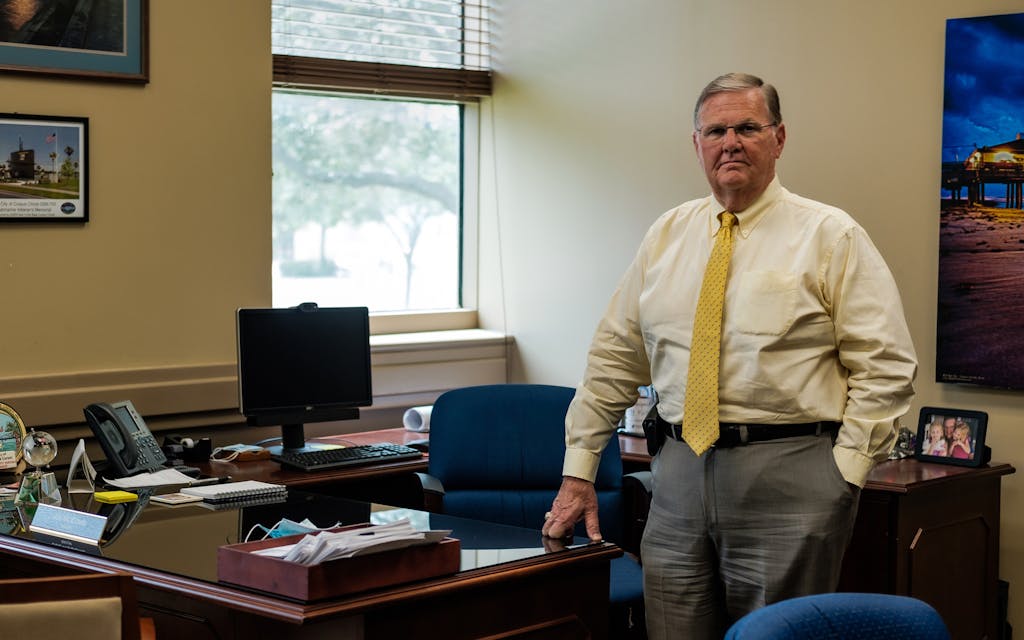 Then Mayor Joe McComb, in July 2020.Christopher Lee/The New York Times via Redux “That was a real game changer . . .”
Desalination plants suck up water, remove the salt and impurities, and route the clean remainder to users. Solid impurities are gathered for landfill disposal, while the watery discharge is typically released back into the wild, a brine salty enough to smother marine life. For every gallon of clean water produced, there’s a gallon of discharge.
One concern about Corpus Christi’s Inner Harbor desalination plant is that this brine won’t dilute in the shallow, salty bay and will create hypoxic dead zones in shoreline areas where many aquatic creatures spend their young lives. Comparable projects, like one in Tampa, feature long, open channels where the discharge can mix with fresh water and air before being released, making less salty, more oxygenated and less dangerous. The Inner Harbor plant would rely on underwater nozzles to diffuse the brine. Studies done as part of the permitting process indicated that the bay could safely absorb the elevated salt levels.
But two Texas A&M University–Corpus Christi scientists were commissioned by the city in 2019 to investigate how the Inner Harbor discharge could affect local waterways. The researchers determined that the best place for a desalination plant to discharge its brine would be entirely outside the bay, in deeper, more turbulent water. Harbor Island could be such a place, if that project releases its brine into the Gulf rather than into a nearby shipping channel. Its developers are seeking permits for both options.
In 2020, councilwoman-at-large Paulette Guajardo ran for mayor against McComb. After previously voting to approve Inner Harbor funding, during her campaign Guajardo voted against the project, citing increasing costs. The stance helped her differentiate herself from McComb, whom she unseated in a December runoff.
After the election, with the reservoirs still low, Mayor Guajardo pivoted again to support the Inner Harbor plant, and the plans plowed forward. (Guajardo declined interview requests.) Contractors vied for the marquee project, and evaluating the submissions consumed months. Meanwhile, a significant increase in industrial water use had already begun. Gulf Coast Growth Ventures started its operations in January 2022, and now uses about 13 million gallons of water a day of its allocated 25 million. A new mill owned by Steel Dynamics began operations in 2023, consuming as much as 6 million gallons daily.
Grassroots opposition to Inner Harbor grew, armed with new research from reputable scientists. Scott Socolofsky, an environmental engineer at Texas A&M, in College Station, found the city’s modeling “assumes the discharge is well-mixed over the whole cross-section of the Inner Harbor channel;” he concluded that scenario was unlikely to happen in a June 2024 report commissioned by Earthjustice. Crucially, he also found the models were only useful for predicting effects near where the discharge is released, not farther away.
The discontent helped seat two new council members aligned with the environmental community, Sylvia Campos and Jim Klein, in 2023. “When they got elected, that was a real game changer for us,” said Isabel Araiza, a local activist and professor of sociology at Del Mar College. “We had somebody on the dais that was asking questions for the first time.”
By the end of 2024, the city’s reservoirs had dropped below a combined 20 percent capacity, triggering emergency restrictions, including a ban on watering lawns. Corpus Christi’s needs were increasing with each rainless day. The Inner Harbor plant was the only solution on track to provide enough gallons. Environmental concerns weren’t enough to stop it, but something else soon would: sticker shock.
“$1.2 billion is too high . . .”
Long hours of bitter debate engulfed the Corpus Christi City Council chambers on the night of September 2, 2025. Tempers were high. During the marathon meeting, anti-desal protestors disruptively chanted “Say no!” and police escorted several out in handcuffs.
The council had been sucker punched two months earlier by the rising construction costs of the Inner Harbor plant, which had nearly doubled to $1.2 billion. The overruns were partly because the city had increased the plant’s proposed capacity to 30 million gallons per day. At the meeting, council members took their displeasure out on their consultants and the contractor.
Guajardo was now the project’s staunchest defender, while other members who had supported it, including Carolyn Vaughn and Everett Roy, had joined Campos in opposition. Word of flagging support for the project had reached Austin, and Vaughn revealed that she’d received a call from the governor’s chief of staff, Robert Black.
“He told me I should be a leader and vote yes on desal,” she said, her voice raspy nearly twelve hours into the meeting. “Then he said if I didn’t, Corpus Christi would receive no future state funding.” She extended one finger, accusingly, as her voice hardened. “No matter who holds office, Republican or Democrat, no one has the right to abuse their influence by intimidating a city council member into voting a certain way,” she seethed. “He called the wrong girl.”
At 1 a.m. the wheels officially came off the project. The council voted 6–3 to halt the contractor’s work on the design. The move would cost the city $122 million in debt service over the next decade and jeopardize hundreds of millions more in approved state funding. “It’s not wrong to cancel a project when costs have spiraled out of control,” Vaughn said. “$1.2 billion is too high a price.”
Inner Harbor’s uncertain fate raised the ire of Governor Greg Abbott, who decried the waste of the state’s funding and had suggested Austin leaders could take over the project. In the following months, the city heard pitches from contractors offering less expensive options for building the desal plant. But in early June—after national headlines raised the specter of Corpus going full Mad Max, and the city’s credit ratings started to dip—the council nevertheless voted 7–2 to postpone any further consideration of Inner Harbor until September to give time to analyze the far-reaching impacts to the bay.
Desalination supporters decried the vote. “For the second time in six months, the Council could have taken meaningful steps to meet the long-term water needs of their citizens,” Robert Black said in a release. “Instead, they chose to bicker, blame, and hide behind excuses and ‘studies’ rather than take action.”
McComb disparaged the demand for more analyses, saying those required during the permitting process were sufficient. He characterized opponents of the plant as engaging in stall tactics. “At some point you run the cost up,” he said. “And you run down the nerves of the people trying to promote it.”
Controversies over the Inner Harbor plant have fed energy to foes of the city’s water policies. Araiza’s organization, For the Greater Good, successfully led a petition drive for a city-charter amendment to eliminate a drought-surcharge exemption for industrial users that the city council approved in 2018. “There’s a whole ecosystem here of groups and organizations now,” Araiza said. “I don’t feel that there’s apathy.”
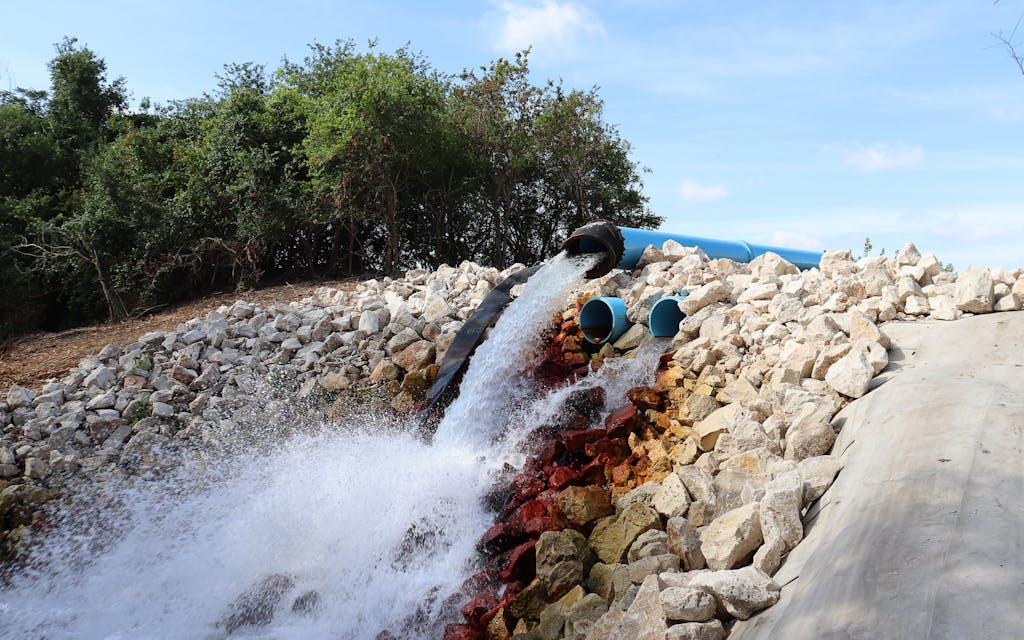 Water pumped from a Nueces County aquifer in the Western Well Field, one of the city’s few new water projects.Joe Pappalardo“Our water situation is an unbounded problem.”
Thirteen years ago, James Dodson publicly urged the city head off a crisis like today’s. He appeared at a water conference sponsored by the United Corpus Christi Chamber of Commerce. By then he’d joined the private sector. His presentation called for “drought proofing” by developing more groundwater supplies, storing excess water in aquifers to better protect it from evaporation, and reusing industrial wastewater, as well as pursuing desalination. Of the options beyond desal, all the city did was commission an analysis of aquifer storage. That was finished in 2019, only to be shelved.
All of the projects Dodson had advocated are now part of $1 billion in infrastructure investments the city council has agreed to make, mostly since February this year. A voluntary program is being organized with refineries to use reclaimed wastewater in place of drinking water. (Both the city and industry are paying for the necessary equipment.) The plans for aquifer storage are being dusted off and funded. Groundwater wells on city-owned land in unincorporated Nueces County, long ago shut down, are being redeveloped to produce as much as 25 million gallons a day when finished this fall.
Optimism increased after July’s epic rainfall. The city’s reservoirs rose above a combined 40 percent but never crested the 50 percent level that would get Corpus out of an official, city-designated drought. The watershed’s recovery certainly won’t be enough to meet the city’s long-term demand. “It rains and you say, ‘I didn’t have to do anything after all,’ ” warned Montagna, of the Harte Research Institute. “That’s the perverse cycle we’re in. But the problem’s not going away.”
Even with a reprieve, Corpus Christi doesn’t yet have the infrastructure in place to fill the next anticipated supply gap. “The projects that the city is making progress on don’t provide enough water, and the projects that would get you in a much more comfortable position are being challenged,” said Paulison, of the Coastal Bend Industry Association. “Our water situation is an unbounded problem.”
The Inner Harbor plant, even if green-lighted immediately, wouldn’t start operating until 2030 at the earliest, too late to avert the now-delayed crisis. And, just last week, the city council again rejected the project. “I want desal, but I want it in the right place,” said council member Vaughn. “I want the cost to be good, and I want it discharged in the ocean.” The same night as the vote, the council heard a presentation by the Harbor Island boosters. Corpus has reserved a 50 million daily gallons from that plant, but faith in that project has ebbed.
The Nueces River Authority’s Harbor Island funding has run out and design work on a critical pipeline has halted. The Texas Water Development Board rejected the NRA’s request earlier this year for $140 million. The plant lost out to other contenders for the limited state funding. The chances of the city taking over at Harbor Island and committing the necessary billions appears to be nil, especially while the lower-cost Inner Harbor project remains an option.
Corpus Christi’s voluntary industrial reuse program will save only 1.5 million gallons a day by December, and just four times that by next June, the city reported. The program’s overall aim is to save 16 million gallons a day by 2028, which would represent about a 25 percent reduction in overall industrial use. That’s an admirable target, but not enough to change the trajectory toward the coming emergency. “I don’t believe we can conserve our way out of this,” Montagna said. “I think the problem is beyond that. It’s too big.”
The Nueces County groundwater wells have failed to produce as much as was hoped because the water extracted is extremely salty. The city has been using the Nueces River to transport the water to its treatment plant, and state law limits how much briny fluid can be released into the river at once. In response, the city has funded a $1.7 million water pipeline to bypass the river, to be opened this winter. Tapping the wells also spurred a backlash among neighboring locals who worry their private wells will diminish and land will subside. Some residents are organizing a local groundwater conservation district to institutionalize the resistance.
In San Patricio County, city-owned wellfields face even more opposition. In June, the existing groundwater conservation district there refused to issue a permit to Corpus Christi. The city and conservation district have been locked in negotiations since then. Corpus had hoped to produce 24 million gallons daily from wells in the county.
Underground water may be plentiful because it’s been gathering for millions of years and protected from evaporation, but it recharges so slowly that it can’t be counted on as a regular supply. About 60 percent of the state’s water comes from aquifers, the vast majority of it used for agriculture. But their use has been trending down since 2020 because they’re running low and getting saltier.
Meanwhile, 20 percent of the city’s supply comes from the drought-diminished Colorado River, and Corpus Christi’s rights to that water are junior to those of other users upstream, such as Austin.
Amid this kaleidoscope of environmental and economic concerns, Corpus Christi has a general election on November 3. The mayoralty and all eight council seats are being contested. In August, Guajardo faced impeachment for alleged ethics violations unrelated to the Inner Harbor and was punished with a thirty-day suspension. She maintained that the removal attempt was orchestrated by desalination critics.
With an embattled mayor, two council members stepping down, and two others facing term limits, the chances of a full-scale changing of the municipal guard seem high. Water issues will no doubt be front and center, with the fate of the Inner Harbor plant to be decided by the new council. The future of the city’s supply is therefore subject to the biggest variable of all—the mood of voting-age Corpus Christians.
“People are scared to buy houses . . .”
Gary Chapman leaned over from his stool at Vernon’s, cell phone screen glowing brighter than the dive bar’s dim overhead lights. It displayed a photo of an acre and a half of dry, cracked dirt on his family’s land near Victoria, about 85 miles north of Corpus. The parched terrain was once a pond, eight feet deep. “I’m sixth generation, and this land has been in my family since the 1800s,” he said. “This has never happened before.”
Chapman, an electrician whose firm often does work for area refineries, was staunchly in favor of desalination and said it should have been done years ago. “Get it over with,” he advised.
On Third Street, four blocks off Shoreline Boulevard, Vernon’s has been around since 1948. It opens at 7 a.m. every day. Nowhere, except maybe an emergency room, offers a more heterogeneous sample of Corpus residents.
“I love the characters who come in here, the regulars who’ve been coming here for seventy years,” bartender Catherine “Cat” Harper told me, seated at a picnic table on Vernon’s back porch. A transplant from England, she moved to Corpus 26 years ago and has worked at Vernon’s for the past seven. “On any day, we’ll have just somebody down-and-out sitting next to a surgeon or a lawyer.”
One common topic among all strata of customers at Vernon’s has been the water crisis. “People seem to be more and more concerned about it as time goes on,” Harper said. “I would say it’s turning more angry at this point, just because people are sick of nothing being done.”
The part-time bartender makes most of her money as a real estate agent, but she hasn’t sold a home in about a year, she says, because of the water crisis. “The word has spread,” she said. “People are scared to buy houses in Corpus.”
The CEO of the Coastal Bend Association of Realtors, Brian Morales, told me much the same. “Water concerns are absolutely entering the conversation,” he said. “We received many reports from agents who have had buyers, tenants, and commercial investors pause their searches or walk away from deals entirely due to anxiety over long-term water security. This is especially true for relocation buyers coming from out of town.”
The Texas Water Development Board reported in 2025 that over recent years, even as industrial use has grown, residential use has fallen. The population in Corpus has essentially flatlined since 2019, and such water savings are typically attributable more to the use of efficient household appliances than to any overt conservation efforts, according to a Texas A&M survey. Industry now uses more than half of the Corpus water system’s available supply, according to the city.
The Port of Corpus Christi is now the third-largest exporter of crude oil in the world. The second quarter of 2026 was the most productive in its history. According to the state’s regional water plan, municipal use in the Coastal Bend region is expected to only slightly increase in the decades ahead, outpaced by industrial demand.
This actually helps explain the city’s imperative to continually grow. With a flattened population, economic growth becomes even more important. If both are stagnant, the tax base would sputter, investments for public infrastructure would suffer, and the dearth of employment would drive away young people who would otherwise stay for a blue-collar job. An industrial slowdown could send the city into a downward spiral instead of reaping the windfalls of the ongoing U.S. energy boom. Try selling a house then.
The future direction seems clear. This June the port authority started negotiating a long-term lease with global logistics leader DP World to develop and operate a container terminal in the Inner Harbor. It’s not a water-intensive project, but port authority CEO Kent Britton called it “another important step in our long-term strategy to expand the port’s capabilities, deliver greater value to our customers, and ignite investment in the Coastal Bend.”
For those who already see an imbalance between available water and the current obligations of the city, the idea of more development is worrisome. “We know the economy is growing. We know that means our industrial capacity will grow. We know we’re going to need more and more water,” said Montagna, the Harte Research Institute hydrologist. “I can’t help but believe that it’s going to get worse.”
Despite this ominous prediction, I don’t regret moving to Corpus. The best beaches in Texas are nearby, and the food can be great. I came to a blue-collar beach town that is only a city by virtue of its usefulness to industry. Why should I be surprised when it acts accordingly? You’re welcome for the nation’s ongoing energy boom. My yard died for it.
Read Next