
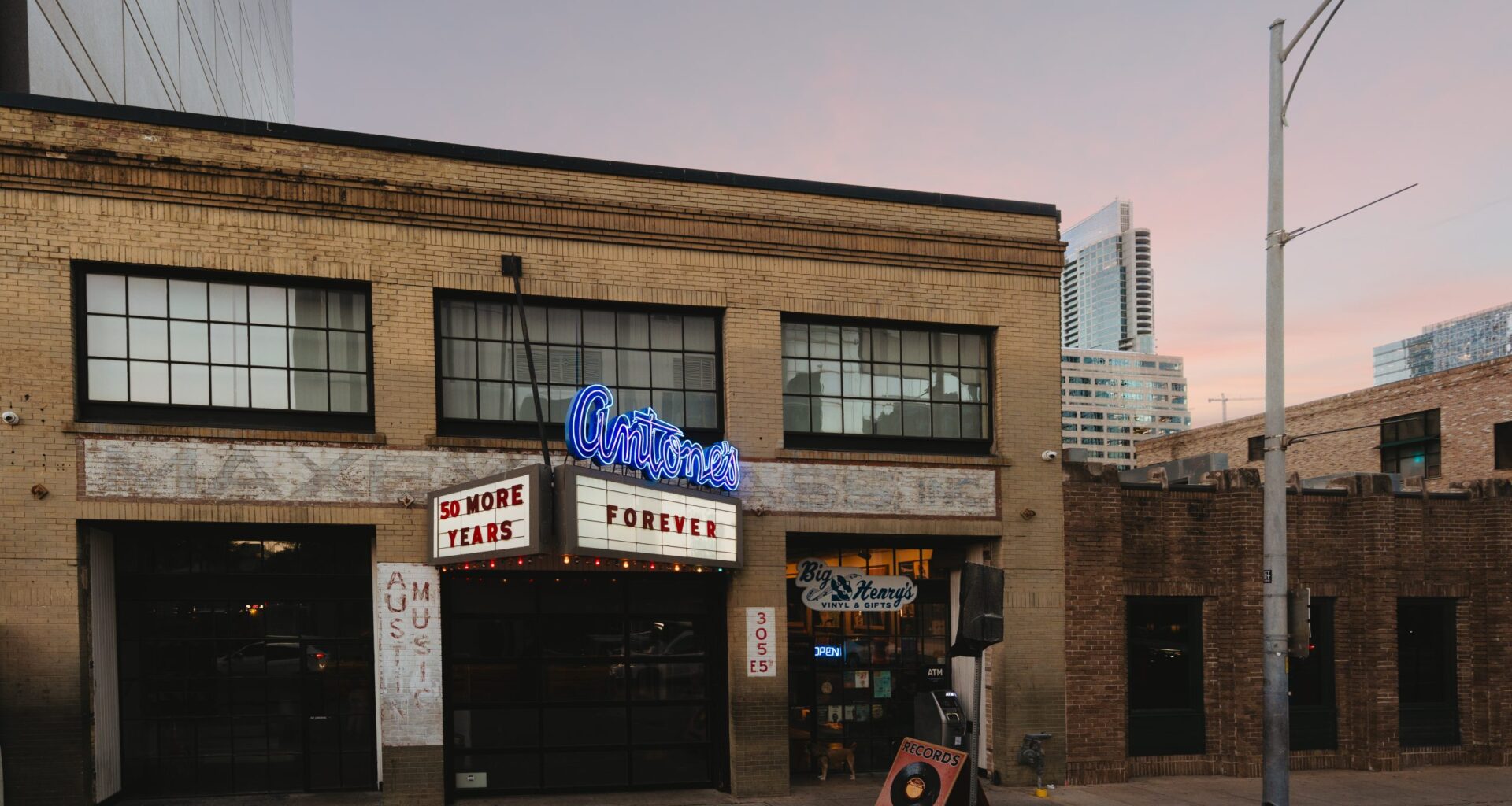
For a locally owned music venue, 50 years can feel like eternity, but the Antone’s team isn’t letting the milestone stall their imagination for the future of Austin’s Home of the Blues.
Today, still basking in the glow of a half-century of operations, co-owner Will Bridges and his team are declaring “Antone’s Forever,” announcing a freshly inked 50-year lease for the club’s Downtown location, a pending museum on the building’s second story, and the creation of the Antone’s Forever Fund to protect the venue’s legacy for the next 50 years and, ideally, beyond.
Bridges and head booker Zach Ernst tell the Chronicle that picturing a 100th anniversary for Antone’s is difficult even for them, but, with a decade leading the historic venue under their belts now, they’re ready to step into a new era.
“People of our generation will be the 89-year-old bluesmen at that time,” says Ernst. “There are some kids who are 15, 20, 25 that are really the real deal, and hopefully Antone’s can be a home for them.”
It was real estate nonprofit Rally Austin’s Iconic Venue Fund, which helped fund similar lease extensions for Hole in the Wall and Empire Control Room & Garage in recent years, that catalyzed thinking differently about Antone’s’ future. With the program in mind, Bridges approached the venue’s landlord about a long-term lease to qualify them for the fund’s financial support.
“He ended up coming to the table and blowing us away with his generosity,” Bridges says. The stability felt wildly unprecedented for the scrappy club, now in its sixth home. Signing the lease gave Bridges, his team, and the Antone’s board of directors the opportunity to shift their mindset, finalizing a $1.3 million investment deal from Rally Austin and embracing the storied stage by officially launching a long-discussed museum project and conservation fund.
“The light bulb moment for us was using the milestone and the achievement of the 50th to get out of the granular street fight of running a music venue day-to-day and graduating into this more preservation and development mindset,” says Bridges. “We just want to really lean into that and own that role unabashedly, and continue to be a beacon for [the] Live Music Capital of the World, Austin, the blues, Clifford’s legacy, all these things.”
The Antone’s World Famous Museum of the Blues, expected to open in 2027, is a pivotal part of that role.
“It’s centered around Antone’s, but it’s also a story of Austin’s live music history and a story of the blues,” Bridges says. “We brought in some other historians and experts to help us kind of show where Antone’s is in [the] overall blues history universe, and how it all fits together.”
Inspired by Memphis music museums like Sun Studio and Stax Museum, Bridges says the curators plan to “pack a lot of punch into a small space,” recreating eponymous club founder Clifford Antone’s office and displaying key memorabilia from musicians who made their mark on the scene.
The first item the group received, which Ernst says “set the standard for how cool this stuff has to be,” was an original Nudie suit made by the great Rodeo Tailor and worn by Billy Gibbons of ZZ Top. “It was on display in the club for a while as a proof of concept during early talks about the museum,” Ernst says. A custom-stitched suit that Doug Sahm wore on his first Austin City Limits appearance and a stageworn suit of Freddie King’s will also be on display, highlighting the fashion of Austin in the Seventies, when the club first opened.
“We bought a significant swath of Clifford’s record collection, a lot of originals, a lot of Seventies and Eighties pressings that were informing his taste as he developed the club,” Ernst, Antone’s protégé, adds. The record collection, he feels, speaks to the founder’s personal taste, which would ultimately become “really critical to the way that Antone’s became a melting pot and launched new generations of blues artists.”
When Bridges, geneticist Spencer Wells, and Austin blues star Gary Clark Jr. resurrected the club at its Fifth Street location in 2016, they knew they were stepping into big shoes. Making the venue viable and infusing enough authenticity into the new location to pass what Bridges calls “the sniff test of the older generation” felt like big enough tasks.
“There’s no amount of money or development that will make or break Downtown,” Bridges told the Chronicle in 2015, when they first secured the space. “What it needs is cultural investment and that’s our generation’s responsibility.” The venue owner seems to feel that responsibility just as much now, describing their next steps as a “growing up moment.”
“We’re not the kids anymore. We’re in our forties, and now we’re kind of the experts, and we shouldn’t shy away from creating the framework and the mechanisms we need to make sure this stuff gets the support it needs so it’s going from surviving to thriving,” says Bridges.
A note to readers: Bold and uncensored, The Austin Chronicle has been Austin’s independent news source for over 40 years, expressing the community’s political and environmental concerns and supporting its active cultural scene. Now more than ever, we need your support to continue supplying Austin with independent, free press. If real news is important to you, please consider making a donation of $5, $10 or whatever you can afford, to help keep our journalism on stands.