
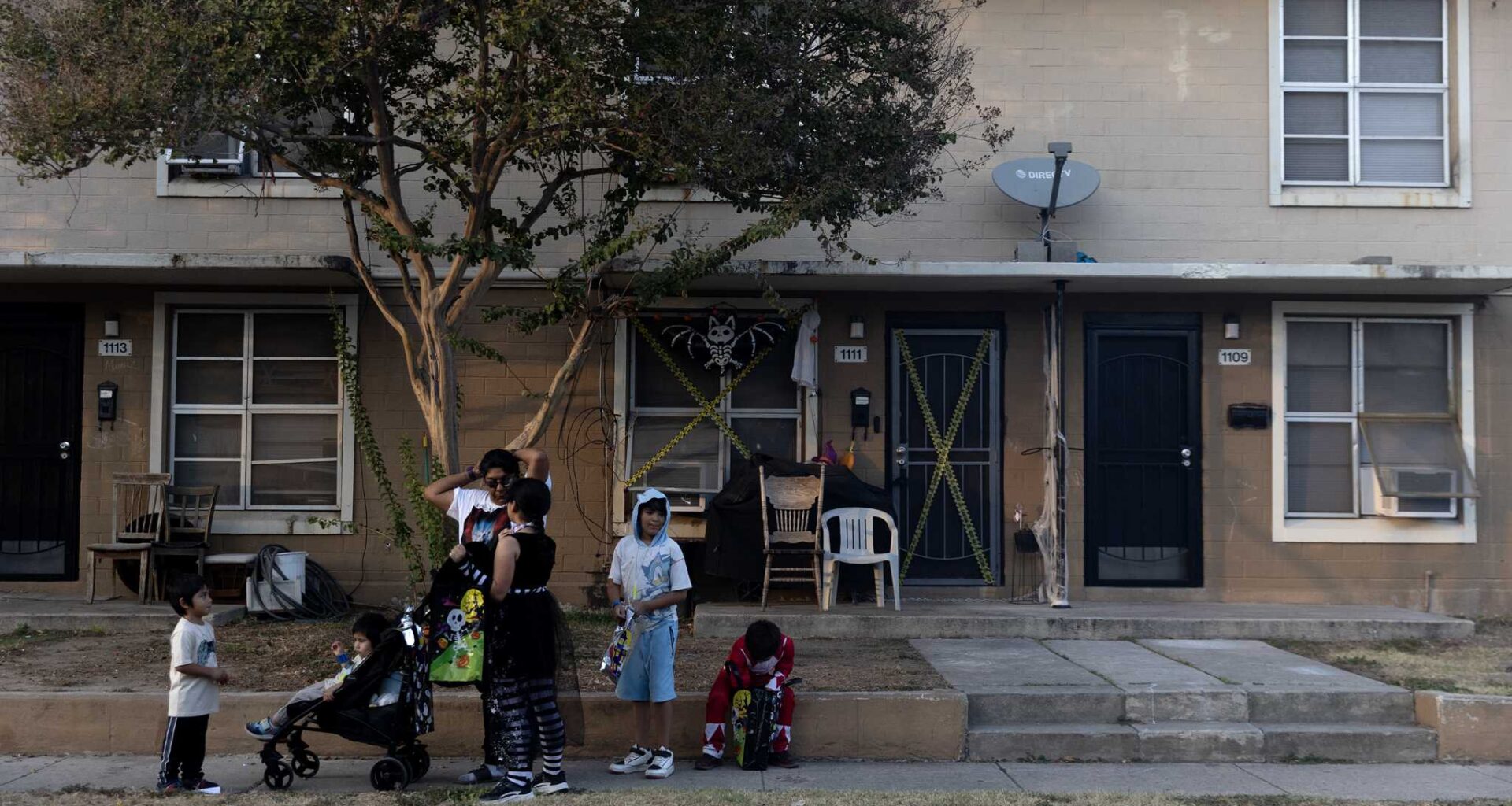
A family walks through the Alazán-Apache Courts while trick-or-treating. Opportunity Home San Antonio, which owns the apartments, last summer unveiled a plan to put $2.5 billion into repairing, acquiring and building housing.
Jessica Phelps
A family at Alazán-Apache Courts prepares to go trick-or-treating. Opportunity Home San Antonio, which owns the apartments, last summer unveiled a plan to put $2.5 billion into repairing, acquiring and building housing.
Jessica Phelps
Alazán-Apache Courts was built in the early 1940s, and it shows.

Residents of San Antonio’s largest public housing community lack central air conditioning in their cramped cinder block apartments, leaving them sweltering in the summers. Dryer hookups are non-existent. There are no elevators for those unable to climb stairs to the second floor of their building.
Article continues below this ad
Yet these aging West Side apartments, owned by Opportunity Home San Antonio, are a critical safety net for some of the city’s poorest families.
Opportunity Home, the city’s public housing authority, also owns Snowden Living in the South Texas Medical Center area.
But beyond sharing the same landlord, the two properties have little in common.
Snowden Living opened in 2025, and the modern complex is geared toward renters aged 62 and older at a mix of income levels, from low to moderate. Along with central heat and cooling and in-unit washers and dryers, tenants have access to a pool, beauty salon, dog park and theater room.
Article continues below this ad
Opportunity Home earlier this summer led a tour of both apartment complexes to illustrate why the housing authority plans to put $2.5 billion into modernizing, developing and acquiring at least 14,500 units through 2037.
After decades of sagging federal funding, Opportunity Home’s leaders say they have to find more sources of revenue to maintain the organization’s properties and build more affordable housing. The money for their new initiative is expected to come in part from issuing bonds, lining up private investors and striking deals with developers, along with federal programs.
Many of the new apartments Opportunity Home wants to build will be out of reach of residents like those who live at Alazán-Apache. Only 500 of 5,500 units the agency is proposing would be for families making up to 30% of the median income, which is the housing that’s most in demand in San Antonio.
But federal laws and a lack of funding mean agencies have largely stopped building traditional public housing for renters with the fewest means.
Article continues below this ad
“This morning you visited the past, and right now you’re in the future,” CEO Michael Reyes said at an event at Snowden Living unveiling the organization’s proposal.
Opportunity Home serves more than 65,000 people, including about 18,000 who live in its public housing units or use vouchers to find options owned by private landlords. Its leaders want to rehabilitate at least 6,000 public housing units — potentially including Alazán-Apache — and 2,500 mixed-income units by making major structural repairs, updating mechanical systems and adding amenities.
“Fellow neighbors live in conditions none of us will accept for our own families,” Reyes said.
With the new housing Opportunity Home wants to build, more than half of the units would be for people earning at least 61% of the median income in the area, which is $100,600 for a family of four, according to the U.S. Department of Housing and Urban Development. Another 1,250 units would be for people earning 51-60% of the median income and 750 for people making 31-50% of the median income
Article continues below this ad
Land for new projects could come through deals with local governments or nonprofits, with whom Opportunity Home says it wants to hash out agreements for swapping or banking properties for development.
The agency also wants to purchase 500 units.
Buying complexes can be cheaper than building new housing and provide options for residents in areas where there’s little in their price range, said Aiyana Longoria, Opportunity Home’s chief strategy, data and innovation officer. The agency estimates the average cost to build a new affordable apartment is $300,000.
Where’s the money coming from?
About $1.5 billion of the $2.5 billion is already in the works through low-income housing tax credits, Reyes said.
Article continues below this ad
Developers sell credits to investors, who can offset their tax liability by providing money for a project. The tax credit program has become one of the primary ways housing authorities finance subsidized apartments.
Opportunity Home expects to get another $800 million from capitalizing on its recently won status as a credit-rated organization that can issue revenue bonds and make loans — options it can tap to pay for repairs and new housing.
Credit-rating agency S&P Global Ratings gave Opportunity Home an A+ rating, which is attractive to investors buying its bonds. The rating signals its bonds would be relatively safe investments. The agency take on debt at lower interest rates, which can help bridge funding gaps for projects, its leaders said.
“It’s an opportunity for financing in a space where there isn’t much financing,” Reyes said.
Article continues below this ad
For another $200 million, Opportunity Home is turning to a federal program called “rental assistance demonstration,” which allows it to convert properties from conventional public housing subsidies to long-term Section 8 voucher contracts tied to specific properties — where owners collect rent from tenants and subsidies from the federal government.
The program was created to offset federal budget cuts. The conversion makes it easier to tap public and private capital, such as institutional lenders and investors, to rehabilitate properties rather than relying on declining federal funding. The long-term contracts provide a reliable source of revenue for prospective lenders to look at, and tenants continue to pay no more than 30% of their income toward rent. Housing authorities partner with private companies to renovate and manage properties.
Opportunity Home’s executives said the move is crucial for preserving affordable housing as it grapples with about $500 million worth of needed repairs and maintenance.
Reyes said the switch is also necessary because Opportunity Home had been using money meant for housing vouchers to maintain its properties and stem operating losses, but Congress changed the rules this year and it can’t fall back on that funding.
Article continues below this ad
“We’ve been playing with fire, and now we’re about to get burned,” Reyes said. “Now there’s no choice.”
But District 5 Councilwoman Teri Castillo, who represents the West Side, and public housing advocates are critical of the involvement of private entities in public housing, and they question whether Opportunity Home properties will be repaired or allowed to continue deteriorating.
They also say they are worried about residents having to move far from their jobs and schools while repairs are being made. After Opportunity Home’s board approved its plans last spring, Castillo criticized the move. She cited Wheatley Courts and Victoria Courts, two public housing communities that few families returned to after the properties were redeveloped to include more expensive housing.
“We cannot repeat those mistakes,” Castillo said in a statement in April. “Affordable housing is one of the most urgent challenges facing our city.”
Article continues below this ad
Opportunity Home isn’t the only housing authority looking for ways to generate revenue to keep its housing stock from further declining. Organizations across the U.S. are in “triage mode” and struggling with decades of shrinking federal support for public housing, said Steve Sherman, associate director of research at the Kinder Institute’s Center for Housing and Neighborhoods.
“The name of the game right now is austerity,” Sherman said.
‘Desperate times’
Opportunity Home also plans to create a nonprofit to raise money from charitable foundations and other philanthropies, and seek funding from the city of San Antonio’s next housing bond. The agency was the largest recipient of funds in the city’s 2022 housing bond, receiving $16.7 million to improve six apartment complexes and build five single-family houses.
Article continues below this ad
Opportunity Home also will keep partnering with developers on mixed-income complexes from which the organization earns fees. The deals are controversial because they often provide a lucrative tax break for developers in exchange for building housing that’s not usually affordable to the city’s neediest residents.
Reyes said financing housing for low-income renters is expensive. Residents of limited means can’t pay more rent, but the cost of constructing and maintaining a building is similar to a market-rate project where owners can charge higher prices. Affordable complexes often require layers of financing.
“I understand the criticism and optics from the outside, but what are housing authorities supposed to do without additional monies to keep things afloat?” Reyes said. “Desperate times require desperate measures.”
In its new plan, Opportunity Home hints that some properties may be too expensive to renovate. The organization said in instances “where rehabilitation is not feasible,” it would look to build new housing and transfer subsidies to those units.
Article continues below this ad
That could affect the Alazán-Apache Courts. Opportunity Home had for years planned to raze Alazán-Apache and work with a private developer to replace it with apartments for residents at a mix of income levels, but the organization reversed course in 2021 after residents and housing advocates pushed back.
Then-CEO Ed Hinojosa Jr. pledged to rebuild the apartment complex and drafted designs. But the organization couldn’t come up with enough funding for it and the project stalled. Opportunity Home’s board of commissioners fired Hinojosa in 2024 and Reyes was later named CEO.
The organization is beginning its shift to the rental assistance demonstration program with a handful of properties, including Lofts at Marie McGuire, Villa Hermosa, Tarry Towne and Westway.
Article continues below this ad
“We’re starting out small and slow,” said Longoria of Opportunity Home. “We want to make sure we get it right, and part of that is to help us build experience towards how we tackle an Alazán.”