
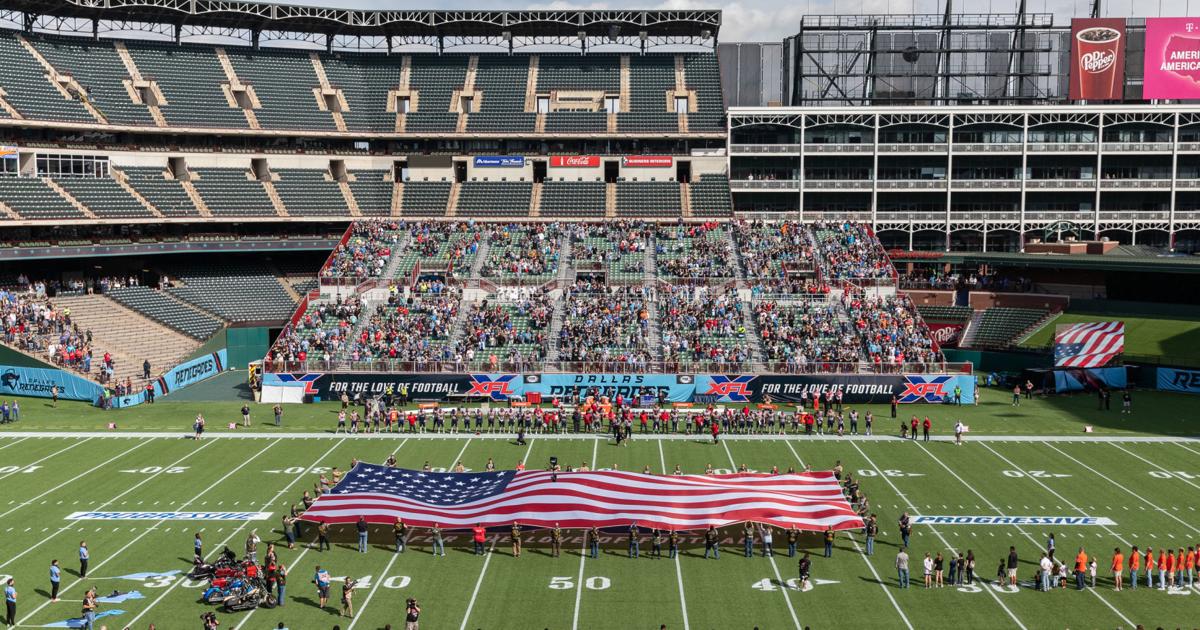

The American flag is draped across the field for the national anthem before the game against the Houston Roughnecks on March 1, 2020, at Globe Life Park.
File photo / The Shorthorn staff
Sports are seemingly tied hand in hand with the story of Sept. 11, 2001.
Some who worked in the World Trade Center who weren’t at work that Tuesday said they were running behind, having gone to bed late after watching the New York Giants play on Monday Night Football.
After the attacks, the New York Yankees and Mets sported hats honoring first responders as greats like Derek Jeter and Mike Piazza helped heal a hurting nation by doing their jobs amid uncertainty about safety.
For many, their first time being checked by a security team was while entering a sporting event, a response by athletic organizations to the possibility of further terrorism.
Twenty-five years later, UTA head coaches reflected on the tragedy.
Shereka Wright, women’s basketball head coach
In the fall of 2001, Wright was a sophomore playing basketball at Purdue University. The semester before, Purdue made it to the national championship, and Wright was named to the NCAA All-Tournament Team as a freshman.
On that Tuesday morning, while Purdue was still preparing for the season, Wright walked into her political science class and witnessed the attacks.
“I remember hearing a lot of other students saying, ‘Oh my goodness, what has just happened?’ and didn’t really know anything until I actually walked into class and we had the TVs on,” Wright said. “All you can see is buildings and fire and people running for their lives and just in disbelief of what was happening.”
She said any player who had family in the area was told to reach out to their loved ones and make sure they were safe. There were worries about coaches whose recruiting trails went through the northeast. Wright didn’t say anyone on the team was personally affected, but she said she does remember being shaken.
The attack came against a country her father made a career out of helping defend. Walter Wright was a retired command sergeant major in the U.S. Army and led an ROTC program in St. Louis. She went to high school in Copperas Cove, Texas, because her father was stationed at Fort Hood.
Shereka Wright said that as the moment’s significance dawned on her with each new piece of information, she reflected on the importance of talking to loved ones, just in case the day comes when they don’t return to be greeted again.
“That’s what really humbled us as a country,” Wright said. “Did we check on our loved ones? Did we say goodbye? You can lose somebody at that very moment that you didn’t probably even expect, or if a conversation happens because you’re mad at somebody, you just never know that that may be the last time that you see someone.”
John Sauerhage, UTA cross-country head coach
It was just a few days after the UTA Movin’ Mavs Cross Country Challenge, a cross-country meet at Vandergriff Park. The Maverick men had a fourth-place team finish, while the women had a runner finish fourth.
Sauerhage and the team had their usual early-morning practice that Tuesday. The coach, at that point in his seventh season leading UTA’s running programs, went home and made breakfast.
As he stirred his scrambled eggs, Sauerhage was watching NBC’s “Today” show, where he witnessed the unthinkable. As the crew discussed the first plane, the second one came on-screen and proved everyone’s worst fear.
“All hell broke loose, basically, and then I was just glued to the TV, almost like a ‘you drop your coffee mug’ type deal,” Sauerhage said.
Sauerhage said he then witnessed as everything turned from discussion about the difficulty of getting those still in the towers out to the worst-case scenario for those still trapped when the buildings fell. Then came the news from the Pentagon. And then from Pennsylvania.
The absence of air traffic over Arlington that day was jarring, he said. The planes that were always coming through the city to either land at or leave the Dallas-Fort Worth International Airport were nowhere to be seen after the American airspace closed and all flights were grounded.
The cross-country team didn’t compete or practice for the rest of the week. They would meet two days after the tragedy.
“We all said a prayer. We talked about if you need to go see somebody, talk to somebody, do that. But this, it was very guarded reassurance to the student athletes that we’re going to try and move forward,” Sauerhage said. “We’re going to try our best to not let terrorism take over our daily lives. We’re going to go about our business.”
Although he found it more convenient to meet recruits at the airport gate instead of baggage claim, Sauerhage said he’s thankful for the heightened security.
“Don’t take anything for granted. Life’s short,” Sauerhage said. “Be a little suspicious of things, and yet don’t let it change how you go about your life. But keep your ears and eyes open on things. Just be a little more aware of your surroundings.”
@TyRoland06