
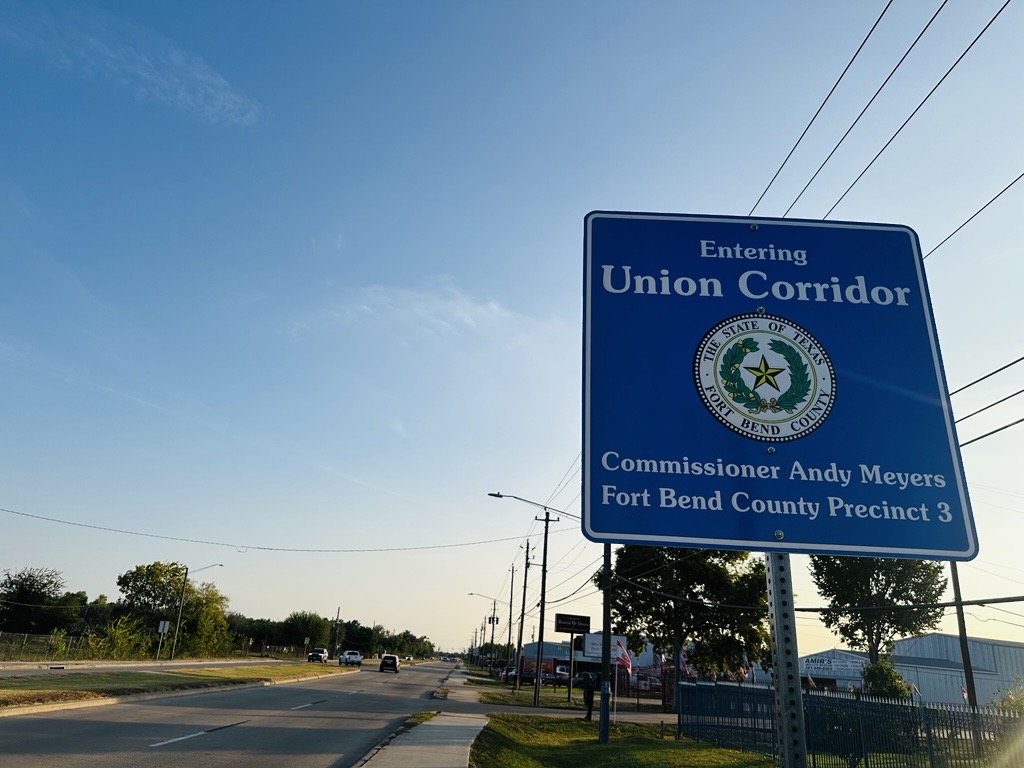
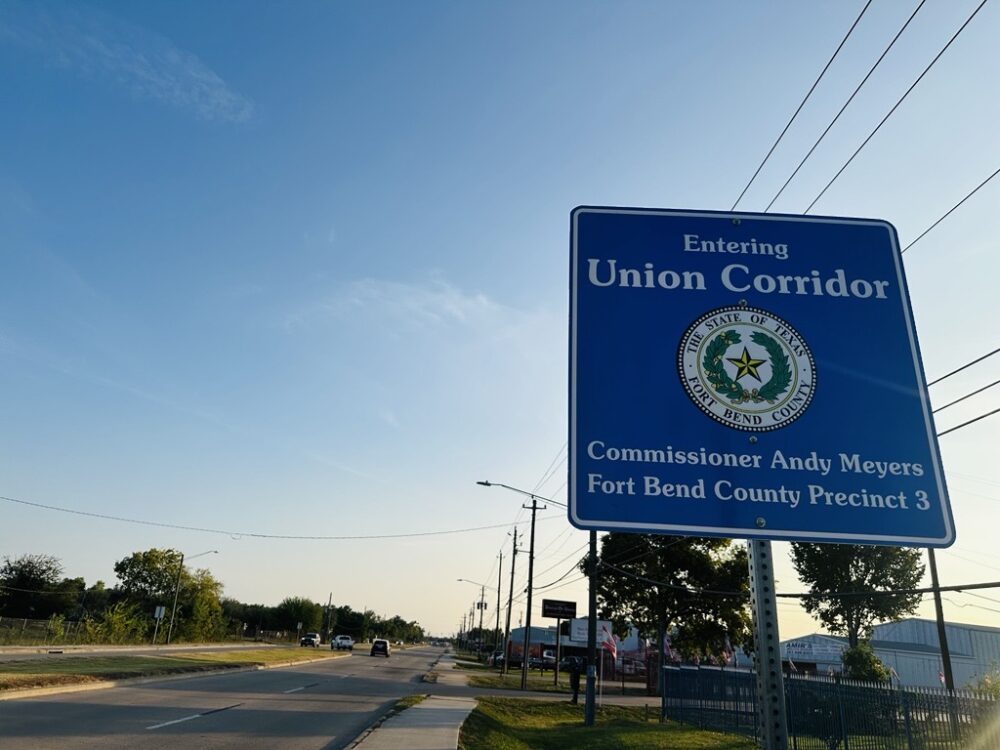
 Union Corridor — a roughly 0.7-mile stretch of Synott Road in Houston’s southwest suburbs — is home to several different houses of worship.
It’s an early October evening at the Sri Ashtalakshmi Temple in Sugar Land, and priests are performing a puja – an act of worship.
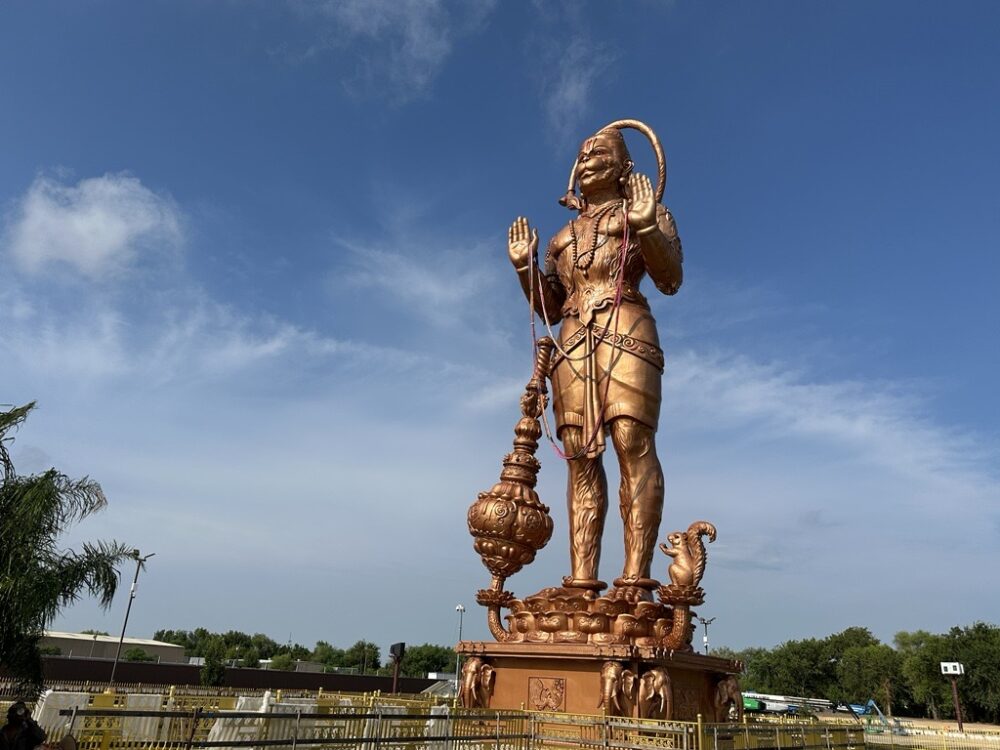
Dozens of faithful sit in folding chairs in the temple’s courtyard near a 90-foot bronze statue of the Hindu deity Hanuman. They’re at the temple for Dussehra, a holiday celebrating the triumph of good over evil.
Aparna Kaliyur is one of them.
“We all have come from different parts of the world and being here — being able to experience what we had experienced since childhood in a place that is so far from home — I think that is pretty satisfying,” she said.
Click here for more inDepth features.
The temple is one of at least eight places of worship located along Union Corridor – a roughly 0.7-mile stretch of Synott Road that connects Houston to its southwest suburbs in Fort Bend County.
For local religious and civic leaders, the road is a mirror of the founding values of the United States.
It’s a place where people of different cultures and faiths – many of them immigrants – can work alongside each other, and religious freedom and tolerance are celebrated.
“We can practice any religion,” said Venkatesan Srinivasa Iyengar, the Sri Ashtalakshmi Temple’s coordinator. “That is important – that freedom the country gave to every one of us.”
Natwarbhai Patel shares a similar view. He’s a member of the International Swaminarayan Satsang Organization, which runs a different Hindu temple next door.
“We try to understand the divinity among everybody, rather than just myself only,” he said. “So we see God in everything, in every atom of the world.”
A tradition of interfaith cooperation

Priests perform a puja at the Sri Ashtalakshmi Temple on Oct. 2, 2025. (Photo Credit: Natalie Weber / Houston Public Media)

Worshippers gather at the Sri Ashtalakshmi Temple on Oct. 2, 2025. (Photo Credit: Natalie Weber / Houston Public Media)

Priests perform a puja at the Sri Ashtalakshmi Temple on Oct. 2, 2025. (Photo Credit: Natalie Weber / Houston Public Media)

Candles at the Sri Ashtalakshmi Temple on Oct. 2, 2025. (Photo Credit: Natalie Weber / Houston Public Media)
The road is also home to a church, a masjid and other temples, representing Hindu, Buddhist and Cao Dai faiths.
They’re tucked between car repair shops and wooded, undeveloped land, bookended by strip malls and gas stations. Although not formally included in the Union Corridor, the nearby streets are also checkered with churches.
According to a 2023-2024 Pew Research Center study, roughly two of every three adults in the Houston area identify as Christian. Still, Harris County and Fort Bend County score high on religious diversity, the Public Religion Research Institute found in 2023.
“Houston is one of the major immigrant gateways in the U.S., and research shows that most immigrants tend to bring their religious and cultural traditions with them,” said Kerby Goff, associate director of research at Rice University’s Boniuk Institute for the Study and Advancement of Religious Tolerance.
Houston has a long tradition of interfaith cooperation, Goff said. He points to the “Three Amigos:” a Baptist reverend (William Lawson), a Catholic archbishop (Joseph Fiorenza) and a Jewish rabbi (Samuel Karff) who together advocated for civil rights for decades.
“That tradition of the Three Amigos and other interfaith initiatives in Houston have really set the stage for religious leaders and other religious communities to work together,” he said.
It’s a value championed by the region’s civic leaders as well.
Fort Bend County Commissioner Andy Meyers and his staffer, Nikita Khambe, spearheaded efforts to recognize Synott Road with the “Union Corridor” name.
For Meyers, the road is a “melting pot” reflective of the country’s diversity.
“That’s what the United States is,” he said. “You know, we’re a melting pot of a whole lot of different nationalities and different religions, et cetera. And I think that this is just a microcosm of that.”
Meyers and Houston City Council member Tiffany Thomas – whose district includes Union Corridor – unveiled the street’s sign this summer.
“These are neighbors,” Thomas said. “They clearly worked together and served together and realized that they are in it together long before we put up a sign.”
“We need to serve people”

A 72-foot statue of Quan Am at the Vietnam Buddhist Center on Sept. 25, 2025. (Photo Credit: Natalie Weber / Houston Public Media)

The outside of the main hall at the Vietnam Buddhist Center on Sept. 25, 2025. (Photo Credit: Natalie Weber / Houston Public Media)

Linda Tu, the tour guide at the Vietnam Buddhist Center, poses for a photo on Sept. 25, 2025. (Photo Credit: Natalie Weber / Houston Public Media)

The inside of the main sanctuary in the Vietnam Buddhist Center on Sept. 25, 2025. (Photo Credit: Natalie Weber / Houston Public Media)
The skyline of Synott Road is dominated by two statues: that of Hanuman, and a 72-foot figure of the bodhisattva Quan Am, which watches over the Vietnam Buddhist Center.
Linda Tu, the center’s tour coordinator, said the temple’s leaders were drawn to the area by cheap land. The community was bolstered by the wave of refugees who came to the United States after the Vietnam War, seeking a better life.
The temple hosts multiple services a week and Tu said the different places of worship along Synott Road will share parking lots when they host large events.
“We need to serve people,” Tu said. “It’s just that same purpose.”
Natalie Weber / Houston Public Media
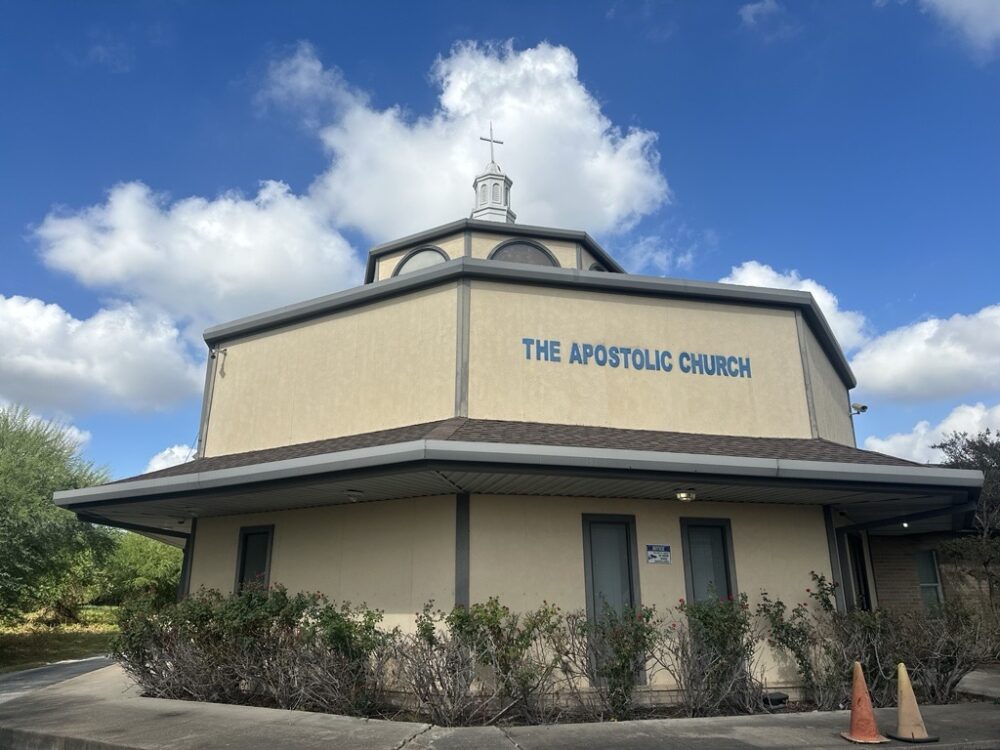
The Apostolic Church, Glorious Vision USA, Synott Assembly on Oct. 6, 2025.
Just down the road, the Apostolic Church and the Masjid At-Taqwa are also known to share parking.
Akintunde Gideon Akinlawon is the church’s pastor. Even though he doesn’t share the same faith as his Muslim neighbors across the street, he said he admires them because the masjid is always filled with people.
“Muslims value (the) Quran which is great,” he said. “And people love to follow what the Quran is giving unto them. That’s a good service to serve the Lord.”
Natalie Weber / Houston Public Media
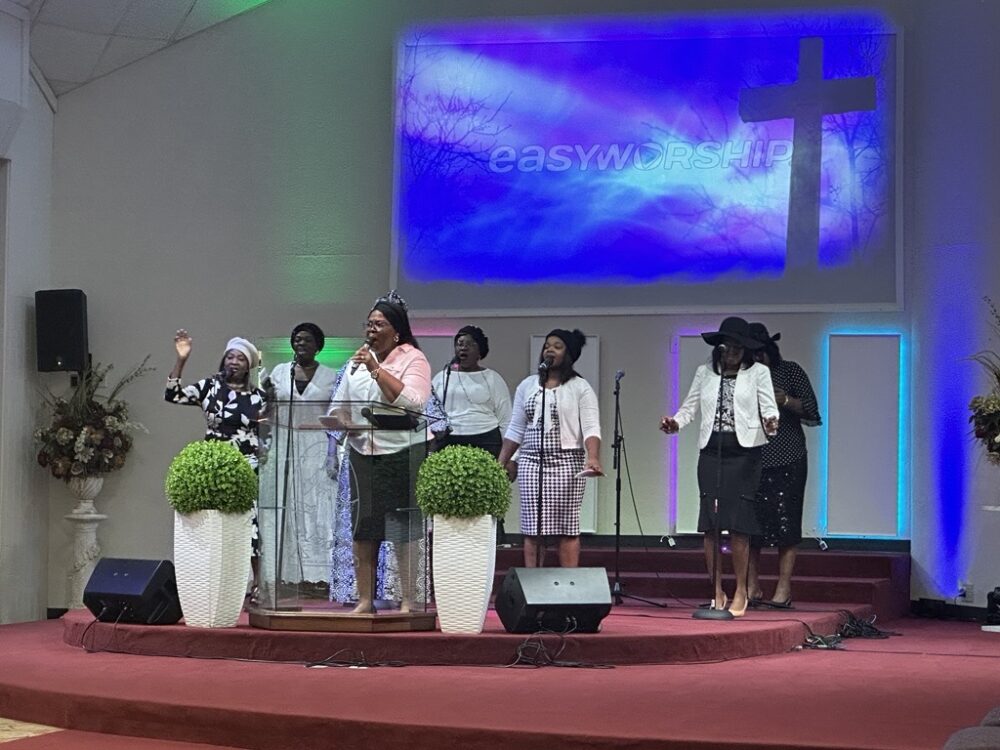
The choir sings during a service at the Apostolic Church, Glorious Vision USA, Synott Assembly on Oct. 5, 2025.
Continuing dialogue
While the road serves as a model of interreligious harmony for many, there are still sometimes conflicts.
Last year, a man sued the Sri Ashtalakshmi Temple, alleging that his son was branded during a ceremony there.
Brant Stogner is an attorney for the man and his son.
“It’s still shocking to us that this is happening just in our backyard in Sugar Land,” he said.
A lawyer for the temple did not return requests for comment.
The temple also received backlash online after it built its statue of Hanuman last year, and a group from a Houston-area church showed up to pray at the statue, prompting the temple to tighten its security.
Natalie Weber / Houston Public Media
The Statue of Union is 90 feet tall and weighs 90 tons.
Greg Gervais is the pastor of the Awakening Nations Church, which prayed at the statue last year. He referred to the statue as a “demon god idol” on social media at the time. However, Gervais told Houston Public Media that the prayer gathering wasn’t meant as a protest and he doesn’t view the statue as a threat.
“We weren’t trying to do anything hateful or harmful,” he said. “We believe that people should be able to practice what they want.”
The temple’s statue of Hanuman shares a common theme with the road it overlooks: the figure was named the Statue of Union upon its inauguration last year.
Vijay Sreenarasimhaiah, a volunteer and former board member at the temple, said the message of Hanuman is one of uniting people across differences for a common purpose. It’s in line, he said, with the values outlined in the U.S. Constitution.
“There’s nothing that’s un-American about it,” he said. “And that’s what the strangest thing is – that you might look at it as something very foreign, something alien to us.”
Sreenarasimhaiah said dialogue and education are key to building more religious unity.
“I think the Union Corridor is just one more aspect of how diverse our city is,” he said. “But we have to have that continuous conversation.”