
“See that pawn shop?” asked the man who tried to sell me an old five-gallon Igloo cooler Tuesday afternoon. “That used to be Smith’s Furniture. And that liquor store? Used to be a feed store. And next door to that was a Kinney Shoes.”
Cedric Beachum was walking along Second Avenue near Elsie Faye Heggins Street, trying, he said, to raise a few bucks for the bus. He introduced himself as “the historian of Second Avenue.” Good timing. I was out here looking for its future.
I’d been walking up and down Second, a long stretch of used-to-be described in the City Council-adopted South Dallas/Fair Park Area Plan as “once the heart of South Dallas” that has become “a shell of its former self.” You know why, too: “years of neglect, under investment, limiting development regulations and the absorption of parts of 2nd Avenue into Fair Park.”
Only, you know, The Oldest Story in Town.
Article continues below this ad
That plan talks about a future for Second that remakes it as “a walkable street with retail, restaurants, office, residential, and mixed-use buildings, with an overall focus on entertainment” — kind of like what Edward “Tex” Harris proposed in 2004, when he wanted to turn Second into Beale Street. Or what urban planner John Fregonese pitched to city officials in 2012, six years before his death.
Cedric Beachum introduced himself as “the historian of Second Avenue.” And, sure enough, he was right about everything.
Robert Wilonsky/Staff writer
Then, I’m old enough to remember when the council discussed sinking six figures’ worth of federal dollars into Second for “afrocentric-oriented entertainment services, retail and restaurants.” That was almost 20 years ago.
A couple of months back, and with little fanfare, the council authorized paying a company called Westwood Professional Services $525,000 to conduct three corridor studies — along stretches of Gaston, Beckley and Second avenues. What it means, I have no idea, as it was never discussed at committee or the full council.
Something to do with lighting, traffic signals, pedestrian markings. Nothing about busting out the defibrillator to restart the heart of South Dallas.
Article continues below this ad
I was about to grab lunch at Laura’s Sunny South BBQ when Beachum approached. He pointed across the street from where we stood: “I went to school there, back when it was called Pearl C. Anderson.” Which Watermark Community Church bought and salvaged a few years ago.
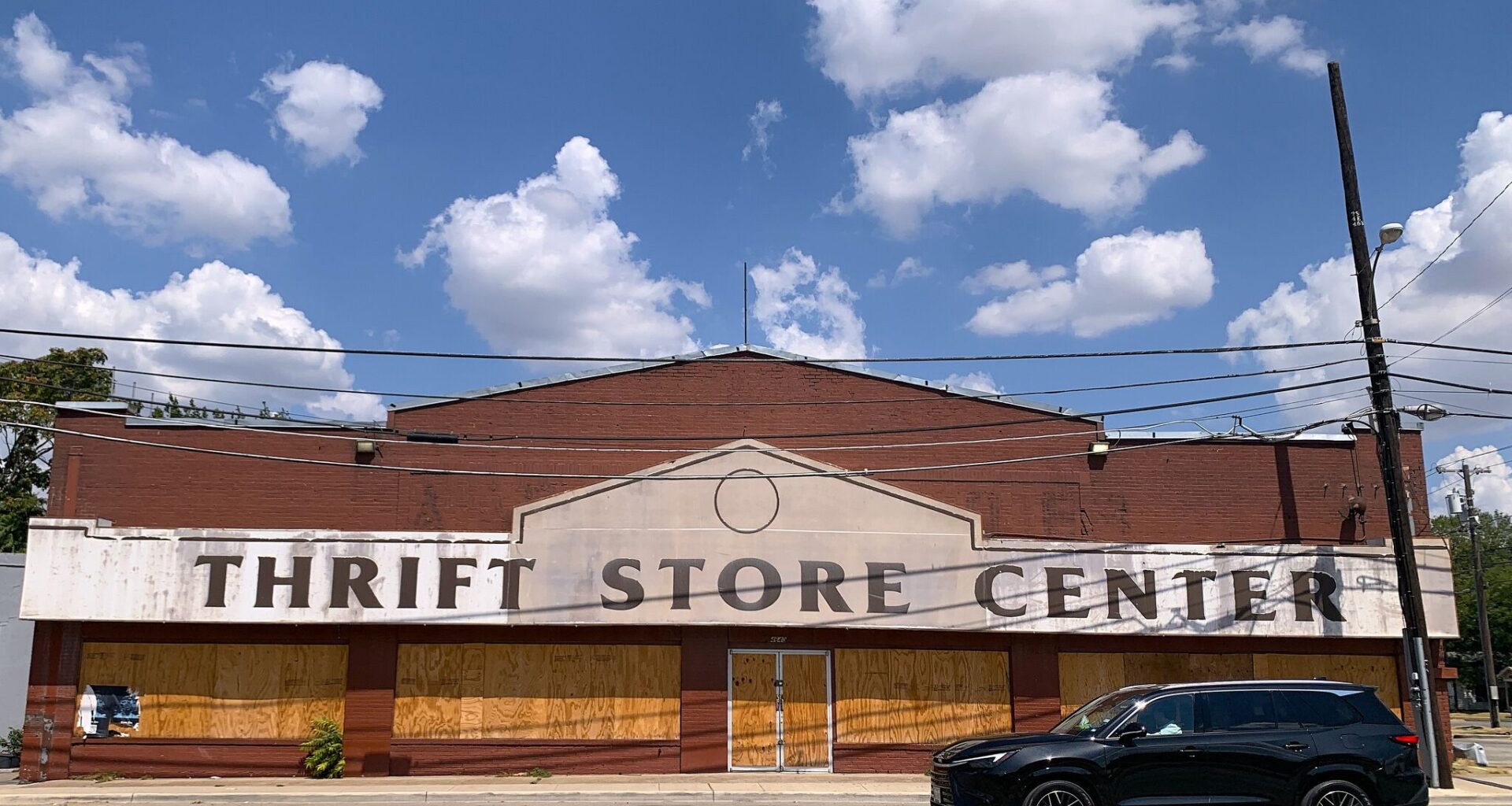
He asked if I knew about Morningside Super Market, which, in the 1950s and ‘60s, used to sit along this stretch of Second. Sure, I told him. That was the DiCarlos’ place before it moved to East Dallas and became Jimmy’s Food Store. Then he pointed toward the recently boarded-up storefront that swallows a corner of Second and Elsie Faye Heggins.
“That was a Tom Thumb,” Beachum said of the building at 4640 Second. “Long time ago.”
The Second Avenue thrift store back when business was booming.
Dallas Central Appraisal District
Which, shame on me, I hadn’t known, though my father and grandfather’s auto parts store sat up the street, where Second hits Scyene Road, from 1955 until 2009.
Article continues below this ad
But, sure enough. First it was a Toro’s supermarket, which, according to The News’ archives, opened on Dec. 11, 1946, with a performance by the Light Crust Doughboys. But Toro’s tanked within three years — something about the owner skipping off to South America, according to legend.
Suppliers Robert Cullum, his brother Charles and partner J.R. Bost wound up taking over the small chain, including the location on Second, which was referred to in 1950 newspaper ads as Tom Thumb Super Market No. 6. A few years back, Reddit debated whether it was the last of the original six Tom Thumbs.
Sometime in the 1960s, give or take, the building was converted into a thrift store that operated under numerous monikers, among them 2nd Avenue Thrift and Prime Thrift. For as long as I can recall, it’s been Thrift Store Center, where a sign posted inside the front door promised “New Stock Updated Hourly.” The parking lot was never less than packed; the front curb, always crowded. But it closed a few months back. Nobody really knows why.
“I went to school in clean clothes from there,” Beachum told me. “Neiman Marcus clothes, too! That store had everything. Stuff I’d never seen anywhere else.”
Versie Martin and Barabas Bennett on the front porch of Martin’s longtime Pine Street home. Martin said she gets calls about selling it “30-40 times a day.”
Robert Wilonsky/Staff writer
About an hour earlier, a 62-year-old South Dallas lifer named Barabas Bennett had said something similar as we stood on a Pine Street front porch, just a couple of blocks off Second.
Article continues below this ad
“That thrift store was South Dallas’ Neiman Marcus,” Bennett said. “That’s because they had everything. You needed an iron, that’s where you went. Or clothes, furniture, household items — you know, stuff. Seek, and ye shall find.”
“The prices used to be reasonable,” said Bennett, who wore a necklace made of washers and bells he’d bought at the thrift store. “But I also called it the South Dallas Neiman Marcus because if you added 49 cents more to the price of everything in there, you could have just bought it brand-new.”
I couldn’t reach the building’s longtime owners, who live in Maryland and whose numbers are all seemingly disconnected. A guy working at the tire store across the street said a store manager said they weren’t getting as much new inventory as they used to, which he didn’t believe. Not in this economy.
“That place was still popular,” Bennett said. “When I drove by and saw it boarded up, I did a double take. Maybe someone made the owner an offer he couldn’t refuse.”
Article continues below this ad
The closing sign still hangs on the Thrift Store Center, a former grocery store that sits on the entire corner of Second Avenue and Elsie Faye Heggins Street.
Robert Wilonsky/Staff writer
Bennett was over visiting 94-year-old Versie Martin, who’d come outside to enjoy a strangely cool breeze cutting through her front porch on a searingly hot midmorning. Behind her home is Opportunity Park; behind that, Oakland Cemetery. Her view is of the brand-new pavement the city just finished pouring on Meyers Street, with vacant, overgrown lots on each side that were once filled with homes whose residents Martin remembers as though they’d just moved away.
Martin said she bought this house on Pine in 1962 and receives “at least 30-40 calls a day” about selling it. She said the house was built in 1950 — “the last house built on this block.” Which would have been around the time that Tom Thumb opened.
That boarded-up thrift store, these neighbors said, is emblematic of the changes that have swept across these South Dallas neighborhoods, where two- and three-story boxes tower over countless tumbledown homes held up with plywood and hope.
The view from Versie Martin’s front porch.
Robert Wilonsky/Staff writer
“They’re just pushing over these old frame houses — whole blocks of ’em, on Birmingham and Metropolitan [avenues],” Bennett said. “They’re boarding up buildings on Second. And they’re building these houses we can’t afford.”
Article continues below this ad
I mentioned that the city’s yet again discussing the possibility of remaking Second. Bennett laughed. “Little by little, the new world order is in effect,” he said. “In 10, 15 years South Dallas won’t even look the same.”
Martin sighed and said, “I don’t think it’ll be that long.”