
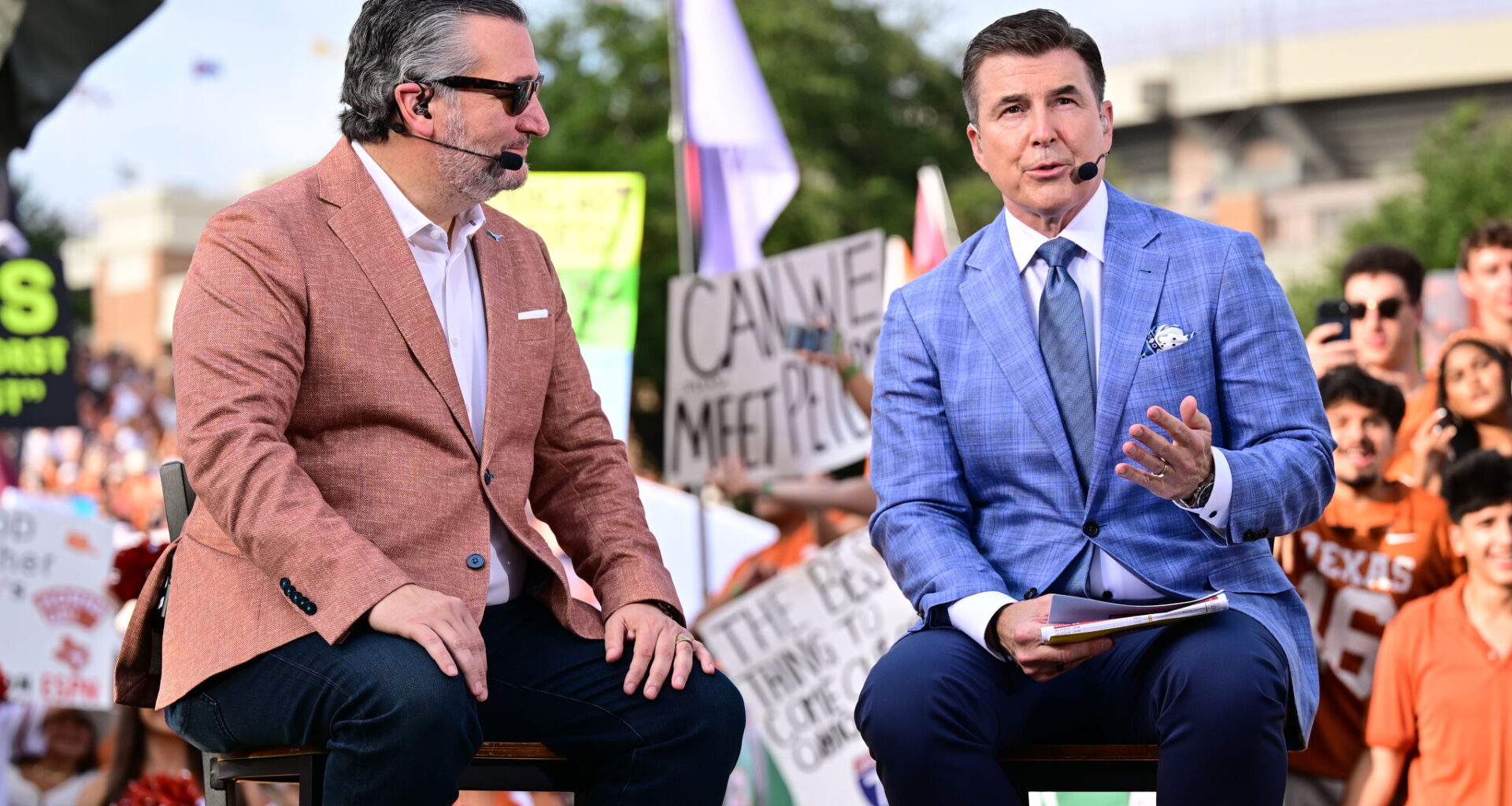
Austin, TX – September 12, 2026 – Darrell K Royal Texas Memorial Stadium: Senetor Ted Cruz and Rece Davis on the set of College GameDay Built by the Home Depot at the University of Texas.
Joshua R. Gateley / ESPN Images
Austin, TX – September 12, 2026 – Darrell K Royal Texas Memorial Stadium: Senetor Ted Cruz and Rece Davis on the set of College GameDay Built by the Home Depot at the University of Texas.
Joshua R. Gateley / ESPN Images
U.S. Sen. Ted Cruz joined the set of ESPN’s “College GameDay” on Saturday morning in Austin to push landmark legislation to regulate college sports ahead of the Texas Longhorns’ highly anticipated matchup with the top-ranked Ohio State Buckeyes.
He did not receive a warm welcome.
Cruz, clad in a burnt orange blazer, was consistently booed by the raucous crowd of Longhorns faithful throughout his nine-minute interview, with fans breaking into chants of “Ted, you suck” and “Get him off.”
Article continues below this ad
He did not acknowledge the jeers, which came on a campus that gave the senator less than 20% of the vote in his 2024 re-election. The Chronicle has reached out to Cruz’s office.
Cruz was in attendance to push the Protect College Sports Act, a bill he co-authored with Sen. Maria Cantwell, D-Washington. The legislation is scheduled for a vote in the Senate next week.
In his interview with ESPN’s Rece Davis, Cruz framed the legislation as an attempt to regain control of football, in particular, which he said has descended into “chaos,” with players transferring annually and some raking in upwards of seven figures in name, image and likeness compensation.
“There are no rules, and the situation with the transfer portal, where kids go and transfer two, three, four, five times, it’s terrible for the game. It’s terrible for the players. It’s terrible for the schools, and it’s terrible for the families,” Cruz said.
Article continues below this ad
The bill attempts to tackle a host of the most pressing issues in college sports. It codifies payments and restrictions for the use of players’ names, images and likenesses, limits athlete transfers and eligibility, tries to block further conference expansion, and carves out protection for women’s and non-revenue Olympic sports.
Arch Manning #16 of the Texas Longhorns reacts after defeating the Texas State Bobcats at Darrell K Royal-Texas Memorial Stadium on September 05, 2026 in Austin, Texas.
Tim Warner/Getty Images
Cruz painted a grim picture of the future of college sports without federal intervention. He predicted that upwards of 50 major football schools would cancel all of their non-football sports, and that “hundreds of thousands” of scholarship slots could disappear. Women’s sports, he said, would be hit particularly hard.
Cruz’s legislative push comes amid a multimillion-dollar lobbying campaign by the NCAA and major college sports conferences in support of the bill. It also comes as college football is awash in more money and eyeballs than ever, and women’s college sports participation has boomed in recent years, despite NIL compensation and loosened transfer rules.
As Cruz noted in his interview, the bill is backed by a bipartisan group of legislators, as well as almost every conference and school, several major professional sports leagues and the unions representing both NFL and NBA players.
Article continues below this ad
Last month, however, the AFL-CIO and the Congressional Black Caucus came out against the bill, arguing it limits athletes’ bargaining power by granting broad antitrust exemptions to schools that aren’t present in other industries.
And Sen. Chris Murphy of Connecticut has become a vocal opponent of the bill, describing it this spring as “a great deal for the NCAA and the rich guys who run college sports, and a bad deal for athletes.” Murphy did not immediately respond to a request for comment Saturday.
Despite the criticisms, Cruz expressed confidence on GameDay that the bill would get the 60 votes necessary to pass, as he encouraged viewers to call their senators if they wanted to “see an end to the madness.”