
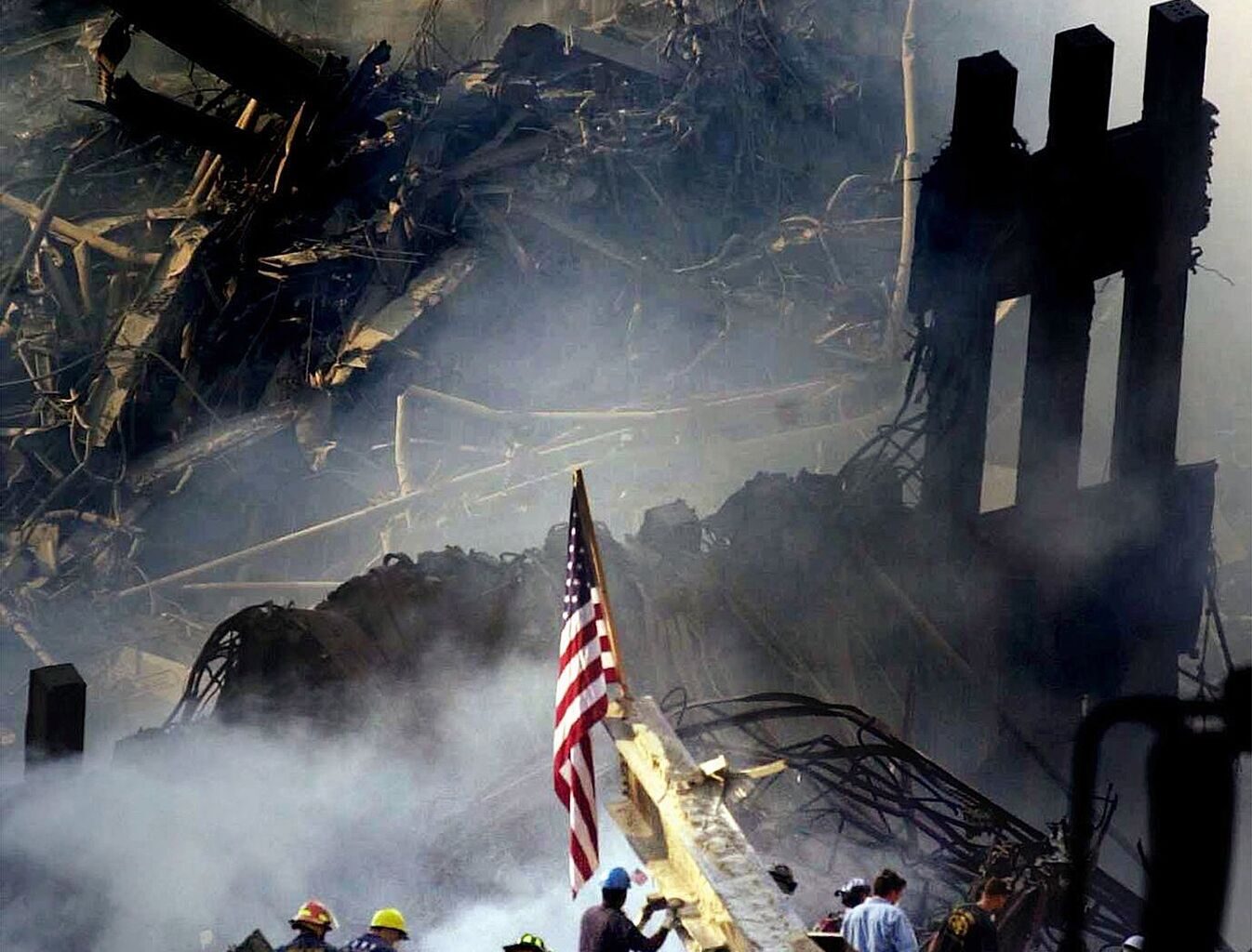
ORG XMIT: S0395648452_WIRE ITED STATES KRT Rescue workers remove a body from the debris of the World Trade Center on Thursday, September 13, 2001, in New York. (PH) NC KD 2002 (Vert) (smd) 0911xSPECIAL 09102006xNEWS
DAVID SWANSON/KRT
As Eddie Martinez thinks back to his deployment to Ground Zero 25 years ago, in the days following the Sept. 11 terror attacks, he feels immense pride. He is also afraid of what that work may have done to him.

Martinez was among 10 Austin Fire Department employees who deployed to New York as members of Texas Task Force 1, helping with search-and-rescue operations amid the tons of debris where the Twin Towers once stood. It was dangerous work that, by some estimates, has been linked to more than 49,000 cases of cancer among first responders. Martinez was the youngest member of the Austin contingent, a 20-year-old firefighter entering what became a defining experience of his career.
Article continues below this ad
“It still weighs on me,” Martinez said. “I’m grateful, at least in this moment, to be healthy. But my biggest fear is that I’ll eventually get cancer.”
Martinez, who retired earlier this year, said the first anniversary of 9/11 was the hardest, and each year since has gotten a little easier. This year has been different: The wider public has shown more interest in hearing from first responders like him, leading him to revisit his own memories and reconnect with former teammates he rarely sees.
Texas Task Force 1, which included 10 Austin Fire Department employees, deployed to Ground Zero in the days following the Sept. 11 terror attacks. While there, the team worked 12 hour shifts across ten days conducting recovery operations.
Courtesy of Eddie Martinez
Remembering, 25 years later
FILE – In this Sept. 11, 2001 file photo, smoke, flames and debris erupt from one of the World Trade Center towers after a plane strikes it, in New York. The first tower was already burning following a similar attack minutes earlier. Osama bin Laden, the glowering mastermind behind the Sept. 11, 2001, terror attacks that killed thousands of Americans, was slain in his luxury hideout in Pakistan early Monday, May 2, 2011 in a firefight with U.S. forces, ending a manhunt that spanned a frustrating decade. (AP Photo/Chao Soi Cheong, File) MANDATORY CREDIT
(AP Photo/Chao Soi Cheong/ST
A picture of civil engineer Ralph Castillo, middle, at Ground Zero one week after the September 11th terrorist attacks is seen at his home in Austin on Thursday, Sept. 3, 2026.
Mikala Compton/Austin American-Statesman
A photo of Eddie Martinez meeting the former President George Bush is displayed in his home to honor his actions and contributions to the search and rescue effort in New York City following 9/11 as part of Texas Task Force 1.
Sara Diggins/Austin American-Statesman
Texas Task Force 1, which included 10 Austin Fire Department employees, deployed to Ground Zero in the days following the Sept. 11 terror attacks. While there, the team worked 12 hour shifts across ten days conducting recovery operations.
Courtesy of Eddie Martinez
A picture of Ground Zero one week after the September 11th terrorist attacks is seen at Ralph Castillo’s home in Austin on Thursday, Sept. 3, 2026.
Mikala Compton/Austin American-Statesman
Texas Task Force 1, which included 10 Austin Fire Department employees, deployed to Ground Zero in the days following the Sept. 11 terror attacks. While there, the team worked 12 hour shifts across ten days conducting recovery operations.
Courtesy of Eddie Martinez
Texas Task Force 1, which included 10 Austin Fire Department employees, deployed to Ground Zero in the days following the Sept. 11 terror attacks. While there, the team worked 12 hour shifts across ten days conducting recovery operations.
Courtesy of Eddie Martinez
Texas Task Force 1, which included 10 Austin Fire Department employees, deployed to Ground Zero in the days following the Sept. 11 terror attacks. While there, the team worked 12 hour shifts across ten days conducting recovery operations.
Courtesy of Eddie Martinez
Civil engineer Ralph Castillo recalls his deployment to New York City one week after the September 11th terrorist attacks while at his home in Austin on Thursday, Sept. 3, 2026.
Mikala Compton/Austin American-Statesman
Retired Austin firefighter Dawn Clopton recalls her deployment to New York City one week after the September 11th terrorist attacks while in Georgetown on Thursday, Aug. 27, 2026.
Mikala Compton/Austin American-Statesman
Retired Austin firefighter Dawn Clopton has felt the passage of time through her own family.
Article continues below this ad
Her oldest niece was born in May 2001 and is too young to remember 9/11. Most of Clopton’s other nieces and nephews were born after the attacks and know about the day only secondhand — as a history lesson, not something they felt happen to the country, the fire service and their aunt.
“It’s really hitting home for me this year how unusual it is that something with so big an effect on our country and our lives happened before so many adults were even born,” Clopton said.
Retired Austin firefighter Dawn Clopton recalls meeting President George W. Bush after her deployment to New York City one week after the September 11th terrorist attacks while in Georgetown on Thursday, Aug. 27, 2026.
Mikala Compton/Austin American-Statesman
Clopton, who retired in 2017 after 33 years as an Austin firefighter, said she had stayed away from most 9/11 ceremonies and interviews over the last decade, in part because of what she described as politicians using the anniversary for publicity. This year, she decided to speak because she wanted people to hear what responders at Ground Zero actually experienced.
Article continues below this ad
One of Clopton’s clearest memories is the sound of a siren, which signaled that firefighters digging through rubble had found the remains of one of their own. It was an unwritten rule among the responders that New York firefighters would handle the recovery of remains believed to belong to another firefighter.
When the siren sounded, work stopped and quiet fell over Ground Zero. Firefighters formed two lines, standing at attention and saluting as the remains were pulled from the rubble and passed underneath an American flag.
It was raining that day, Clopton recalled, which made it easier for the mass of emergency responders to hide their tears.
“It can be hard for us to cry sometimes,” Clopton said. “But as one of my guys said, ‘Sometimes it’s good to cry.'”
Article continues below this ad
Handmade thanks
Civil engineer Ralph Castillo tears up as he looks at a handwritten card he received during his deployment to New York City one week after the September 11th terrorist attacks while at his home in Austin on Thursday, Sept. 3, 2026.
Mikala Compton/Austin American-Statesman
Ralph Castillo, a structural engineer and the only civilian from Austin to deploy to Ground Zero with the task force, said he rarely thinks about the deployment outside the anniversary season. But one image has stayed with him: people lining the street, holding photographs of missing loved ones and begging responders to help find them.
“It was hard,” Castillo said. “We knew we weren’t going to be rescuing anyone. We could just find remains to help bring closure to people.”
Article continues below this ad
In a scrapbook of mementos from his deployment, Castillo keeps one item that still holds great significance for him 25 years later: a handmade card from a child in New York — what Castillo believes was simply a class assignment at a local school.
“Our prayers are with you,” the card reads in a child’s handwriting, beneath a hand-drawn American flag. “Hope you are ok.” Below the message are drawings of a peace symbol and a heart.
“I never thought something like that would have an effect on me,” Castillo said, tearing up as he looked at the card. “But it did. All these years later, it still does.”
The card reminded him that people were watching, grateful for the service he and other responders provided.
Article continues below this ad
“We wanted to help, and I’m grateful we had the chance to,” Castillo said.
Into the voids
Retired Austin Fire Department firefighter and member of Texas Task Force 1 Eddie Martinez at his home in Austin, Sept. 2, 2026. Martinez and the task force deployed to help with search and rescue efforts in New York City following 9/11.
Sara Diggins/Austin American-Statesman
By the time the Austin responders arrived at Ground Zero, cranes were pulling twisted steel from around the towers’ stairwells, where many people had tried to escape. Each piece of rubble removed opened a new void — and a new place for crews to search for remains.
Article continues below this ad
The work called on every specialty the Austin contingent had brought with them.
Clopton, a rescue squad officer, supervised a team of five specialists who rappelled into sections of the pile and used torches to cut through heavy steel so ironworkers could clear it with cranes. Once her team opened a pathway, Martinez — a hazardous materials specialist — went in to test the air and check for other dangers.
The first void Martinez remembers entering was thick with superheated air from fires still burning beneath the pile. He and a teammate strapped on air packs, harnesses and ropes, unsure whether the opening ran straight ahead or dropped away beneath them.
It opened into what looked like a hallway, an office and a supply closet, Martinez recalled. A desk still sat in place, even though that part of the building had collapsed hundreds of feet.
Article continues below this ad
Then the debris shifted around them, and Martinez and his teammate leapt from the opening to get clear.
“It felt like a rumble and a shake,” he said, “and everything shifted over us.”
Crews kept working the voids with dogs, cameras and listening devices, shoring up what they could, cutting steel for the cranes and ironworkers to haul away. Clopton remembers firefighters anchoring themselves to the pile and rappelling down again and again to cut through steel in hopes of finding victims to bring home.
Atop the wreckage
Texas Task Force 1, which included 10 Austin Fire Department employees, deployed to Ground Zero in the days following the Sept. 11 terror attacks. While there, the team worked 12 hour shifts across ten days conducting recovery operations.
Courtesy of Eddie Martinez
Castillo’s job kept him above the voids as much as inside them.
Article continues below this ad
At one point during the deployment, he was standing on top of a pile of crushed steel and concrete when a New York Fire Department battalion chief approached him with a question.
Castillo looked around. The rubble pile stood more than 80 feet high in some areas. Smoke curled up from underneath the wreckage. Cranes swung heavy sections of steel overhead. The debris shifted under firefighters’ boots, and melted aluminum had pooled across the disaster zone.
By then, Castillo had determined the pile was settling slowly — they were not in immediate danger. But safe?
Article continues below this ad
“No,” Castillo told the New York chief. “It’s not going to collapse, but I wouldn’t say this is safe.”
Castillo, who had joined the Austin Fire Department as a structural engineer in 1990, spent his deployment evaluating compromised buildings and telling rescue crews how they could safely get inside them. It was the assessment of the wreckage that Clopton’s rescue squad and Martinez’s hazmat team relied on before they ever climbed down into a void.
What they carried home
Texas Task Force 1, which included 10 Austin Fire Department employees, deployed to Ground Zero in the days following the Sept. 11 terror attacks. While there, the team worked 12 hour shifts across ten days conducting recovery operations.
Courtesy of Eddie Martinez
At Ground Zero, the three responders found connection in the people working beside them, and in the strangers who offered food, clean equipment and encouragement.
Article continues below this ad
Clopton, who became the Austin Fire Department’s first woman to reach the rank of division chief, remembers the sense of unity that briefly followed the tragedy. The anniversary, she said, reminds her not only of the lives lost, but of how strangers cared for one another in the aftermath.
“As terrible as it was, I would like to see us get back to the days after,” Clopton said. “Everybody was kinder and nicer and on the same team.”