
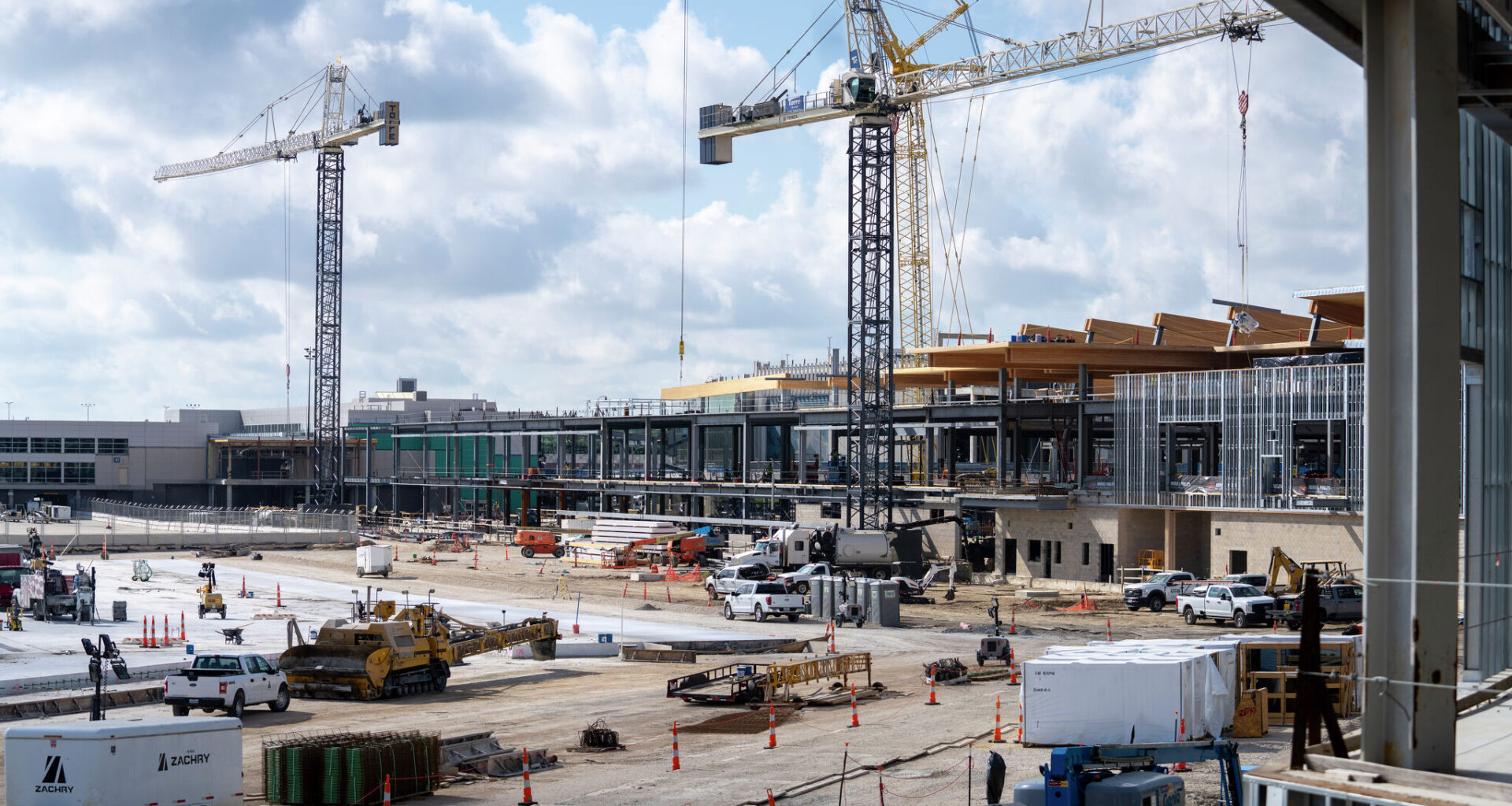
Construction progress’ on the new Terminal C at the San Antonio International Airport. The new $1.7 billion terminal will have 18 gate’s and is planned to open in the second quarter of 2028.
Robin Jerstad/Contributor
The next time you fly through San Antonio International Airport, take a look around. In about six years, almost none of what you see will look the same.

With a pair of projects with a total price tag of about $2 billion, paid for mostly with city-issued bonds, the airport is building a new terminal, Terminal C, while drawing up plans to overhaul the existing ones, Terminal A and Terminal B.
Article continues below this ad
The idea is not only to expand the airport’s capacity — though that’s a big part of it, as the city keeps reaching for its holy grail of a transatlantic flight — but to elevate its digs for an era in which travelers expect more from airports: shopping, accessibility, local authenticity, and for some, exclusive luxury.
ALSO READ: San Antonio Airport adds sweeping murals to its public art collection
Ten months after groundbreaking, about 80% of the steel structure for Terminal C is in place, along with large sections of its lofty timber ceilings, said Jesus Saenz, the city’s director of airports, and Tim O’Krongley, the deputy aviation director. On a given day, about 650 workers are laboring there, in two shifts spanning nearly all 24 hours. Due to San Antonio’s often extreme heat, concrete is being poured at night so it doesn’t set too fast.
The construction involves 2,929 metric tons of timber, covering 152,000 square feet, as well as 7,144 tons of steel, airport officials said.
Article continues below this ad
With a cost of $1.7 billion — more than $1 million for each day of construction — the new terminal is one of the most expensive public investment in San Antonio’s history. It is on track to open on time in June 2028, and on budget, O’Krongley said.
Though few finishing touches are in place, a walk through the construction site gives a sense of the airy, expansive, sunlit public space that Terminal C is set to become. In places, its tilted timber ceilings will be 90 feet tall. At 850,000 square feet, it will be larger than the two existing terminals combined.
It will feature 41,000 square feet of concession space and 29,000 square feet of club lounges — exclusive areas, such as Delta’s Sky Club, that travelers can access by purchasing memberships or holding certain credit cards.
The 18-gate terminal is designed to meet the air industry’s future needs, Saenz said. Three of the gates will be wide enough to accommodate wide-body commercial aircraft of a kind that do not now fly into San Antonio, he said.
Article continues below this ad
“When we’re finished, you’re going to see a beautiful airport,” he said. “As the city grows, as more and more business opportunities surface… the airport needs to be the engine.”
Construction continues on Terminal C at San Antonio International Airport. The $1.7 billion terminal will have 18 gates and is expected to open in 2028.
Robin Jerstad/Contributor
Costly expansion plan
But the growth comes with a cost. The bond debt will be paid off with revenue generated by the airport, including passenger fees, concessions and airline rents.
Article continues below this ad
The airport’s cost per enplaned passenger – a metric indicating its affordability to airlines flying in and out — is expected to rise from $14.45 in fiscal year 2026 to $32.63 in fiscal year 2035, according to a financial analysis commissioned by the city of San Antonio.
The new terminal will help attract more flights, said travel industry analyst Henry Harteveldt, president of San Francisco-based Atmosphere Research Group. But the cost of its use will be an important factor, he said.
Airlines “may look at the terminal and the design and the architecture and say, ‘That’s nice – tell me how much it’s going to cost to operate there,” Harteveldt said. “If San Antonio is able to keep its cost per enplanement to a reasonable number, that will help the airport attract more airlines, and encourage them to hopefully add more nonstop destinations.”
Airlines have signed lease agreements for the terminal’s gates. With the agreements in place, “we are confident we can continue to grow air service while providing passengers some of the lowest costs in the region,” airport officials said in a written statement.
Article continues below this ad
ALSO READ: Council approves $220.5M contract for renovating S.A. airport terminals
Other major Texas cities are working on billion-dollar airport expansion projects of their own – including at Austin-Bergstrom International Airport, a competitor to San Antonio International. San Antonio residents might consider it worthwhile to make the drive to Austin to catch one of its direct flights to Europe, Montreal or Pittsburgh, while people along the Interstate 35 corridor can choose between the airports.
Construction is underway on a 7,000-vehicle parking garage in Austin, and a three-gate, 85,000 square-foot expansion of one of its terminals. Two bigger projects are in design phase: a concourse adding another 26 gates, at a cost of $1.1 billion; and a $865 million arrival and departures hall. Both are expected to be completed in the early 2030s.
Construction progress’ on the new Terminal C at the San Antonio International Airport. The new $1.7 billion terminal will have 18 gates and is planned to open in the second quarter of 2028.
Robin Jerstad/For the Express-News
Positioning airport for growth
City and airport officials are counting on the San Antonio airport’s expansion to help the city draw more direct flights to other U.S. cities, as well as Europe and beyond. In 2023, City Manager Erik Walsh referred to Terminal C as “the most important project that the city has going forward,” adding, “We have not kept up at the airport and everybody knows it.”
Article continues below this ad
The airport has lately suffered a series of setbacks, including the loss, in 2024, of its first nonstop service to Europe – a flight to Frankfurt through the German airline Condor. The decision to cancel that route decision resulted from a court ruling in Germany that affected Condor’s business model, not the economics of the flight itself, airport officials said. Nonetheless, the loss of the much-lobbied-for and much-incentivized flight exposed San Antonio’s tenuous link to Europe.
This year, the low-cost carrier Spirit Airlines filed for bankruptcy, which killed routes from San Antonio to Atlanta, Baltimore, Nashville, Las Vegas, Los Angeles, Orlando and Puerto Rico, among other places.
The airport has seen declining numbers of passengers and freight traffic this year. In June, 938,721 passengers came through, down 4.3% from the same month last year.
ALSO READ: Study finds passenger rail route between S.A., Austin could cost $13.5B
Article continues below this ad
Saenz attributes the passenger decline in part to Spirit’s exit. Airport officials are talking with other low-cost carriers, such as Breeze and Frontier, about increasing their service through the airport, he said.
“You know, we have peaks and valleys,” Saenz said. “We’ve lost Spirit, and we’re still only 5% down. That’s good for us.”
Construction crews work at Terminal C at San Antonio International Airport. The $1.7 billion terminal will have 18 gates and is expected to open in 2028.
Robin Jerstad/For the Express-News
Aiming for authenticity – and luxury
The guide star in designing Terminal C was to create a sense of local authenticity, Saenz said. In describing the facility, he and O’Krongley use words familiar from San Antonio’s historic center, such as paseo, mercado, acequia.
Article continues below this ad
Much of the terminal’s exterior will be covered with limestone. The paseo, outside the entrance, will feature a natural area, landscaped with trees and shrubs, with plentiful seating and an event space, O’Krongley said. It will include bridges reminiscent of those on the River Walk.
“It will look like that natural street space. It has trees. That’s really unique. I don’t know of any other airports that have it,” O’Krongley said.
Going inside, travelers will find themselves in a “welcome plaza,” with trees growing in the natural light offered through floor-to-ceiling windows. About three-quarters of the terminal will be lit with natural sunlight, O’Krongley said. This area will feature a mock acequia, with cascading water. The terminal’s ticketing hall, by itself, will be nearly the size of Terminal B.
In its concourse, the terminal will feature large art installations by local artists and terrazzo flooring, reminiscent of river stones. As part of the retail component, there will be an outdoor patio, with a view of the airfield.
Article continues below this ad
ALSO READ: Study ranks San Antonio International Airport high for ease of passenger pick-up
The airport is now doing excavation work for a seven-level parking garage with 2,500 spaces, scheduled to open in early 2028.
Terminal C is being outfitted with facilities for international travel, including a controlled corridor taking passengers to a Federal Inspection Services center.
Two of the terminal’s three club lounges have been claimed. Delta Airlines has committed to lease 11,000 square feet of space for a Delta Sky Club, and American Airlines, a 10,000 square-foot space for its Admirals Club.
Article continues below this ad
Construction progress’ on the new Terminal C at the San Antonio International Airport. The new $1.7 billion terminal will have 18 gate’s and is planned to open in the second quarter of 2028.
Robin Jerstad/Contributor
Sprucing up terminals A and B
After Terminal C opens, the airport plans to embark on a $300 million renovation of both Terminal A, built in 1984, and Terminal B, built in 2010. The renovation work is expected to last until 2032.
The goal is to make them over so extensively that they will merge seamlessly with the wood ceilings and glass-curtain walls of Terminal C, Saenz said.
Article continues below this ad
“We hope, if we do a good job, you won’t be able to tell the difference between the three,” he said.
Terminal A, in particular, has long been seen as in need of a makeover. It has one of the narrowest concourses among major U.S. airports, resulting in bottlenecks of travelers during peak times.
ALSO READ: San Antonio’s first ‘diverging diamond’ interchange is now open
To ease congestion in the two existing terminals, the airport will likely reduce their number of gates by eight or nine, Saenz said. The terminals now have 17 gates.
Article continues below this ad
The city and airport haven’t released detailed plans for what the renovations will look like; the project is currently in design, after the San Antonio City Council last month hired a construction manager in a $220.5 million contract. But Saenz suggested the revamped terminals could feature timber ceilings and glass curtain walls, like Terminal C.
Another question is which airlines will use the older terminals after they are renovated. The condition of Terminal A led Southwest Airlines to sue the airport and director Jesus Saenz in 2024, claiming Saenz had promised the airline would have gates in Terminal C, but then sought to confine the airline to Terminal A.
Jesus Saenz is director of airports for the city of San Antonio. “When we’re finished, you’re going to see a beautiful airport,” he said. “As the city grows, as more and more business opportunities surface… the airport needs to be the engine.”
Robin Jerstad/Contributor
The airport is “in discussions” with airlines about using Terminal A, Saenz said. He said he did not foresee difficulties filling the gates.
Article continues below this ad
“As we move forward, someone’s going to want to be in there,” he said.
The lawsuit with Southwest was settled in May, with the city agreeing to grant Southwest gates in Terminals B and C. There are no hard feelings, Saenz said.
“We have a great relationship. We talk,” he said.
Article continues below this ad