
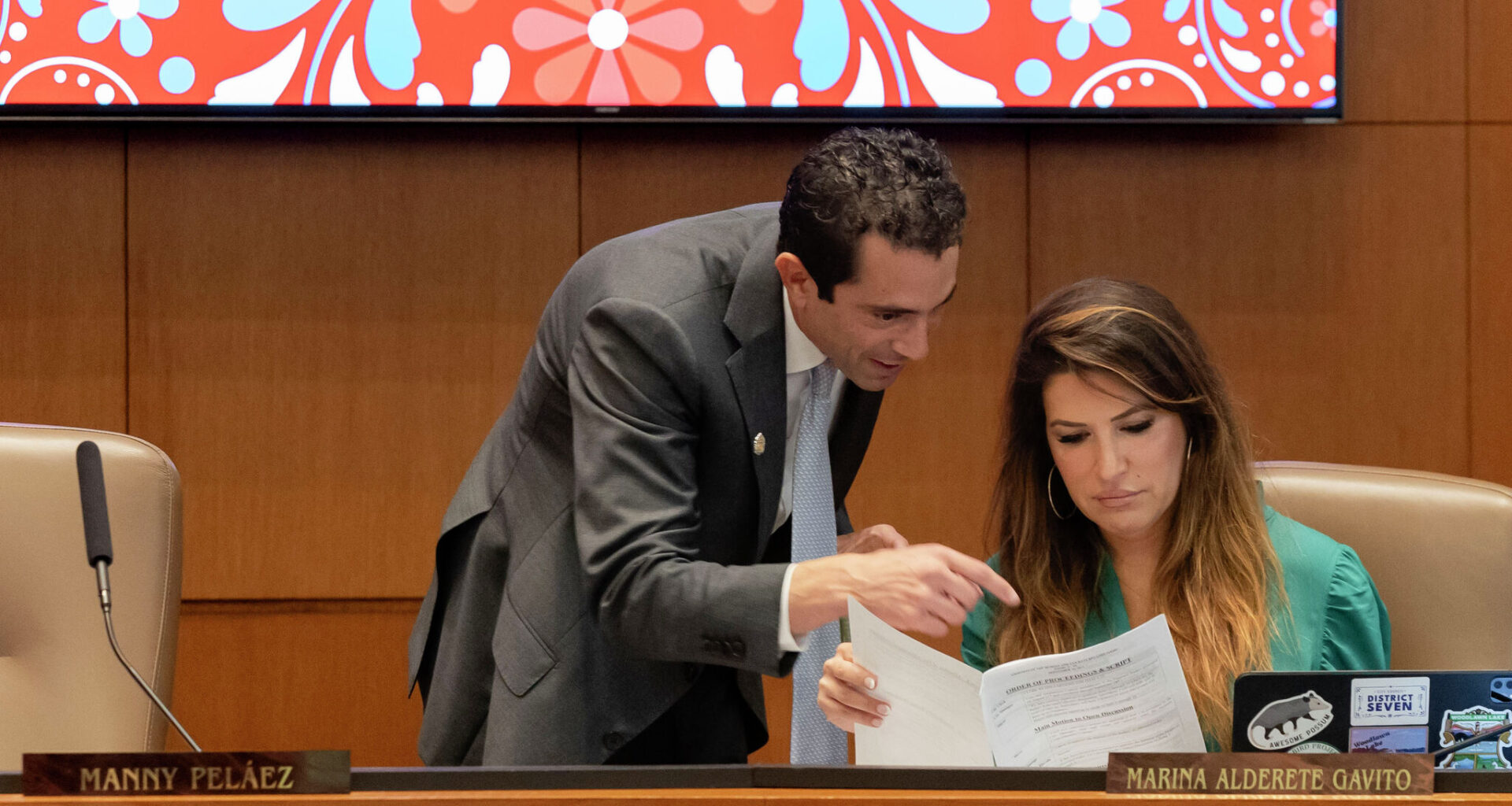
San Antonio City Council Members Marc Whyte and Marina Alderete Gavito have opposed a proposed property tax increase to help balance the city’s budget. They are right. The city should be looking at more spending cuts before raising rates.
Josie Norris/San Antonio Express-News
The city of San Antonio’s proposed budget doesn’t add up.

Oh, it is balanced through a mix of cuts and a modest tax rate increase. We are not saying it doesn’t add up on the Excel spreadsheet. We also are not saying that what has been proposed doesn’t make sense. We understand how this approach avoids certain painful cuts.
Article continues below this ad
But it bothers us, and it should bother taxpayers, that while the city is staring down a massive shortfall of $158 million over the next two years, under this proposed budget, the city’s general fund would grow by 4%.
That is what does not add up — not at a time when households are grappling with inflation, the high cost of gas, economic uncertainty, potential but necessary utility rate increases and even increases in school district property tax rates.
Why is the general fund, which covers day-to-day operations, increasing if there is a projected two-year shortfall?
At least with utility rate increases, the public can see the benefits of investing in infrastructure to keep the power on and fix water lines. At least with school district property tax rate increases, the public can — hopefully — see the promise of investing in children and understand how the state is starving public schools of funding.
Article continues below this ad
EDITORIAL: City of San Antonio’s case for property tax rate increase lacking
With the city, we can’t get there. If the City Council approves this mix of cuts and a property tax rate increase, the city’s general fund will increase to $1.76 billion.
That would continue a trend that goes back years. In 2022, the city’s general fund was $1.36 billion. In 2025, the general fund was $1.67 billion. In 2026, it was $1.69 billion.
In essence, if the City Council wanted to, it could reduce spending to 2024 or 2025 levels, saving about $90 million from this year’s proposed budget. We have a hard time believing the city’s population has grown so much in recent years that maintaining spending at the 2025 level would be devastating.
Article continues below this ad
Beyond this, we remain unconvinced that city officials have exhausted every possible avenue for savings. Case in point: It’s disturbing the city spends millions of dollars a year on its redundant detention center on South Frio Street, perpetuating deadly double magistration, rather than partnering with Bexar County to end this inhumane practice.
The city can’t partner with the county to end double magistration — or find other efficiencies — but it will raise taxes on its residents?
Another concern is whether state leadership will leverage this modest tax rate increase to further undermine city governance. Whatever revenue is gained through this increase may not be worth the pain from Gov. Greg Abbott and lawmakers should Republicans retain control of state government this election.
Abbott has called for deregulating the electricity markets for San Antonio and Austin, a move that would threaten the contribution CPS Energy makes to San Antonio’s general fund and could be financially devastating to our city.
Article continues below this ad
As for Bexar County, it doesn’t get to skate from budget criticism either. The county is also facing a massive deficit through 2028, and Commissioners Court will likely avoid making cuts or raising taxes by tapping reserves. This avoids political pain and tough decisions, but it doesn’t address the structural budget issues.
While we expect these proposed budgets to pass this coming week, the city and county need to adopt zero-based budgeting to identify savings, and they need to create an ad-hoc working group to identify efficiencies. The fact that this hasn’t happened reflects a lack of local elected leadership.
It doesn’t make sense for the city to be raising taxes to increase its general fund when facing a budget shortfall.