
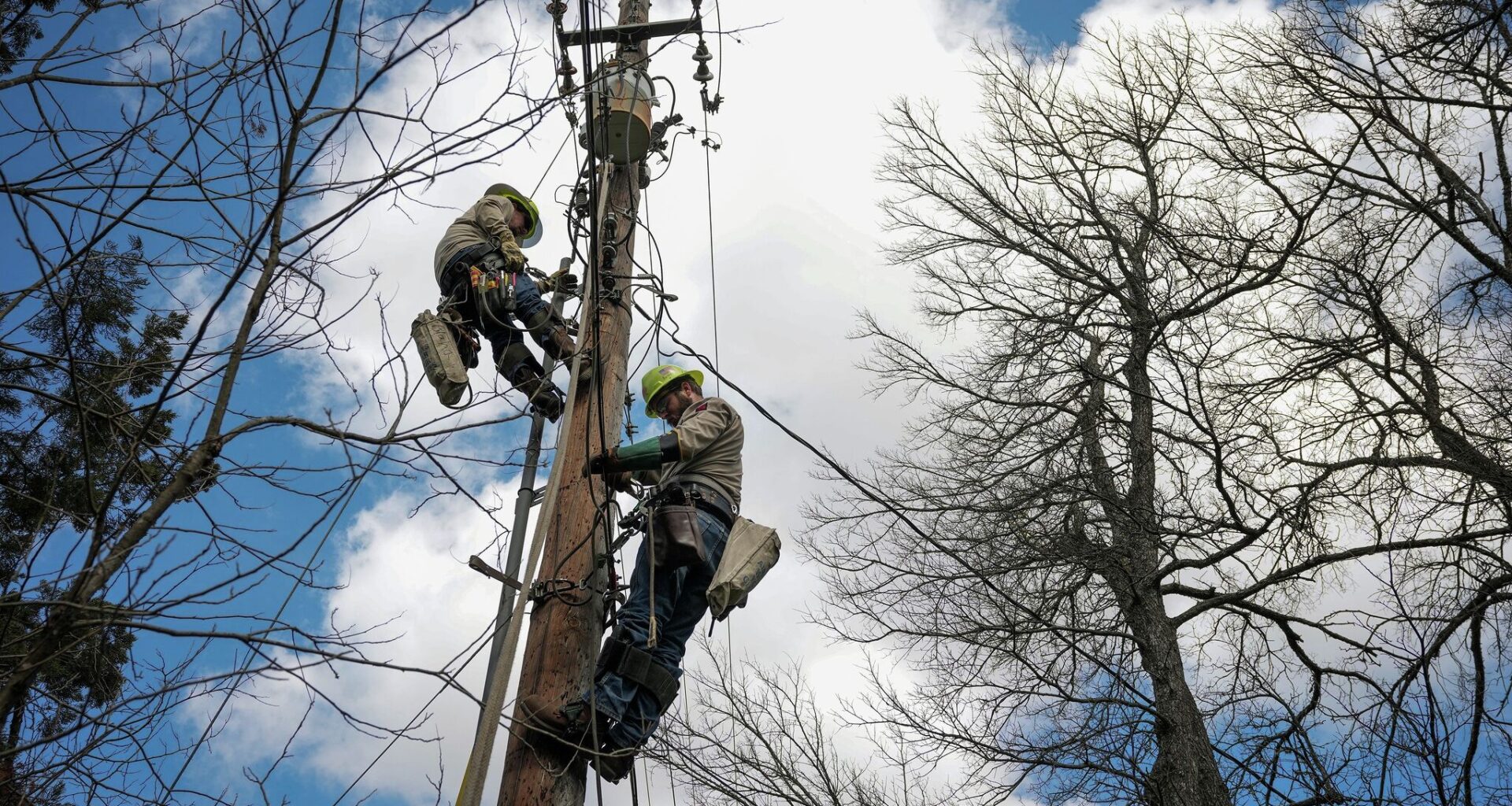
Austin Energy workers restore power to a northwest Austin neighborhood in 2023. State Rep. Ellen Troxclair, a former Austin City Council member, says municipally owned utilities have strayed from being a bargain.
Jay Janner / American-Statesman
A lot has changed since 2002 when Texas opened its electricity market to competition.

Our economy has grown to $2.9 trillion. Texas’ population has jumped to 32 million.
Article continues below this ad
But the Texas economic miracle couldn’t have happened without reliable and affordable electricity produced by the state’s competitive power market.
In 1999, Gov. George W. Bush signed SB7 opening retail electric competition to the ERCOT market covering most of Texas. Prudently, SB7 developed the market gradually so customers, providers, generators and regulators could learn as it matured.
We’ve made reforms along the way, including those after Winter Storm Uri. That’s what state government should do to maintain a robust market: Set sensible, fair guardrails and then get out of the way to let the market deliver choices to consumers.
Today, the Texas power market is the envy of the nation with average residential rates that are well below the national average.
Article continues below this ad
Most cities and counties are in competitive areas. However, SB7 gave cities with their own monopoly electric utilities the chance to opt out of competition.
Allowing cities such as Austin, San Antonio, Garland, Denton, Bryan-College Station and others to own and run monopoly utilities may have been a good idea in 2002. But no longer.
ALSO READ: If Gov. Abbott wants to lower energy bills, start here
From my experience on the Austin City Council, I know local governments generally work best when they provide residents with affordable quality services. But municipally owned utilities have strayed from being a bargain. They charge rates so high that millions of dollars are left over by design to funnel to city councils for pet projects unrelated to generating and selling power.
Article continues below this ad
No Texans should be held hostage by monopolies. When local governments become obstacles at this scale to affordably serve their people, action is needed.
That’s why I’m supporting Gov. Greg Abbott’s “Keep Texas Affordable” agenda to lower electricity costs by expanding consumer choice.
More than 5 million Texans live in cities with monopoly utilities and can’t shop around for cheaper electricity.
At CPS Energy in San Antonio, the current 12-month average residential rate is 12.9 cents per kilowatt-hour. In competitive areas just outside San Antonio, customers can find rates at 11.9 cents, with introductory offers as low as 6.2 cents.
Article continues below this ad
Austin Energy currently charges an all-in rate of 13.4 cents per kilowatt-hour, while the adjacent competitive average rate for a 12-month term is 12.1 cents, with the lowest at 6.2 cents.
Rates under various providers can rise or fall based on usage, but customers in competitive areas can compare plans and choose the one that best fits their needs. Customers served by municipally owned utilities cannot.
ANOTHER VIEW: Abbott’s attack on Austin Energy is a costly path to ‘affordability’
The central planners at these city utilities whine that their monopolies are too complex and calcified for competition. And rate plans in the competitive market are too confusing.
Article continues below this ad
A generation ago, Texans figured out how to restructure the power market for the entire state.
And if Texans buy houses, cars and cellphone plans, they can figure out the best price and retail electric plan for their home or business.
What these monopolies don’t want to do is give up their double taxation. Their high rates cover costs and then shovel millions to their city councils.
Article continues below this ad
This year, CPS Energy will fork over roughly $559 million to the city of San Antonio. Austin Energy will send $139 million to the city of Austin.
Yes, some utility revenue supports basic city services. But San Antonio used $500,000 to create a Reproductive Justice Fund initially intended to help women travel out of Texas for abortions. Legal challenges later led the city to redirect the money to other reproductive care, but it still was not used for essential city services.
The annual Austin Energy transfer sends millions of ratepayer dollars into the city’s general fund, where they can be spent on priorities unrelated to providing reliable electric service. A 2021 audit of $179 million in homelessness spending found the city lacked the information needed to fully track the programs and evaluate their effectiveness.
Article continues below this ad
The time has come for captive customers in these monopoly cities to be set free to choose the lower rates and innovative products offered by our competitive power market.
State Rep. Ellen Troxclair is a Republican who represents western Travis, Blanco, Burnet, Gillespie and Kendall counties in House District 19.