
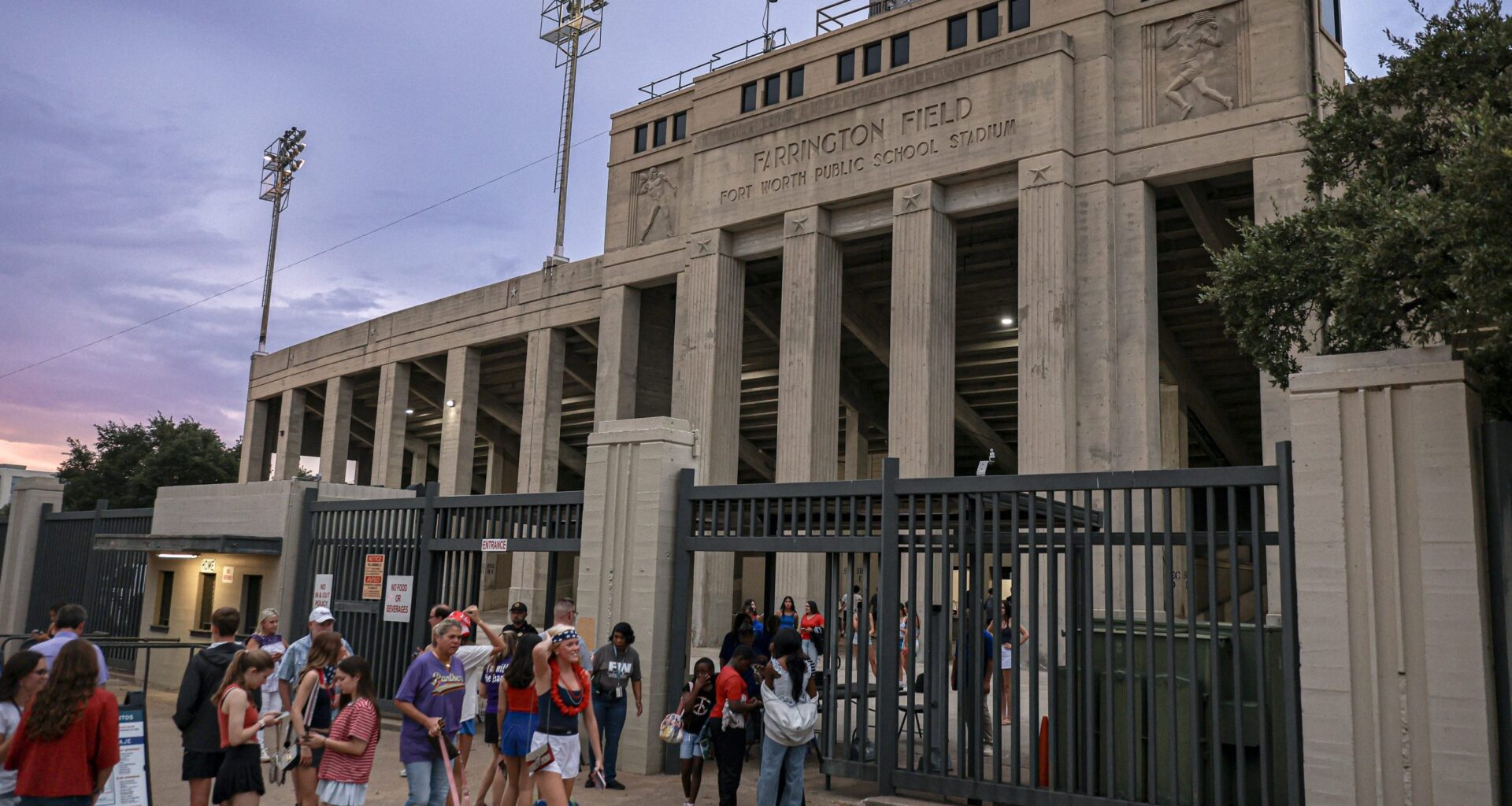
The vision for Fort Worth ISD’s Farrington Field glowed on a screen.
A rendering showed the 1939 stadium transformed and modernized around a bright green soccer pitch. The track surrounding the field was gone. Farrington’s familiar art deco entrance remained. Apartments, shops and other development rose around the field, outside the stadium.
The vision promised men’s and women’s professional soccer with a $65 million renovation that included $10 million in private capital, mixed-use development, new tax revenue and that preserved Fort Worth Stock Show parking. There were benefits pitched for students, too: continued use for high school football, alongside soccer clinics and internships.
“Let’s Build Something Incredible Together!” the November 2024 presentation declared.
Emails obtained through an open records request by the Fort Worth Report show how the city, school district and businesspeople developed a professional soccer-anchored plan for Farrington more than a year before FWISD opened the property to competitive redevelopment proposals in January 2026.
Officials involved in the back and forth identified Nathan Hanks and Jonah Football Holdings as a driving force in the Farrington effort. FWISD and the city were working toward an agreement with Hanks involving the project before the district opened the surrounding property to competing developers.
The urgency showed up in a July 8, 2025, email from Hanks to City Manager Jay Chapa, who consulted on the project before his appointment as Fort Worth’s top administrator.
“Thanks for giving this a nudge. We’re really pushing it on the schedule so anything you can do to keep an eye — and some pressure — on this is appreciated,” Hanks wrote. “Really trying hard to make the 2026 Super League opening (women’s) in the fall.”
Hanks declined to comment out of respect for FWISD’s ongoing procurement process.
Chapa declined an interview request. Before becoming city manager, Chapa consulted on how participation in the tax district could support Farrington’s redevelopment, spokesperson Sana Syed said.
The records do not show that FWISD’s eventual requests for proposals were written for the development group involved in the soccer proposal or that the group received preferential treatment.
Kellie Spencer, FWISD’s deputy superintendent of operations, said that, to her knowledge, private parties involved in the earlier discussions did not review the request for proposal before it was released. Outside legal counsel developed it, she said, while Fort Worth ISD consulted with the city on development requirements tied to a new tax increment financing district.
Former Superintendent Karen Molinar led much of the negotiations, which she said began before she became interim superintendent in October 2024.
She initially viewed the conversations with Hanks as an exploratory effort to determine whether the district could find a partner to help renovate Farrington and lease the field for professional soccer, she said, while FWISD retained ownership and continued using it for student athletics.
Her understanding of the district’s discussions later expanded beyond stadium use to development of the surrounding land, she said. FWISD recognized the project required a competitive process at that point.
“We had to kind of halt on just a lease agreement because it became developing the land around it,” Molinar said.
City records show mixed-use development had been part of the broader Farrington concept earlier.
The records show how Fort Worth’s pursuit of professional soccer, FWISD’s need to address an aging stadium and private development interests converged around one of the city’s most valuable pieces of public land.
Two problems converge
 A sculpture of a football player adorns the outside of Farrington Field’s main entrance on Sept. 10, 2026, in Fort Worth ISD. (Elvis Martinez-Cartagena | Fort Worth Report)
 Stars decorate the facade of Fort Worth ISD’s Farrington Field on Sept. 10, 2026. (Elvis Martinez-Cartagena | Fort Worth Report)
Farrington’s future had been an open question for years.
The 1939 stadium is a beloved piece of Fort Worth history and an active home for FWISD athletics. But the iconic landmark needs tens of millions of dollars in repairs and accessibility upgrades that district leaders have said would be difficult to pay for without taking money from classrooms. At the same time, the valuable land surrounding the stadium — in the heart of the Fort Worth Cultural District, with downtown skyline views — has long tempted developers.
Finances drove the district’s interest in the soccer proposal, Molinar said.
“Our district would not be able to afford to renovate Farrington Field unless it was through a bond,” she said.
FWISD voters in 2021 rejected a $104.9 million bond proposition that would have added three smaller, neighborhood-based stadium complexes elsewhere in the district. Farrington was not included in that proposition and Superintendent Kent Scribner told the Report in 2022 the district would not seek a separate bond.
In 2022, Fort Worth and FWISD jointly sponsored a three-day study of Farrington and the surrounding property by the Urban Land Institute, a nonprofit network of real estate and land-use experts. Fernando Costa, then a Fort Worth assistant city manager, coordinated the city’s involvement.
The Urban Land Institute panel confronted a complicated site: an aging, active school stadium surrounded by valuable developable land, with stormwater, parking, easement and infrastructure constraints. Costa said the Urban Land Institute offered to return for another two- or three-day technical assistance panel at no additional cost. To his knowledge, FWISD never authorized that, he said.
 Clouds loom over Fort Worth ISD’s Farrington Field on Sept. 10, 2026. (Elvis Martinez-Cartagena | Fort Worth Report)
Fort Worth, meanwhile, had been trying to bring professional soccer to the city.
After his recent appointment as president of the Fort Worth ISD board of managers, Pete Geren said he was told the city first approached the district about Farrington because of its interest in bringing professional soccer to Fort Worth.
By summer 2024, the city’s pursuit of professional soccer and FWISD’s need to address Farrington had converged.
On June 6, 2024, then-city official Carlo Capua told three other Fort Worth officials in an internal email that the city was working with a developer and FWISD on a plan to renovate Farrington for both student football and professional soccer, with mixed-use development surrounding the stadium.
“This has been a controversial topic in the past,” Capua wrote, “so we need (to) keep this close to our chest if/until FWISD is ready to go public.”
He wanted city officials to avoid going public with the idea before FWISD, which owned the property, was ready, Capua said in an interview.
Costa was added to the exchange because he had led the earlier Farrington work. He urged officials to study the site and build consensus before moving forward.
Private negotiations are common in economic development, Costa said. His concern was whether city government had done enough homework before advancing a proposal involving public property.
By September 2024, a city email said Fort Worth was “advancing the pro-soccer-at-Farrington Field project” and exploring whether a tax increment financing district could help make the numbers work.
A rosy financial picture
 Attendees line up next to large concrete columns while waiting at a concession stand during a football game between R.L. Paschal High School and Weatherford High School at Fort Worth ISD’s Farrington Field on Sept. 10, 2026. (Elvis Martinez-Cartagena | Fort Worth Report)
The presentation reduced the financial implications to a circle.
FWISD faced about $25 million in repairs to Farrington. But the presentation said an extra $40 million would make the stadium capable of supporting professional sports.
The $65 million in stadium improvements would make Farrington capable of hosting professional soccer, while surrounding mixed-use development would generate new property taxes that could help pay for Farrington’s repairs, stormwater work and other public improvements.
The presentation argued that pairing a mixed-use development with professional soccer was the rosiest option.
The presentation projected a $37.6 million net benefit to FWISD over 20 years and $23.1 million to Fort Worth. Private development on the currently tax-exempt district land was projected to generate more than $150 million in property-tax revenue for taxing entities.
“If for some reason soccer doesn’t work out, we still have a great facility for kids to play sports in.That should be a No. 1 priority.”
Fort Worth Mayor Mattie Parker
Council members Elizabeth Beck and Macy Hill represent the Farrington area. Both had their reservations.
“I thought it was a big risk for the city to take,” Beck said.
Beck remembers questioning an early concept that called for about $10 million in private capital for the stadium while relying on tens of millions of dollars in proposed public participation. She also questioned Hanks’ experience and how much information elected officials and the public were receiving.
“I don’t know why the city is putting more into an asset that they don’t own than the entity that owns it,” Beck said.
She said she was never shown an independent market or feasibility analysis demonstrating that professional soccer could succeed at Farrington.
Hill likewise wanted a full feasibility study before the city committed to a professional soccer project at Farrington.
“I was not and still am not on board with the project that was presented,” Hill said. “We don’t have all the information. We don’t know if this would actually be successful in the city of Fort Worth.”
The city council created the Near West Side tax district in June 2025. It includes Farrington and uses future growth in property-tax revenue to help pay for public improvements in the area, including potential work at the stadium. Hill voted for the district and now chairs its board.
 Players from Fort Worth ISD’s R.L. Paschal High School and Weatherford High School set up the next play during a football game at Farrington Field on Sept. 10, 2026. (Elvis Martinez-Cartagena | Fort Worth Report)
Nearly all of Hill’s focus on the district has been on stormwater and infrastructure, she said.
Campaign finance records show Hanks contributed $1,000 each to Beck and Hill. Both council members said Hanks’ contribution had no bearing on their concerns.
State campaign finance records also show Hanks contributed $10,000 to Gov. Greg Abbott, who appoints the Texas education commissioner.
Trustee Tobi Jackson previously questioned the timing of the takeover. In late March, the Texas education commissioner installed a new board and superintendent three days before elected trustees planned to consider rescinding the Farrington solicitation.
Jackson said the takeover ensured the elected board would “not necessarily have the final say on the future of Farrington Field.”
Trustees had grown uneasy as the redevelopment proposal changed from what they were originally shown. Trustee Michael Ryan said the elected board’s effort was about “making sure we’re doing it right.”
Beck’s concerns were not resolved before the city council created the tax district in June 2025. She voted for it, she said, because she wanted a financing district in the area before the soccer proposal because of longstanding flooding and stormwater problems around West 7th Street.
The final tax district plan is far broader than Farrington. The city estimated it could pay for roughly $260.5 million in eligible projects, including about $150 million for stormwater and flood control and up to $55 million for Farrington.
Nathan Jensen, a University of Texas at Austin professor who studies economic development, said sports stadiums generally provide weak economic development returns. Money spent at games often supplants entertainment spending that would have occurred elsewhere in the same region.
His question, he said, is whether the apartments, shops and other taxable development envisioned around the stadium would happen anyway. Especially considering that Farrington sits in the Cultural District on property that could be attractive to developers even without professional soccer, Jensen said.
The debate over Farrington also differs from a typical stadium subsidy question, he said. FWISD already owns the stadium, it requires substantial investment, and policymakers may see public value in preserving it even if another use of the money would produce greater economic returns. Farrington was listed on the National Register of Historic Places in 2022.
In addition, the soccer league itself adds uncertainty, he said.
The presentation given to officials focused on the United Soccer League, a national organization that operates several professional and preprofessional soccer leagues. It plans to launch a Division I men’s league in 2028 and eventually link its men’s leagues through promotion and relegation.
That model could make the soccer proposal more complicated, Jensen said: If a club eventually moves from one division to another, officials would have to consider how changes in attendance, sponsorships and other revenue could affect the financial assumptions supporting a long-term public-private deal.
USL spokesperson Valerie Panou said the league believes Fort Worth is a strong market for professional soccer thanks to the city’s size, population growth and soccer community. She said a future Fort Worth club could create a North Texas rivalry with Atlético Dallas, which is scheduled to begin play in 2027.
“And we have a local ownership group with the vision and commitment to build a successful, community-rooted club there,” she said.
Professional soccer would be an exciting addition to Fort Worth, Mayor Mattie Parker told the Report, but said any agreement about Farrington should protect FWISD if the soccer venture does not work out.
“If for some reason soccer doesn’t work out, we still have a great facility for kids to play sports in,” Parker said. “That should be a No. 1 priority.”
From private talks to public competition
 R.L. Paschal High School football players stand during the national anthem before a game against Weatherford High School at Fort Worth ISD’s Farrington Field on Sept. 10, 2026. (Elvis Martinez-Cartagena | Fort Worth Report)
In a June 2, 2025, email, Superintendent Molinar told Chapa that district leaders would seek trustees’ approval to begin negotiating a potential agreement about Farrington and the professional soccer team. Elected trustees on June 24, 2025, allowed Molinar and her team the ability to do so.
Molinar said she viewed the memorandum of understanding as a way to explore whether such a partnership could work, rather than as a commitment to Hanks or his group. The central question, she said, was whether a soccer tenant could fund Farrington’s renovations while FWISD kept ownership and continued using the stadium for district athletics.
“What would that look like? What would they need, and could they work around us maintaining ownership and having use for our school district needs?” Molinar said.
Over the following months, representatives of the school district, city and Jonah Football Holdings exchanged revisions. Hanks was included in project communications alongside district and city officials and attorneys. Spencer and then-Chief Financial Officer Carmen Arrieta-Candelaria were included on the email chains.
In August 2025, a city attorney wrote that he was reviewing FWISD’s latest revisions to determine how they affected the city’s position. The records do not identify which district official proposed those revisions.
By Sept. 4, outside counsel wrote that FWISD had signed off and that the memorandum would next go to Hanks and attorneys before it was finalized.
Whether the parties ever finalized and signed the memorandum of understanding remains unclear. Because the agreement itself has not been released, the Report could not determine exactly what commitments it contemplated.
Molinar said she could not recall what FWISD had agreed to by that point or whether the memorandum was ultimately signed.
Arrieta-Candelaria did not respond to a request to comment.
The Report requested every version of the memorandum and records showing its status. Fort Worth located responsive records but asked the Texas attorney general for permission to withhold some under attorney-client and deliberative-process protections. The attorney general has not yet ruled on the city’s request. The city described some records as communications concerning “the drafting of a memorandum with a private party and a local school district.”
Beck and Hill both said they did not know the memorandum was being developed. Learning about the agreement raised concerns about public involvement, Hill said.
“We owe transparency to the general public,” Hill said.
 Stadium lights shine over Fort Worth ISD’s Farrington Field during a football game between R.L. Paschal High School and Weatherford High School on Sept. 10, 2026. (Elvis Martinez-Cartagena | Fort Worth Report)
Ryan said FWISD trustees knew negotiations were happening because they had authorized district officials to undertake them.
Elected trustees were kept informed as the talks progressed, Molinar said, pointing to posted agendas and repeated closed-door sessions about Farrington.
“I’ve always been very consistent about communicating to my board around what steps we were taking,” Molinar said. “They were aware.”
A memorandum of understanding is not unusual, Costa said. Governments and developers often use preliminary agreements to determine whether the pieces of a complicated project can align.
Parker similarly said the existence of a memorandum of understanding did not concern her on its own. She was not involved in those discussions, she said, and did not know whether an agreement was ultimately executed.
City economic development staff are typically cautious about due diligence and appearances of favoritism, and emphasized that Farrington is unusual because Fort Worth does not own the property, Parker said.
Transparency is key, Costa said.
“I would not take it a great distance without opening the process,” Costa said, emphasizing he was speaking about public procurement generally.
Once public property is competitively solicited, he said, the process should have clear criteria and a fair playing field.
Costa was not involved deeply enough in the later Farrington process to make any conclusions, he said.
“The expectation is that this is intended to be a transparent process, to solicit the best ideas rather than a perfunctory exercise to legitimize something that was done in the back room,” Costa said.
 The Fort Worth ISD board of managers listen to speakers during a meeting on April 28, 2026. (Maria Crane | Fort Worth Report/CatchLight Local/Report for America)
Farrington’s future is in the hands of FWISD managers
The vision on the screen had been seamless: one stadium, one soccer project, one mixed-use district.
The request for redevelopment proposals was more modular.
FWISD divided the land around Farrington into seven parcels. Developers could pursue some or all of them. Farrington itself was not for sale, but the first solicitation contemplated selling surrounding property.
The approach did not mesh with the design trustees discussed, Ryan said. Beck agreed.
“That certainly wasn’t how the project was ever described,” she said.
Spencer said Arrieta-Candelaria, working with FWISD facilities officials, developed the seven-parcel configuration. The goal was flexibility: Bidders could pursue fewer parcels, and FWISD could ultimately transfer less than all of the property.
The original solicitation contemplated sales. A revised version later added ground leases.
The request for proposal itself was developed by outside legal counsel, Spencer said. FWISD also consulted with the city of Fort Worth over development requirements for the tax increment zone.
Spencer said that, to her knowledge, Hanks, Jonah Football Holdings, consultant David Berzina, JLL, Chapa and the other named participants did not receive a draft or review it before public release. Berzina declined to comment.
FWISD recognized a formal procurement process was needed once Molinar became aware the concept expanded beyond use of Farrington itself and into development of surrounding land, she said. The process restricted communications and barred potential respondents from seeing the solicitation in advance, she said.
“They were not involved in the request-for-proposals process at all,” Molinar said of Hanks and his group.
Capua, who left the city before the request for proposal was issued and said he was not involved in FWISD’s procurement, said he never saw or heard anything suggesting an outside developer influenced the request for proposal or that it was written to favor one.
The first solicitation drew two proposals and proceeded to clarification and interviews. Spencer said there was no official determination that both were qualified and responsive.
“We don’t know if this would actually be successful in the city of Fort Worth.”
Fort Worth City Council member Macy Hill
Two days after the solicitation was released in January 2026, Fort Worth Assistant City Manager Dana Burghdoff asked whether city staff shared it with developers.
“This is an important site and we want FWISD to get lots of good proposals,” Burghdoff wrote in a Jan. 17 email.
Superintendent Peter Licata and his administration later restarted the solicitation.
A revised request for proposal was issued May 29, with ground leases and other development conditions. The new proposals remain under review.
The managers also adopted new property sales rules Aug. 11 that require FWISD to obtain an independent appraisal, review title and environmental conditions, document the property’s use, hold a neighborhood meeting, accept written comments for at least 30 days and use competitive bidding.
“When that is presented to us, we will use the new policy to review any proposed sale that comes before the board,” Geren said.
For now, the Farrington shown in the presentation remains just that: a rendering.
The soccer pitch has not replaced the track. The buildings wrapping the stadium have not been built. No professional team has moved in.
The managers could select a developer, negotiate something different or decide the proposals do not provide enough benefit to FWISD to proceed.
“Fairness is important in any public business,” Costa said. “When you’re dealing with public property, you’re obligated to function under a certain set of rules that would not necessarily apply to a totally private transaction.”
Now, nearly two years after one vision for Farrington was put on paper, what actually gets built there remains an open question.
 The Farrington Field press box stands behind a fence on Sept. 10, 2026, in Fort Worth. (Elvis Martinez-Cartagena | Fort Worth Report)
Editor’s note: This story was updated Sept. 12, 2026, to clarify the restarting of the Farrington Field development bid process.
Matthew Sgroi is an education reporter for the Fort Worth Report. Contact him at matthew.sgroi@fortworthreport.org or @matthewsgroi1.
Disclosure: FWISD manager Pete Geren leads the Sid W. Richardson Foundation, a financial supporter of the Fort Worth Report. FWISD manager Laurie George is a member of the Report’s reader advisory council. At the Fort Worth Report, news decisions are made independently of our board members and financial supporters. Read more about our editorial independence policy here.
This <a target=”_blank” href=”https://fortworthreport.org/2026/09/12/before-fwisd-sought-farrington-bids-a-pro-soccer-vision-was-already-taking-shape/”>article</a> first appeared on <a target=”_blank” href=”https://fortworthreport.org”>Fort Worth Report</a> and is republished here under a <a target=”_blank” href=”https://creativecommons.org/licenses/by-nd/4.0/”>Creative Commons Attribution-NoDerivatives 4.0 International License</a>.<img src=”https://i0.wp.com/fortworthreport.org/wp-content/uploads/2021/04/cropped-favicon.png?resize=150%2C150&ssl=1″ style=”width:1em;height:1em;margin-left:10px;”>
<img id=”republication-tracker-tool-source” src=”https://fortworthreport.org/?republication-pixel=true&post=778543&ga4=2820184429″ style=”width:1px;height:1px;”><script> PARSELY = { autotrack: false, onload: function() { PARSELY.beacon.trackPageView({ url: “https://fortworthreport.org/2026/09/12/before-fwisd-sought-farrington-bids-a-pro-soccer-vision-was-already-taking-shape/”, urlref: window.location.href }); } } </script> <script id=”parsely-cfg” src=”//cdn.parsely.com/keys/fortworthreport.org/p.js”></script>