
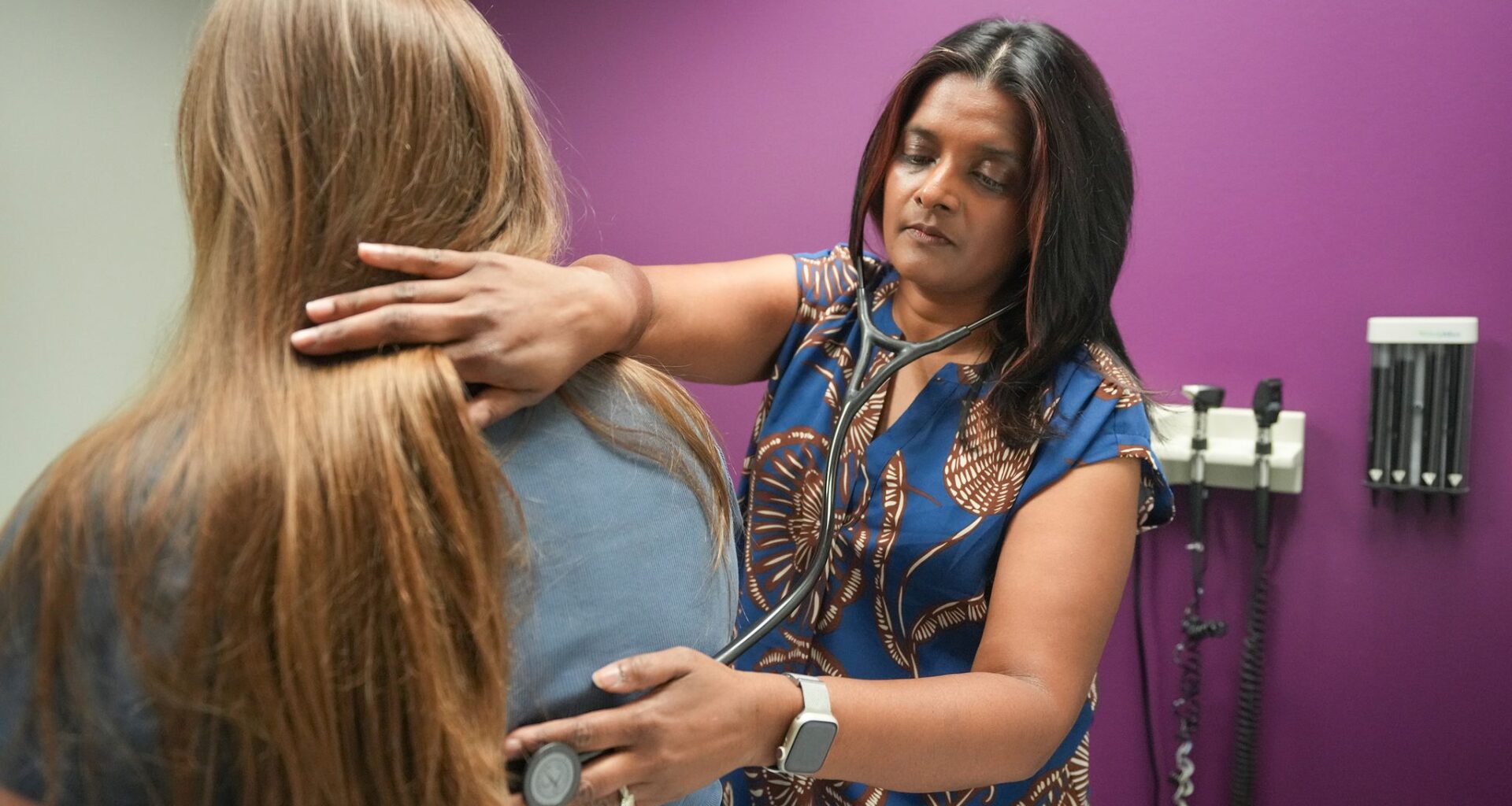
Primary care physician Dr. Tina Philip examines patient Liberty Haude at her private practice in Round Rock. Philip feels the increasing strain of the economics of being a private practice family doctor, but she loves building relationships with patients and the flexibility of owning her practice.
Jay Janner/Austin American-Statesman
At Tina Philip’s private family practice clinic in Round Rock, the staff is just her and her office coordinator.

They know their patients. Some have grown up with them. One has already become a doctor.
Article continues below this ad
Philip and her coordinator, Kennette Sheriff, know to schedule more time with a patient who is talkative or more medically complex. They also know how to coordinate care with the specialists their patients might see.
Philip is increasingly a rarity: a primary care physician in private practice.
Texas currently does not have enough primary care physicians, and the shortage is expected to worsen as older doctors retire, fewer medical school graduates choose primary care and many independent physicians leave private practice because of shrinking reimbursements and rising costs.
Primary care includes family medicine, internal medicine, geriatrics, pediatrics, obstetrics and gynecology. More medical school students are choosing more higher-paying specialties at the same time existing primary care doctors are retiring or becoming concierge doctors by charging patients an additional monthly or yearly fee or becoming direct-pay doctors who no longer take insurance.
Article continues below this ad
“Every year medical supplies cost more, employees expect you to pay more; all your costs go up, but the reimbursement stays the same or goes down,” Philip said. “How can you make a living?”
“I’ll do it as long as I can,” she said. “I don’t like to think this way, but it might not be feasible in 10 years.”
Family practice Dr. Tina Philip doesn’t know how many years she can financially keep a private practice going. She and other primary care doctors like her are seeing increasing costs and decreasing reimbursements.
Jay Janner/Austin American-Statesman
Her patients love her and have experienced what happens when doctors have retired, or gone to direct-pay or concierge models, or joined a bigger practice.
Article continues below this ad
“I get in faster,” said Annette Thompson of Philip’s practice. Her family has been seeing Philip for several years after their previous doctor joined a larger practice. Thompson also has the Veterans Affairs system at her disposal, but every time she uses it, she has to wait to be seen, and it can be a different doctor every time. With Philip, she said, “it’s someone who knows you. She already knows the history.”
Primary care physicians do more than care for patients when they have a cold or flu. They manage a patient’s overall care by coordinating referrals to specialists. They also provide preventive care by looking for potential problems five, 10 or 15 years down the road. And, increasingly, the vast majority of mental health care happens in primary care, said Dr. Nicholas Yagoda, the CEO of CommUnityCare, a network of community health clinics.
Is primary care headed for a crisis?
Across the United States and in Texas, the number of doctors in primary care is shrinking as the need for those positions increases.
Article continues below this ad
Doximity, an AI-powered physician workflow platform, found that the top five types of doctors in demand in the U.S. were:
Internal medicine
Family medicine
Psychiatry
Obstetrics and gynecology
Pediatrics
The Texas Department of State Health Services projects that unmet demand for primary care physicians will increase from 37% in 2022 to 42% by 2036.
“The number of communities without a primary care physician will continue to grow,” said state Rep. Donna Howard, D-Austin, at a State of Healthcare Workforce Forum hosted in August by Workforce Solutions Capital Area and Rural Capital Area.
Article continues below this ad
Family practice Dr. Tina Philip examines patient Liberty Haude at her private practice in Round Rock. The patients are why she became a doctor. The paperwork and economics of a private practice add a layer of complexity.
Jay Janner/Austin American-Statesman
It’s not just a future problem. According to research done this year by healthcare analysts at KFF, in Texas about 50.98% of primary care needs are being met, and 1,147 more primary care practitioners are needed to fill the gaps.
Texas has 418 areas that are considered Health Professional Shortage Areas, and 7.3 million people live in those areas. Those areas are in 224 of 254 counties.
Some counties surrounding Austin have been designated shortage areas: Bastrop, Caldwell and Burnet counties.
Article continues below this ad
It’s the same all over the country. In the U.S., 17,306 more primary care practitioners are needed, according to the federal Health Resources and Services Administration.
This problem will only grow. By 2030, 40% of current physicians are expected to reach retirement age. In Texas, that figure is already 29.4%.
In addition to physicians retiring, many in primary care want to reduce their hours and work two or three days a week for work-life balance, said Anas Daghestani, president and CEO of Austin Regional Clinic.
The complexity of administrative tasks and the number of hours spent outside the clinic maintaining electronic records, making referrals and completing prior authorization paperwork for procedures and many medications are driving some physicians to reduce their hours, he said.
Article continues below this ad
“It puts a lot of burden on the nonclinical,” Daghestani said. As a physician, you went to medical school to take care of patients.”
ARC is trying to use automation and AI to reduce physicians’ administrative burdens. One example is an automatic system to tell patients if their lab tests are normal, rather than the doctor having to follow up on a normal test.
Another big gap: Primary care vs. specialty salaries
In Texas in 2022, the unmet demand for medical specialists was 8% but by 2036, it is expected to decrease to 0%. The doctors coming out of medical schools are increasingly choosing to go into specialty fields.
Article continues below this ad
Nationwide, primary care specialties were all on the lower side of salaries compared with those of specialists, according to Doximity’s research.
A neurosurgeon makes an average of $829,161 a year, while a pediatrician makes $273,665; a cardiologist makes $604,683, but a family medicine doctor makes $325,040; a radiologist makes $609,684, but an internal medicine physician makes $339,274; and an orthopedic surgeon makes $696,852, but an obstetrician and gynecologist makes $420,859.
Pediatrician Dr. Monica Thint signs into her electronic health record system in the new pediatrics office at CommUnityCare in Bastrop. The county is considered to have a shortage of doctors.
Nicole Villalpando/American-Statesman
In Austin, the average pay for any physician is $427,520, according to Doximity.
Article continues below this ad
This gap, as well as the amount of student loan debt medical school students carry after graduation, can make choosing to be a primary care doctor more financially difficult, Yagoda said.
The American Association of Medical Colleges, which represents medical schools, estimates that 70% of medical students take out some debt, with a mean amount of $223,130 in student loans. Helping students pay off medical school debt if they go into a primary care practice could be one way to increase the primary care doctor pipeline, Yagoda said. There is some federal assistance for new doctors who join a federally qualified health center like CommUnityCare.
No longer able to make it on their own
In the 1980s, 80% of doctors worked in practices with 10 or fewer doctors, and less than 5% were in practices with 50 doctors or more, according to the American Medical Association. By 2024, that had shifted. Doctors working in practices with 10 or fewer physicians fell 47.4%, and now 18.3% of doctors work in practices with 50 or more doctors.
Article continues below this ad
The cost of running medical practices has significantly risen. Since 2001, costs have climbed almost 60%, according to the American Medical Association, because of the need for more technology, including electronic health record systems and patient portals, and the need for more staff to handle insurance approvals.
At the same time, Medicare reimbursement has fallen 33% when adjusted for inflation, the association said.
That Medicare pay rate doesn’t just affect the reimbursements for patients who have Medicare. Many insurance companies use that as the base rate for negotiating with doctors’ practices. It also impacts pediatricians because Medicaid rates are based on Medicare rates, but at a lower reimbursement scale.
“When you are in private practice, it’s hard to make money on Medicare and Medicaid,” Yagoda said. Federally Qualified Health Centers get a supplement for caring for patients that a private practice doctor wouldn’t receive, but it’s still difficult to make money in primary care, he said.
Article continues below this ad
Family practice Dr. Tina Philip talks with patient Annette Thompson, whose family comes to Philip’s practice.
Jay Janner/Austin American-Statesman
Looking for a different model
For doctors who are in primary care, many are looking to supplement what insurance or Medicare is not paying them. Others are selling their practices to hospitals or private equity firms, or joining a bigger group.
Research out of Johns Hopkins University found that between 2018 and 2023, the number of primary care practices that are in the concierge (insurance plus a monthly or yearly payment) or direct-pay (no insurance, just private pay), grew by 83.1%.
Article continues below this ad
Concierge and direct-pay practices generally allow physicians to see fewer patients while charging membership fees, but the fees are out of reach for many people. In areas where this is happening, the number of primary care physicians might be enough for the size of the population, but most people could not afford to see these doctors.
“Concierge is not the problem,” Daghestani said. “It’s the symptom of a problem. The payment systems for physicians in smaller independent practices have not kept up with inflation at all.”
Losing primary care doctors could actually cost patients and the system more. When patients have to change doctors or they lack a primary care doctor adequately overseeing their care, “the lack of coordinated care adds a lot of waste,” said Kari Klaas, the senior vice president of growth at Harbor Health who deals with their insurance plans. Providers are retesting or duplicating procedures, or they miss screenings that could have found a health concern earlier.
When doctors don’t go into primary care, or they retire or go to concierge or direct pay, that also affects the pipeline of nurse practitioners and their ability to practice in primary care fields.
Article continues below this ad
In Texas, nurse practitioners need a delegating physician, whom they pay for this service. That delegating physician doesn’t physically have to be in the same practice, but a nurse practitioner cannot take insurance unless the delegating physician is also on that insurance plan.
“We wouldn’t be able to do what we are doing every day until we could find a new delegating physician,” said Stephanie Atkinson, a nurse practitioner in McKinney who owns her practice with a fellow nurse practitioner. That happened to Atkinson when her delegating physician retired. It took more than four months to find another physician, which meant the practice’s 4,000 patients had to find another care provider during that time.
Differences in pay rates
Larger practices, such as those owned by hospitals or private equity firms, have the ability to negotiate better reimbursement rates with insurance companies because they have more patients and do more business.
Article continues below this ad
“A small practice or a solo practice — it’s just me — we don’t have a lot of leverage to negotiate with insurance,” Philip said.
The Medical Group Management Association’s 2025 Physician Compensation and Production Report found that for the same billing code, people in solo practice were reimbursed between 18% and 24% less than people in group practices.
Even specialists not attached to a large hospital or private equity firm continue to struggle.
“Expenses to run a practice have skyrocketed,” said Dr. Harish Gagneja, who is part of the physician-owned Austin Gastroenterology. “We have been trying very hard to stay independent. We have a connection to our patients, to our patients’ family.”
Article continues below this ad
He estimates Austin Gastroenterology might be able to remain physician-owned for only three to five years if things don’t change.
Hospitals now employ nearly six in 10 physicians, according to Becker’s ASC Review. Corporate entities such as private equity firms now own more practices than hospitals — 33.2% compared with 30.6%.
Larger practices, especially those with multiple specialists or attached to a hospital, have the ability to spread costs across a broader range of services because they are not just relying on primary care billing; they have hospital rates, including facility fees; and they make money on procedures done by specialists. Procedures typically are paid at a higher rate than an office visit for the same amount of time.
“Hospitals lose money on primary care because it doesn’t get reimbursed adequately, but the reason they still have it is because they want to direct the referrals from primary care to the hospitals,” said Dr. Clay Johnston, the former dean of Dell Medical School and now chief medical officer at Harbor Health. “They make money on the inpatient care their patients use.”
Article continues below this ad
Dr. Cathy Castillo listens to Amelia Douglas’ heart during her checkup at Austin Regional Clinic’s Senior Care Clinic. The need for more gerontologists, like other primary care physicians, will only increase in Texas as the population ages.
Mikala Compton/American-Statesman
Recruiting more primary care doctors
“The primary care deficit from a training perspective is getting worse over time,” Yagoda said. This year, nationally, 92% of primary care residency spots were filled, he said.
There’s also not enough residency positions available to keep up with the need for primary care physicians. The Texas Department of State Health Services estimates that to keep up with demand, 253 more residency positions (a 13.2% increase) would have to open up in internal medicine in Texas, 166 in pediatrics (23.1%), and 28 in geriatrics (80%). It did not calculate the family medicine positions needed.
Article continues below this ad
One of the reasons for creating Dell Medical School at the University of Texas was to create more residency positions and encourage more students to pursue careers in primary care. Since welcoming its first class in 2016, Dell Medical School has graduated 321 physicians. Of those graduates, 140 stayed in Texas for residency and 104 entered a primary care field.
The school also has medical students train at local primary care clinics like CommUnityCare to get students interested in primary care.
“Those pipelines have been extraordinary,” Yagoda said of Dell Medical School and Ascension Seton, where medical school students also train. “We’ve been able to hire a number of graduates.”
Dr. Nicholas Yagoda, CEO of CommUnityCare, said the relationship with Dell Medical School has been key to getting more future doctors interested in primary care and practicing at a federally qualified health center like CommUnityCare.
Nicole Villalpando/American-Statesman
Where physicians train is often key to where they want to practice, Yagoda said.
Article continues below this ad
For Yagoda and many health experts, encouraging medical students to go into primary care, opening more residencies and fellowships in primary care, and changing compensation rates to be closer to specialists’ rates would make a difference.
Yagoda thinks of primary care as prevention instead of the rescue medicine that specialists practice.
“If we really want to change the trajectory of life expectancy in this region,” he said, “we have to start in primary care.”
Article continues below this ad