
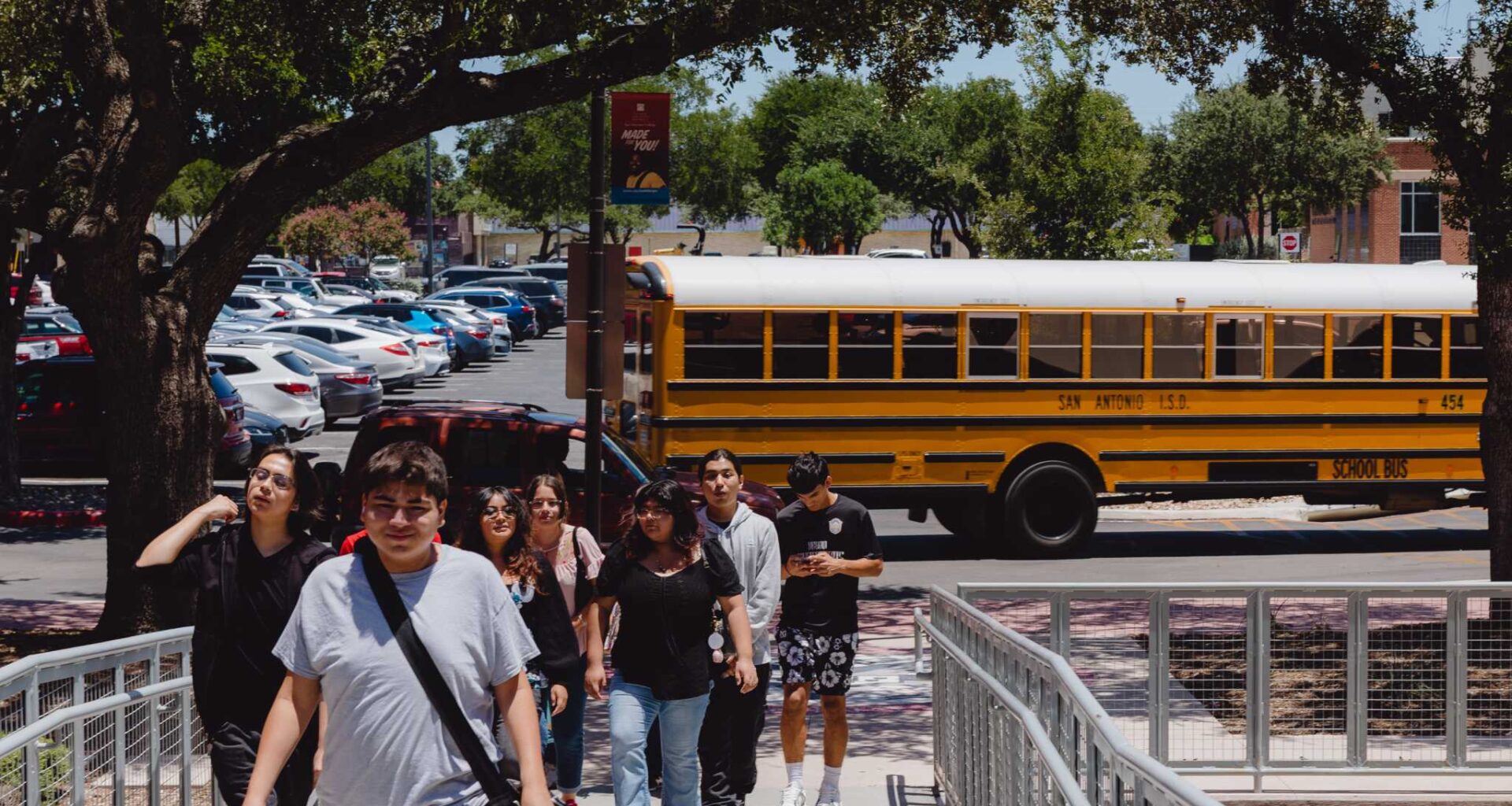
Students from SAISD arrive by a school bus to participate in San Antonio College’s Beat The Heat enrollment program at the Fletcher Administration Building at SAC in San Antonio, Texas on Wednesday, July 23, 2025. San Antonio-area school districts have reported bus driver shortages as the new school year begins.
Christopher Lee/Staff Photographer
As school districts across the country struggle to find enough bus drivers to take kids to class, the North East Independent School District’s bus fleet is the most staffed it has been since before the COVID-19 pandemic.

But driver retention challenges still plague nearby districts, including three of the area’s four largest: Northside, San Antonio and Judson ISDs. San Antonio ISD has 16 bus driver vacancies for about 125 total routes and Judson ISD needs 10 more drivers to be fully staffed, according to the districts.
Article continues below this ad
As of a special board meeting on Aug. 27, Judson’s director of transportation, Earl Stewart, said the district had a total of 84 bus routes and was five drivers short. A full staff includes substitute drivers who can step in when drivers take time off. Their routes typically include three trips — serving the area’s zoned elementary, middle and high schools.
Northside ISD Director of Transportation Tesilia Soliz said the district is experiencing the same transportation staffing challenges affecting districts nationwide. The district currently needs 35 bus drivers and 40 bus assistants to be fully staffed. It also needs 15 minibus drivers, who don’t need a commercial driver’s license to do the job.
Mounting budget deficits at districts across the state exacerbate staffing shortages, making it harder for districts to increase pay to attract new candidates. The state funds school systems at roughly $1 per mile driven by buses, but only for students who live more than two miles away from their schools. The money funds the cost of gas, vehicle maintenance and drivers’ salaries and benefits.
Facing driver recruitment challenges
Facing a budget shortfall of $38 million, Northside ISD froze the transportation department’s staff salaries, Soliz said, instead of providing the usual 2% to 3% pay boost. The freeze only added to pre-existing recruitment and retention challenges, and it forced the transportation department to consolidate some routes to get all students to school each day.
Article continues below this ad
In some cases, the district combined two routes with 30 kids each, putting a bus that can hold 50 to 70 passengers at its maximum capacity, Soliz said. This process doubled each route’s length and significantly increased the time students spend in transit.
“Nobody wants to be on the bus a long, long time, but we’re doing the best that we can with the resources that we have,” she said.
Should Northside voters approve a proposed tax increase on Nov. 3, she hopes the district will use the new money to support employee salary increases for the transportation department once again.
Bus drivers are required to have commercial driver’s licenses to drive their vehicles, and San Antonio’s four largest school districts pay new drivers while they earn the credential. However, school districts usually pay significantly less than other commercial trucking jobs. The Bureau of Labor Statistics shows that semi-truck drivers make $58,640 on average per year, while school bus drivers typically earn $49,390.
Article continues below this ad
The pay disparity makes retention a challenge for many school districts, including both Judson and Northside ISDs. At Judson, transportation administrators have stepped in to temporarily cover bus routes, and some drivers occasionally pick up additional routes.
In an Aug. 27 meeting, Judson ISD trustee Stephanie Jones asked the district’s transportation director about the number of drivers after hearing from community members that the department was understaffed.
“I think there’s a lot in the community making it sound like we have nowhere near the amount of bus drivers we need to service our students,” Jones said.
Stewart explained that issues arise when drivers don’t come into work, but the department isn’t overly understaffed on typical days. He said now that most kids have registered at their campuses, his team will focus on limiting overcrowded buses and making sure students arrive on time.
Article continues below this ad
Where is bus driver retention working?
At North East ISD, the district is in the best staffing shape since before the pandemic, Executive Director of Transportation Bill Harrison said. Most transportation departments mark 2020 as the beginning of a years-long national bus driver shortage, he said.
NEISD currently needs 12 more bus drivers to transport students. In total, the department operates more than 200 routes.
In the first three weeks of school, NEISD has been able to cover all its routes without drivers doubling up or tapping supervisors to drive, he said.
Article continues below this ad
“That’s unheard of since the pandemic,” Harrison said. “It’s just a breath of fresh air.”
Harrison said he didn’t know what made his team so successful while other districts in the area struggled to find or keep drivers, especially since NEISD experienced extreme shortages over the past six years. He said the department’s retention rate has skyrocketed to nearly 80% — of the 52 drivers hired last year, about 40 remain. This is well above the industry norm of 50% driver retention, he said.
Last year, his team needed about 30 more drivers than it had. At the peak of the post-COVID need in 2022 and 2023, the department was 50 drivers short. Harrison expects his team to be fully staffed by Thanksgiving, with 17 drivers currently in training, another 12 in the interview process and 15 more applicants he still needs to contact.
Article continues below this ad
Now, supervisors can focus on supporting drivers rather than stepping in to drive buses themselves, Harrison said. In the past, the shortages made it hard for supervisors to ride along with new staff or help with route or student issues.
While North East ISD’s starting pay of $17.64 is slightly lower than what is offered by some other districts, the district previously gave signing bonuses of up to $2,000. After it discontinued the bonuses last spring, applications continued rolling in at a steady pace.