
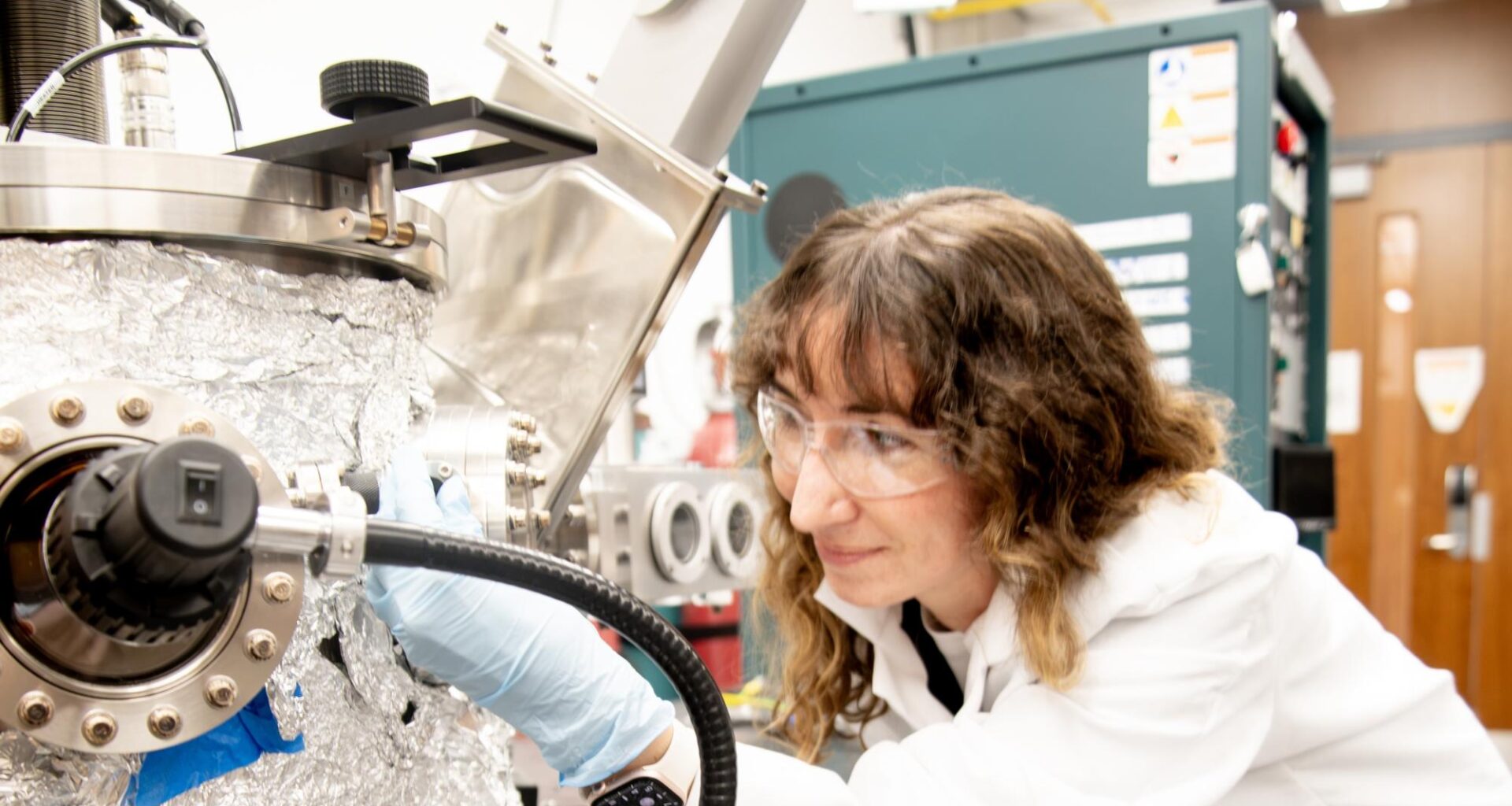
UT researchers have been working on technology that would allow some artificial intelligence to use less energy in a collaboration with the world’s largest semiconductor foundry, according to an Aug. 28 news release from the Cockrell School of Engineering.
Researchers from UT and the Taiwan Semiconductor Manufacturing Company released a paper in August after three years of work that explored the use of spin-orbit torque magnetic random access memory, also known as SOT-MRAM, for AI. According to the news release, SOT-MRAM uses less energy than other memory technologies and does not require data centers to run.
The goal of the project is to reduce AI’s resource requirements without compromising the accuracy of the models, said Jean Anne Incorvia, the faculty lead on the project.
“We can’t just keep pushing more energy and water into these big data centers to train these models,” Incorvia said. “We do need more efficient ways, and that comes back around to, again, from the bottom up. Like how does every waste storage be more efficient?”
Incorvia said the research group will continue working with TSMC even after publishing the paper. Incorvia said interest in this area of study has increased.
“We’re very interested in being creative and thinking forward, but we also want to think about technologies that could actually have a path forward to be used, like in our phones someday, and so that’s where it was really exciting,” Incorvia said.
Electrical and Computer Engineering Department Ph. D. student Vivian Rogers, who joined the study a year ago, said she is excited to continue working with TSMC. Rogers took over from Sam Liu, who began the study and is listed as the paper’s first author, after he graduated.
“TSMC is like this big titan of the semiconductor industry, and to get to collaborate with them on this testing out of this advanced process and trying to find good applications for their new memory chips is like a really crazy opportunity,” Rogers said.
Rogers also said UT itself was a good place to study technology and material science. The UT administration has said it wanted to devote resources to materials science over the past year.
“Working at the intersection of material science, semiconductors and computer engineering is super rewarding,” Rogers said. “We’re really lucky to be in an environment at UT that, at least in the electrical engineering department here, feels very creative, and a lot of it is self-directed in such a way that there’s a lot of support and guidance.”