
Tex-Mex is as Austin as it gets.
While the rage for interior Mexican cuisine and Indigenous techniques recovered by a new generation of chefs has swept over the city during the past few decades, Tex-Mex — by definition a fusion food — is arguably as authentic to this plot of land as longhorns and the Lone Star.
During the past year or so, the most popular theme in this newspaper’s “Jim Duncan’s Austin” series has been the area’s Tex-Mex restaurants. The retired city planner has researched the business histories of more than 40 of them so far.
Article continues below this ad
We offer a roundup of those histories, which include some of the institutions’ ancestors and descendants, in two batches. Part 1: Up to 1975. Part 2: After 1975.
“Collecting and encapsulating these Tex-Mex histories has been a labor of love,” Duncan says. “Although I grew up in South Texas where the cuisine is common, it was not until the late 1950s when, as a University of Texas student, I discovered my apex of Tex-Mex, the El Mat crispy taco.”
Note on these histories: In some cases, especially older businesses, such as the Bertram Building and the Lung family restaurants, the Tex-Mex years are only part of the story. For readers who find that we’ve skipped one of your favorite comfort spots, send nominations for the next round to mbarnes@statesman.com.
1925: Tony’s Café / Tortilla Factory
Tony’s Cafe is visible on the left in the photograph of Capitol Truck and Trailer.
Neal Douglass/Austin History Center
Before he became Austin’s “Titan of Tortillas,” Antonio “Tony” Villasana faced two formidable historical hurdles: the Mexican Revolution and the 1928 Austin City Plan. To escape the revolution, 11-year-old Tony and his family emigrated from Tamaulipas to Austin in 1912. By the mid-1920s, he had opened Tony’s Café, a small eatery near Republic Square, where most of the city’s Mexican residents then lived. In 1928, however, his business was interrupted when city leaders pushed the Hispanic community toward lower East Austin.
Article continues below this ad
After brief downtown stops on Congress Avenue and Brazos Street during the Depression, he relocated to 1300 E. Seventh St. in 1935, where he rebranded the business as Tony’s Tortillas, which was noted on city maps as a corn chip factory. After Tony Sr. retired, Tony Jr. continued to operate the business until financial problems caused it to file for bankruptcy in the 1980s. Tony Sr.’s legacy, however, lived on through his two oldest daughters. Carmen and her husband, Moses Steve Vasquez, founded the Tamale Houses in 1960, and Gudelia and her husband, Camilo Jo “C.J.” Villegas, opened the El Mercado restaurant chain in 1985. Tony Sr. died in 1974, Tony Jr. in 1992, Carmen in 1999 and Gudelia in 2019.
Bean and cheese and carne guisada tacos are served at Joe’s Bakery & Coffee Shop.
Aaron E. Martinez/Austin American-Statesman
Joe Avila’s stepfather and mother, Florentino and Sophia DeLao, opened La Oriental Grocery & Bakery at 2305 E. Ninth St. in 1935. The store was not just a business; it was also the family home. La Oriental flourished until 1957, when the family closed shop and took some time off. In 1961, they reopened at 2217 E. Seventh St. However, due to her husband’s failing health, Sophia sold the bakery to her eldest son, Joe Avila, who had been his stepfather’s apprentice over the years. He renamed the bakery Joe’s Bakery & Coffee Shop and the business boomed.
Article continues below this ad
Joe took on every aspect of running the bakery, working 18-hour days, and soon found himself adding a restaurant. In 1969, he relocated the restaurant two doors down to the old Lott Lumberyard at 2305 E. Seventh St. Joe’s has always been a family affair. In addition to his wife, Paula, Joe’s daughters, Carolina and Rose Ann, joined the business. In 2003, his granddaughter, Regina Estrada, came on board to manage the restaurant and continue the family tradition and the Avila legacy, which began almost nine decades ago. Sophia died in 2009 at the age of 102. Joe died in 2011. In 2023, Joe’s was one of only six restaurants nationally to receive the America’s Classics Award from the James Beard Foundation.
1938: Spanish Village / Pelons Tex Mex
Restaurants, starting with Spanish Village, have been serving Tex-Mex at Red River and East Seventh streets since 1938.
Alberto Martinez/Austin American-Statesman
Before it became the oldest restaurant in Austin to have continuously served Mexican food, the six-room stone structure at 802 Red River St. functioned as a residence for more than two decades. Located near the Capitol and the University of Texas, the restaurant was especially popular with politicos and students. Built in 1915 by Joseph Curry, the structure was converted to a restaurant in 1938 by Jay W. Caldwell. It has since had three more owners: Alexander Alanis “Lupe” Abieta from the mid-1950s to 1979, Jaime M. Tames and Charlie Tames from 1980 to 2011, and Douglas Walter Guller and Tasha Miller from 2012 to present.
Article continues below this ad
For more than 70 years, the restaurant was known by variations of “Spanish Village.” In 2012, it was rebranded Pelons Tex Mex in honor of owner Guller (“Pelons” is Spanish for “bald one”). Abieta died in 1983, Caldwell in 1990 and Jaime Tames in 2007. Today, Spanish Village and Pelon’s salsas and queso are sold online and at Whole Foods, Central Market and Royal Blue Grocery.
1939: Old Seville / El Toro (1954)
The stone building that houses The Clay Pit restaurant dates from 1872. It was home to two Mexican restaurants.
Deborah Lykins/American-Statesman File
Two Tex-Mex eateries are part of the history of the Bertram Building, which sits on the site of a trading post established in 1853 by one of Austin’s earliest pioneers, German immigrant Rudolph Christian Bertram. Located near the northern edge of town, it was one of the few places where Native Americans bartered with white settlers.
Article continues below this ad
On West 16th Street (formerly Cherry) between Guadalupe and Lavaca streets, the current building dates to 1872, when Bertram opened a general mercantile store there. The town of Bertram in eastern Burnet County, built as a cotton hub on the Austin and Northwestern line, was named for him. He died in 1892. In 1883, German immigrant William Andrew Achilles purchased the building and doubled its size. A saloon, carriage house, feed warehouse, blacksmith shop, wheelwright shop and wagon yard were part of the complex by 1889.
He and his family continued to operate Achilles Grocery until 1939, when the building began to host a series of restaurants. Among them were Old Seville Mexican (1939-1954), El Toro Mexican (1954-1974), Red Tomato Italian (1974-1989), Texas BBQ (1991-1995), Bertram’s Restaurant & Bar (1995-1998) and the Clay Pit, which has occupied the building for the past quarter-century.
Tex-Mex Trivia:
The term began as “TexMex,” a shortened version of the Texas and Mexican Railroad, chartered in 1875 — originally without a hyphen — to run from Mexico City across the Rio Grande to points in Texas. By the 1920s, Tex-Mex, with the hyphen, referred to Texans of Mexican descent. Out of that grew the custom of applying the term to food by the 1960s.
Employees prepare breakfast tacos at Cisco’s Restaurant and Bakery, which was founded by Rudy “Cisco” Cisneros in 1945.
Mikala Compton/American-Statesman
One of Austin’s oldest active Tex-Mex restaurants is located in an East Austin building initially occupied by meat-packing companies. From 1914 to 1933, James B. “Jim” Pierce, a rancher who drove cattle up the Chisholm Trail in the 1880s, owned and operated Pierce Brothers Packing Company in the two-story stone building at 1511 East Sixth Street. Over the next decade, the building was occupied by two more packing companies — Austin and Blue Bonnet. In 1945, Rudolf Pena “Rudy” Cisneros moved his father’s bakery into the building. In 1950, he expanded the bakery to include Tex-Mex food. Cisneros is credited with popularizing huevos rancheros and migas.
Article continues below this ad
Popular with politicians, many political deals were hammered out in Cisco’s back room. Known as the “Mayor of East Austin,” Cisneros served on many boards and committees, donated to numerous causes, and sponsored regular civic appreciation dinners. In 1995, Cisneros’s son, Clovis, took over the business. In 2021, Cisco’s brought migas to Muny by opening a satellite café at Lions Municipal Golf Course in West Austin. More recently, Cisco’s ownership expanded to include Cisneros’s grandson Matt Cisneros, Will Bridges, Rick McMinn and Bryan Schneider. Pierce died in 1945 and Rudy Cisneros died in 1995.
1947: El Matamoros / Monroe’s (1952) / El Toro and El Charro (1950s)
El Matamoros, “Home of the Crispy Tacos,” 504 East Ave. in 1957.
Neal Douglass/Austin History Center
Although his restaurants were long ago shuttered, the entrepreneurial legacy of Monroe Monseis Lopez continues to influence Austin’s restaurant industry. He was a restaurateur extraordinaire and is said to have been Austin’s first Tex-Mex millionaire. Lopez opened his first restaurant in 1947 in a four-room house at 504 East Ave., now Interstate 35. He named it El Matamoros, and it was universally known as “El Mat.” It was the first Mexican restaurant to offer crispy tacos, frosted beer mugs and an “all the Mexican food you can eat” special.
Article continues below this ad
In 1952, he opened Monroe’s next door, where he was the first to offer Mexican food to go. Lopez also opened El Toro at 16th and Lavaca streets and acquired El Charro at 10th and Red River streets during the 1950s. In 1980, he closed his four restaurants to devote more time to his other business interests: a radio station and oil and gas exploration. In 1986, Lopez returned to the restaurant scene, joining Ramon Lopez “Ray” Servantez in operating Casa Daniel at 11835 Jollyville Road. Lopez died in 1992. In 1996, Casa Daniel became Antonio’s Cantina. Today, it is the Pour House Pub.
Customers wait to be seated at Matt’s El Rancho in Austin, Friday, Aug. 21, 2026.
Mikala Compton/Austin American-Statesman
Matt Martinez and Janie Gaiton Martinez opened El Rancho in 1952 at East First Street (Cesar Chavez) and San Jacinto Street with $75 cash and a $300 loan. In the beginning, Matt worked the front of the 10-seat café and Janie ran the kitchen. They had no employees. Matt’s dad, Delfino, had immigrated to Austin from Monterrey, Nuevo León, and made tortillas and tamales for a living. Matt had gotten his first taste of entrepreneurship at age six, peddling tamales near the Capitol. El Rancho’s first menu featured only blue-plate specials, such as chicken-fried steak. It was the occasional enchilada special, however, that garnered the most attention, and it wasn’t long before Mexican food took over the menu.
Article continues below this ad
In 1986, Martinez sold the downtown property to the developer of the Four Seasons Hotel Austin for $5 million and relocated El Rancho to five acres at 2613 South Lamar Blvd. Today, Matt’s El Rancho seats more than 600 diners nightly and has the highest alcohol sales of any restaurant in Austin, thanks to margaritas. Of its current $20 million in annual revenue, one-third comes from alcohol sales. Matt’s is still family-owned and operated by daughters, Gloria, Cecilia and Cathy, and daughter-in-law, Estella. Matt Jr. moved to Dallas and became a well-known restaurateur, celebrity chef and author. The elder Matt Martinez died in 2003, Matt Jr. in 2009 and Janie in 2013.
1954: El Patio
El Patio Restaurant closed August 9, 2019, but an ownership group that includes family members of the founder reopened the restaurant the following month.
American Statesman staff
In 1933, Harry Paul Joseph, whose family immigrated to Austin from Lebanon in the 1890s, opened the Schoonerville Drive-In at East 30th and Guadalupe streets just north of UT. Two decades later, his nephew, Paul Christopher Joseph, purchased the café and changed its name to El Patio.
Article continues below this ad
While hamburgers and fried chicken initially stayed on the menu, they eventually gave way to Tex-Mex selections. One of Paul’s popular menu items was the “puffed krunchy taco.”
Signed photos of celebrity regulars, including Darrell Royal, Lady Bird Johnson and Walter Cronkite, hang in spaces not occupied by murals of Pancho Villa. The stone building harkens back to a time when air conditioning was a novelty.
Students who came in and munched on free tortilla chips and salsa while not ordering led Paul to institute an El Patio trademark. He began putting saltines on the table to control costs. Saltines remained an El Patio tradition until the mid-1990s, when the vendor enacted a price increase. Tortilla chips returned, but saltines are still available on request. After shuttering El Patio briefly in 2019, Joseph family members reopened it with manager Jesse Herman. Harry died in 1991 and Paul in 1995.
Mini crispy tacos from Maudie’s Tex-Mex were just one of the many food options.
Austin American-Statesman
From biscuits to burritos, Maudie’s Café has served Austinites a full range of Southern delicacies for more than 70 years. For its first four decades, Maudie Oleta Wilson Hamilton and her husband, Albert, ran a homestyle restaurant at Exposition and Lake Austin boulevards. Her specialties were biscuits and gravy, Southern fried chicken and chicken and dumplings. The merits of Maudie’s were put to song in 1986 by local journalist Winston Bode: “Oh, in Austin on the banks of the Old Colorado, there’s a place they make the world’s best enchiladas. They’re cheesy and greasy and meaty at Maudie’s Café.”
Article continues below this ad
When Maudie retired in 1993, she sold the property to Joseph Anthony Draker, who converted it into a Tex-Mex café. Maudie died in 1995. Roe and Pete Hernandez and Jorge Arredondo helped Draker transform the menu. Over the next two decades, Maudie’s Tex-Mex expanded to six restaurants in Central Texas: Maudie’s (1994), Maudie’s Too (1997), North Lamar (2000), Milagro (2002), Hacienda (2003) and Hill Country (2010).
1957: El Gallo
Owner Abel Kennedy seats a customer at El Gallo on Tuesday, January 24, 2017, shortly after the popular restaurant announced it would be closing after sixty years in business.
Austin American-Statesman
In 2017, skyrocketing property taxes caused another Tex-Mex old-timer to bite the dust. El Gallo was founded by Abraham Gonzales Kennedy and his wife, Maria, in 1957. Except for four years in the early 1980s, the Kennedy family owned and operated the restaurant. Located directly across the street from St. Edward’s University at 2910 South Congress Ave., El Gallo was known for its weekend live music. Interestingly, the restaurant’s name and exterior color were influenced by an early customer who was a sign painter. As a Mexican immigrant, Abraham wanted to name it after some matador with a long name. After he found out that sign costs were calculated by the letter, he branded it with a rooster instead (gallo is Spanish for rooster). As for the pink building, the customer happened to have pink paint on sale at the time.
Article continues below this ad
After Kennedy died in 2000, his son, Abel, and his wife, Jill, ran the restaurant. Maria died in 2015. Despite owning the property and having no liens or debts, Abel decided to sell it in 2017. The reason: His taxes had doubled almost every year for the previous five years. In 2019, St. Edward’s purchased the one-acre property. The vacant fenced lot now bears a sign from the city of Austin that mixed-income housing is on the way.
A gently flowing fountain is the focal point of the lush courtyard of Tamale House East.
Austin 360
From a tiny walk-up window at West First Street and Congress Avenue, Moses Steve Vasquez and his wife, Carmen, sold tamales to hungry downtown Austinites for over two decades. Governor Mark White said, “Tamale House was an institution, and Moses was the master. Best tamales in Austin. Enjoyed them for years. Wish I had six right now.” Carmen Vasquez called it “just a shack. When it rained, customers waiting in line got wet. I felt so sorry for them.” Moses had bought the property in 1969 for $80,000, with $4,000 down, and earned money playing with a Spanish and calypso band. Before that, he rented.
Article continues below this ad
Their five children all helped. Then came the real estate boom of the 1980s, and Lincoln Properties offered them $1.6 million for their “shack” to build a high-rise office building, which was at the time the highest-ever-per-square-foot real estate sale in Austin. They accepted and used the money to open four new Tamale Houses in South Austin (2218 College St.), near the UT campus (2825 Guadalupe St.), Delwood (5003 Airport Blvd.) and East Austin (1707 East Sixth St.). Tamale House East is the only location that remains open. Carmen died in 2001 and Moses in 2014.
Tex-Mex Trivia:
Tex-Mex existed before the name was adopted to describe the cuisine. San Antonio had the “Chili Queens” from the 1860s to the 1940s, and New Braunfels had Gebhardt’s chili powder in 1896. The company moved to San Antonio in 1903. Austin was not far behind.
1962: Cocina del Sur
Joe Lung’s family came to Austin in the 1880s. They owned a series of diners, restaurants and sandwich shops. Later in life, Lung welcomed visitors from around the world at the Capitol Gift Shop. MICHAEL BARNES / AMERICAN-STATESMAN
Austin American-Statesman
From the end of the 19th century to almost the 21st century, three generations of the Lung family owned and operated a series of local, culturally diverse restaurants. Considering their collective culinary contribution to Austin, the Lungs are a serious contender for the local title of “First Family of Food.” It all began in 1899 when Joe Lung, a Chinese immigrant, opened Joe’s Café, an American restaurant, at East Sixth and San Jacinto streets. In 1924, he moved around the corner to 507 San Jacinto St., and his son, Samuel Pete “Sam” took over. At the end of World War II, Sam closed the San Jacinto location. He then opened and operated Lung’s Chinese Kitchen at 1200 Red River St. from 1945 to 1972. It is said that Sam introduced the use of chopsticks to Austin.
Article continues below this ad
From 1962 until 1982, Joe’s grandson Jimmie Joe operated a Mexican restaurant, Cocina del Sur (roughly, “Southern Cuisine”), at 2700 Anderson Lane. It was at Cocina del Sur that Jimmy Buffett had his first frozen margarita and wrote a song about it: “Margaritaville.” Also starting in 1962, another grandson, Joe Michael, opened several sandwich shops downtown and around town. Joe died in 1926, Sam in 1974, Jimmie Joe in 1997 and Joe Michael in 2014.
1963: El Azteca
The late Jorge Guerra, owner of El Azteca Restaurant, at his home in 2016.
Austin American-Statesman
More than four centuries after Hernán Cortés conquered the Aztec Empire, skyrocketing property taxes claimed Austin’s El Azteca restaurant. For more than 50 years, El Azteca had been a popular Austin Tex-Mex eatery at 2600 E. Seventh St. Its founder, Jorge De Jesus Duron Guerra, had immigrated to Austin from Reynosa in 1950 when he was 18 years old.
Article continues below this ad
El Azteca was one of the first local Tex-Mex restaurants to offer vegetarian options. Its menu included something for both herbivores and carnivores. Popular items were cabrito, carne guisada, spinach and mushroom enchiladas, vegetarian tostadas and chile rellenos. Aztec paintings and Aztec calendars covered its interior walls. In 1992, Fiesta Patria named Guerra an “Outstanding Hispanic Citizen,” and in 2000, El Azteca received the Chronicle’s “Most Happily Recovered Vegetarian” award. The restaurant was also featured on an episode of “No Reservations” with Anthony Bourdain, who met up with local music legend Alejandro Escovedo for lunch. El Azteca closed in 2016, and Guerra died the following year.
1973: Casita Jorge’s / Enchiladas Y Mas
The enchiladas verdes, enchiladas rancheros, beef enchiladas and migas at Enchiladas Y Mas on Anderson Lane. photo by Ha Lam/for Austin American Statesman
Austin 360
For four decades, Casita Jorge’s was one of Austin’s most popular Tex-Mex restaurant chains. Founded by George Corpus “Jorge” Arredondo in an old burger joint in East Austin in 1973, it was known for its cheese enchiladas, spicy salsa, tasty barbacoa and frozen margaritas. From 1973 to 2002, Arredondo opened and closed seven more restaurants, including those at 218 E. Sixth St., 2538 Elmont St., 1720 Lavaca St., 304 W. 15th St., 2205 Hancock Drive, 2700 W. Anderson Lane and 1620 N. Interstate 35 in San Marcos.
Article continues below this ad
During that time, he also experienced several legal and fiscal setbacks in the form of lawsuits and foreclosures. Using his recipes and building on the Casita Jorge’s name, however, several of his family members continued to open Tex-Mex restaurants during the 1990s and 2000s. In 1994, two of Jorge’s brothers-in-law, Roumaldo “Roe” Hernandez and Robert Martinez, opened Enchiladas Y Mas at 2804 N. Interstate 35. Soon after opening, they received the Austin Chronicle’s award for “Best Chorizo Migas.” Needing more space, they moved to 1911 W. Anderson Lane in 1999, where they doubled their number of tables and added a full-service bar. Today, Enchiladas Y Mas is the only direct descendant of Casita Jorge’s still operating.
1972: Rosie’s Tamale House
The combination plate No. 1’s beef taco at Rosie’s Tamale House.
Amber Novak/For American-Statesman
For more than 50 years, Rosie’s Tamale House has been a primary source of Tex-Mex food in far West Travis County. It all began when Joe Estanislas Arriaga and his wife, Mary Rose, opened Rosie’s in 1972 in an old vacant gas station at the corner of Texas 71 and FM 620. Eventually, the restaurant became a family affair involving their daughter and five sons. In 1984, they lost their lease and moved farther west to 13436 Texas 71.
Article continues below this ad
From day one, Rosie’s has been a popular stopover for those heading to Lake Travis and the Hill Country. A review by Roadfood described it as “a rough-and-tumble roadside eats place that sells excellent Mexican food at rock bottom prices.”
Rosie’s has had its share of celebrity customers, including Darrell Royal and George Strait. They also have a Willie’s Plate named after their Spicewood neighbor. Unfortunately, the Arriagas were not able to transfer their success in the boonies to the big city. During the economic downturn of the 1980s, they opened a second café in Lincoln Village on North Interstate 35. It lasted only five years. In 1993, they tried again at 13776 Research Blvd. It closed in 1997. Joe died the same year.
El Arroyo displays an Election Day themed sign during Mayor Kirk Watson’s mayoral election watch party in Downtown Austin Tuesday, Nov. 5, 2024.
Mikala Compton/American-Statesman
El Arroyo has become as well known for its iconic sign as for its Tex-Mex. Founded by Robert Lee Ogden and his wife, Mary, in 1975 at 1624 W. Fifth St., it was owned and operated by University of Texas business graduate Joseph Clayton “Clay” McPhail and UT football legend Lowell Douglas “Doug” English from 1978 until 2012, and then by Ellis Brian Winstanley and his wife, Paige. The restaurant is also called “The Ditch” because it was built over a drainage channel, and arroyo is Spanish for “ditch.”
Article continues below this ad
El Arroyo attracts diners not only with its Tex-Mex menu and margaritas but also with its world-famous changeable sign. With daily puns and musings that are funny, uplifting, snarky and timely, the sign has become a social media fixture. With more than 660,000 followers across all platforms, the marquee has taken on a life of its own. The restaurant also publishes picture books of the signs and has received recognition from celebrities. In 2020, the cast of “Queer Eye” posed in front of the sign while in town filming the series. The first sign ever read: “Warning: All traffic must exit — entering Tex-Mex zone.” Police made Ogden change it because so many people were slamming on their brakes and pulling in. McPhail’s favorite sign was “El Arroyo: Conveniently located near most hospitals,” and Winstanley’s was “The Last Queso Stop Before a Bunch of Yoga Studios.”
1975: Fonda San Miguel
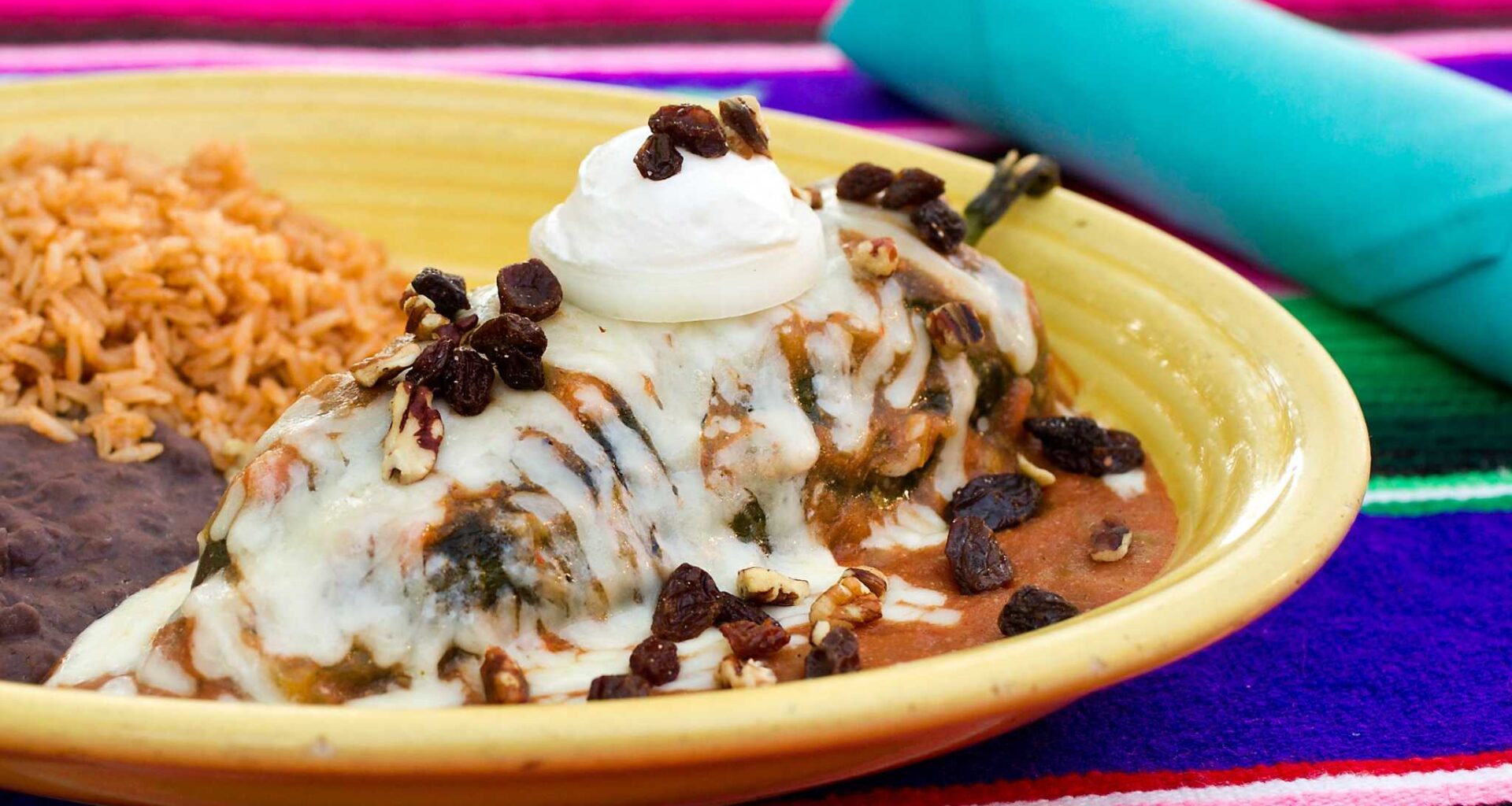
Fonda San Miguel serves some of the best chiles rellenos — maybe the best — in town.
Tracey Maurer/Fonda San Miguel
Is this part of Austin Tex-Mex history? We think so. Founded in 1975 at North Loop Boulevard and Woodview Avenue near Hancock Drive, Fonda San Miguel was one of the first restaurants in Texas to focus almost exclusively on authentic regional cuisine from Mexico’s interior culinary traditions. It transports diners to a stylish restaurant in Mexico City, Oaxaca or the Yucatán. But Fonda is more than a fine Mexican restaurant; it is also an unofficial art gallery, social salon and culinary archivist. Co-founder and owner Tom Gilliland has presided over Fonda for its full 50 years.
Article continues below this ad
His co-founder, Miguel Ravago, died in 2017. Gilliland continues to honor Ravago’s legacy with an ongoing commitment to Mexican cuisine and hospitality. On most nights, you’ll find him circulating in the dining room, greeting old and new customers. Recently, Gilliland opened a new restaurant next door called Tzintzuntzan, which translates to “Place of Hummingbirds.” It serves breakfast and lunch, meals not offered at Fonda San Miguel.