
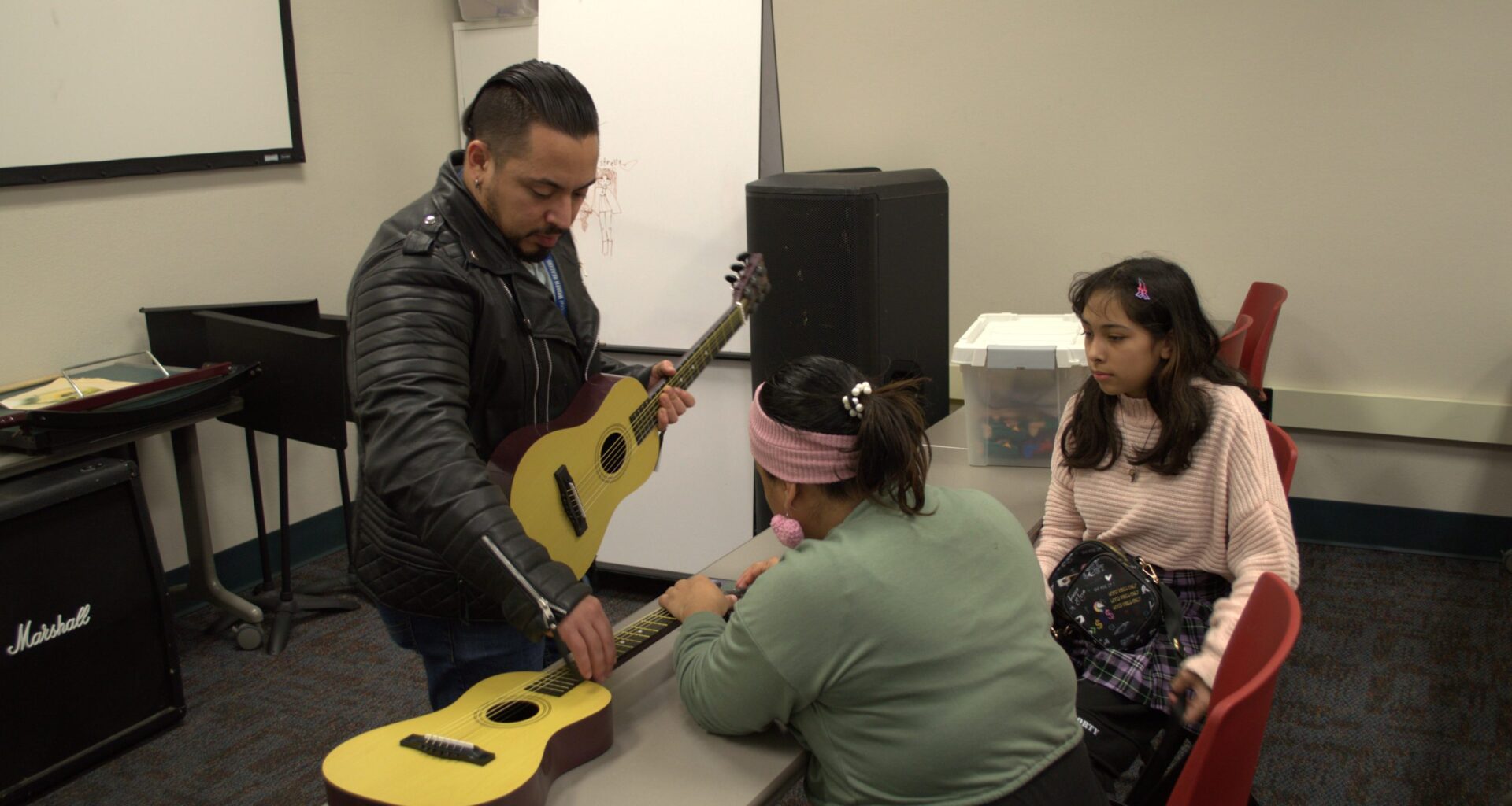
Music has been a defining part of 17-year-old Axel Aguayo’s life.
When he was around 7, his parents bought him a brown acoustic guitar from a garage sale. Aguayo later spotted a flyer advertising guitar lessons with Erick Ibarra. His mom signed him up, and he studied under Ibarra for the next five years.
“Ibarra taught me how to play different songs, chords and melodies,” Aguayo said. “I owe a lot to him.”
Now Ibarra is bringing free music education to underserved communities through the Music 4 Libraries Project. He has partnered with libraries to provide instruments and lessons to show kids like Aguayo the power music has to connect and transform lives.
The Music 4 Libraries Project starts with sound exploration, introducing children to basic music concepts. Advanced stages include guitar lessons, often with donated instruments, as the project seeks to acquire more guitars to expand its offerings. Ibarra’s goal is a national network of libraries hosting music ensembles.
In Forest Hill, the timing was perfect. Executive director Michael Hardrick said the library was already exploring ways to revamp story time by bringing more music when Ibarra reached out.
“It was good timing,” Hardrick said. “Music and literacy go hand in hand. When you think about the alphabet, you sing it.”
The library launched sessions in topics ranging from music theory to jam sessions in October.
“Learning music is a lifelong skill that kids will be able to use in other areas of their lives,” Hardrick said.
‘Love at first touch’
For Ibarra, 39, music did not come as early. Growing up in Caracas, Venezuela, he didn’t pick up a guitar until he was 17.
“I remember the first time I grabbed a guitar, it was love at first touch,” Ibarra said.
Self-taught at first, his dedication carried him into two conservatories, where he became a section leader of the Simón Bolivar Guitar Orchestra. He also earned a bachelor’s degree in library science at Universidad Central de Venezuela.
In 2016, Ibarra immigrated to the United States. Starting over meant taking jobs outside his field before landing in a public library in 2019. Still, he was searching for a way to combine music and education while serving his community.
That vision evolved into the Music 4 Libraries Project, which offers music lessons in underserved communities for all ages.
“Music is a way to communicate and be free,” Ibarra said.
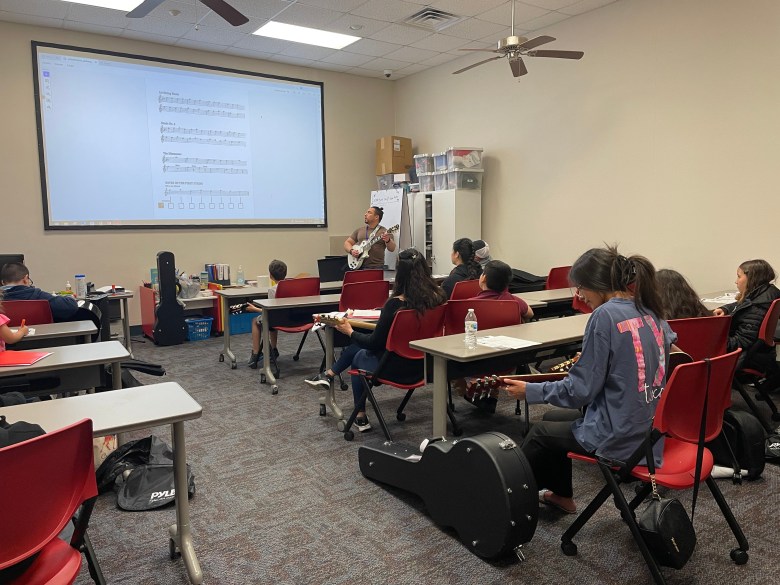 Erick Ibarra picked up his first guitar at 17. Since then, he’s joined two conservatories, and became a section leader of the Simón Bolivar Guitar Orchestra. (Courtesy photo | Erick Ibarra)
Making music accessible
The program makes music accessible.
At Azle Memorial Library, assistant library director Victor Gonzalez said its program is a free, six-week course for beginners that requires participants to bring their own acoustic guitar.
Typically, guitar lessons range from $70 to $100 across the United States, according to the ArtMaster website.
“Music is essential,” Gonzalez said. “It’s cathartic, healing, and it meets people where they’re at.”
Both libraries are seeking instrument donations to expand opportunities.
“People can achieve whatever they want with effort,” Gonzalez said. “Libraries speak to those who want to achieve the most in life, and music is a perfect way to do that.”
Sparking an inspiration
The impact of accessible music lessons is evident for Aguayo.
He grew up surrounded by a family of musicians. His grandfather, a mariachi, gave him his first guitar lesson when he was 7.
“He told my parents, ‘He learns quickly,’” Aguayo said.
By 10, Aguayo’s love for music deepened while listening to a guitar solo from Bunbury’s “Más alto que nosotros sólo el cielo.”
“I want to learn how to play guitar like that,” Aguayo said. “That’s when I asked my parents to buy me a guitar.”
Today, Aguayo plays guitar, bass, drums and keyboard. He performs with a band and credits Ibarra for teaching him new techniques.
Aguayo believes programs like Music 4 Libraries can spark inspiration in kids, as it did for him.
“Music connects people,” he said. “It gives you a place to belong.”
Orlando Torres is a reporting fellow for the Fort Worth Report.
At the Fort Worth Report, news decisions are made independently of our board members and financial supporters. Read more about our editorial independence policy here.
Related
Fort Worth Report is certified by the Journalism Trust Initiative for adhering to standards for ethical journalism.
Republish This Story

Republishing is free for noncommercial entities. Commercial entities are prohibited without a licensing agreement. Contact us for details.