
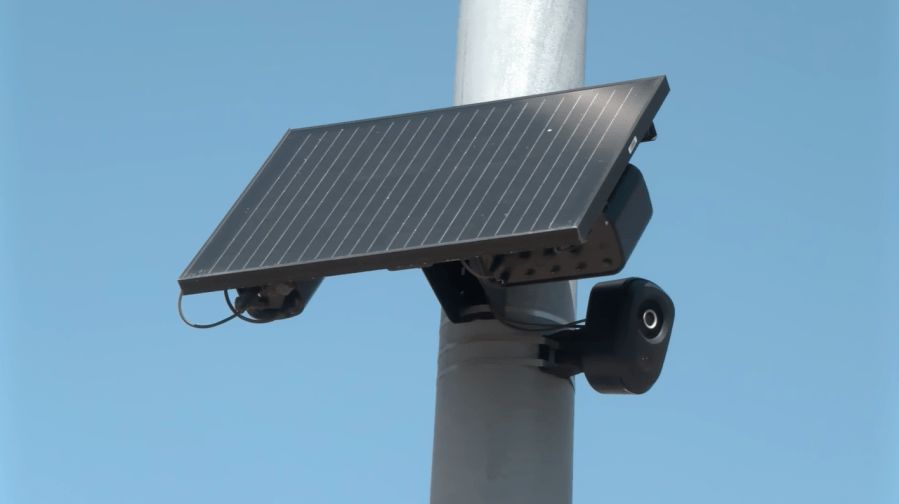
EL PASO, Texas (KTSM) — The El Paso City Council voted unanimously Tuesday, Sept. 15 to remove fixed Flock cameras tied to the City’s former contract and require council approval before similar technology can be used again.
Flock cameras are automated license plate readers, or ALPRs, that scan license plates and collect details about passing vehicles. Police can search that information while investigating crimes.
The vote applies only to the 150 cameras included in the city’s former agreement with Flock Safety. It does not affect cameras operated by private businesses or other organizations.
Separate mobile license plate readers installed in El Paso Police vehicles are also not affected and will remain in use.
The first measure directs the city manager to ensure the fixed Flock cameras and related equipment are removed from City property and rights-of-way within 60 days.
Flock owns the equipment, and El Paso Police Chief Peter Pacillas said the company has already been notified that the City will not renew its agreement and that it needs to retrieve the cameras..
City Rep. Chris Canales added an amendment addressing what happens if the equipment is not removed within that period. Any remaining cameras would be covered with opaque material for up to 30 additional days to ensure they are not being used or collecting data while removal is completed.
The second measure prevents the City from signing, renewing or extending an agreement with Flock or another company offering similar fixed license plate-reading technology unless the City Council approves it.
The decision follows Gov. Greg Abbott’s move in August to suspend state funding for automated license plate reader programs. EPPD then stopped using its state-funded Flock cameras and ended its agreement with the company.
City Rep. Josh Acevedo said the Police Department had placed safeguards on its use of the technology, but concerns remained about the company.
“Chief, I appreciate you putting all those guardrails in, but we can’t trust the other party,” Acevedo said during Tuesday’s meeting.
Several residents also urged council members to remove the equipment, raising concerns about privacy, data sharing and what they described as mass surveillance.
Pacillas defended the cameras as an effective investigative tool. He said the system generated more than 20,000 hits and that the department found no misuse by EPPD employees.
“Just since the time we shut down the fixed ALPRs out there, auto thefts have gone up 62%,” Pacillas said.
Pacillas did not specify during the interview what period the 62% increase was compared with. He said losing the fixed cameras means investigators must rely on more time-consuming manual methods to identify vehicles and develop leads.
Canales acknowledged that the cameras have helped police and said there were no known problems with EPPD’s use of the system. However, he pointed to reported cases of misuse and improper data sharing in other parts of the country.
“We’ve never seen a particular problem necessarily here with the El Paso Police Department and their specific use of Flock,” Canales said. “But we have seen problems that have arisen in all kinds of other places around the country.”
Pacillas said data collected under the City’s agreement is subject to a rolling 30-day retention period. Unless it is needed for an investigation, the information is purged from the system.
The city manager will now work with Flock and the City Attorney’s Office to carry out the removal. City staff is still determining what the removal could cost if Flock does not retrieve the equipment.
Copyright 2026 Nexstar Media, Inc. All rights reserved. This material may not be published, broadcast, rewritten, or redistributed.For the latest news, weather, sports, and streaming video, head to KTSM 9 News.