
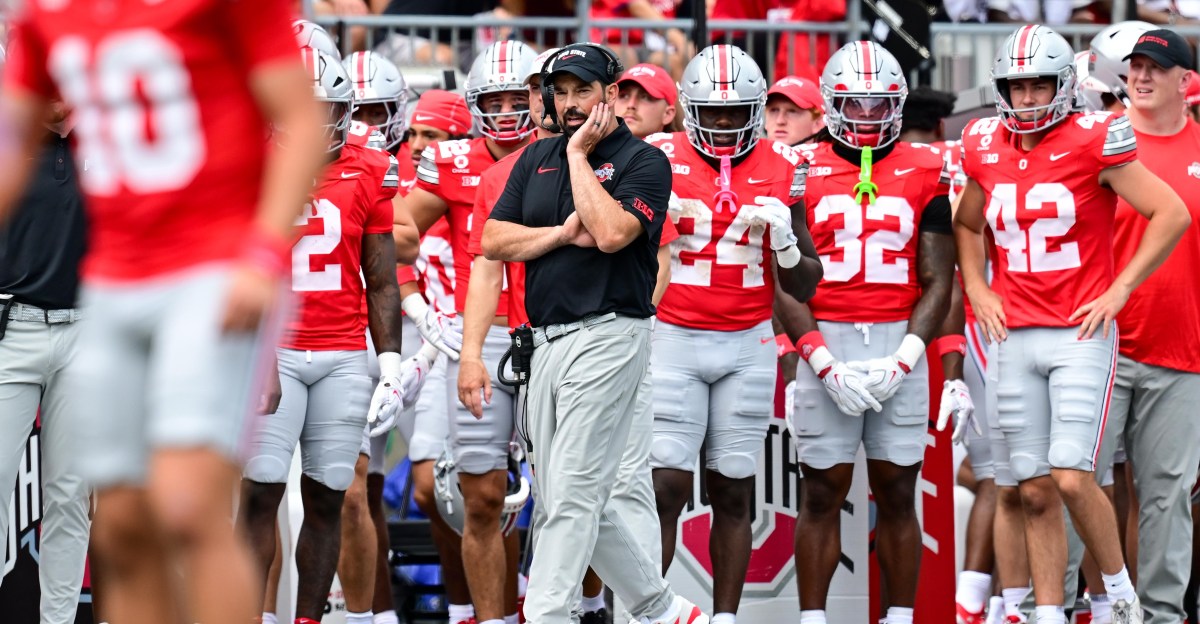
There is no universe in which blowing a 23-3 fourth-quarter lead is a good thing. The then-No. 1 Ohio State Buckeyes had thoroughly dominated the No. 4 Texas Longhorns in Austin, in front of 105,000 people, and somehow managed to turn what should have been a statement win into one of the most frustrating losses of the Ryan Day era. Texas scored 21 unanswered points in the final quarter, while the Buckeyes managed to transform from an aggressive, confident, dominant force into a team seemingly focused solely on getting the game over with as quickly and quietly as possible.
So, no, I’m not going to try to convince you that a loss of this magnitude is somehow a good thing; it is objectively awful. But as a terminally biased Ohio State fan, I can’t help but try to find the silver lining to that catastrophic outcome, and I think I might have found one.
History suggests that beyond having tape against a title-worthy opponent or getting to see young players in high-pressure situations, there could be another unexpected benefit to what happened in Austin, because Ryan Day’s teams have often been at their best when they are angry, doubted, embarrassed, and/or backed into a corner.
I’m sure I don’t need to remind you, but two seasons ago, Ohio State suffered a loss that was exponentially more humiliating than Saturday’s. The Buckeyes were 10-point favorites against their rivals, playing at home against a 6-5 Wolverine team, and somehow lost 13-10. It was Ohio State’s fourth consecutive loss in The Game, and for the next three weeks, everyone in Buckeye Nation was staking claim to their own unique hot take about Day’s future, his toughness, his program’s culture, and whether the Buckeyes were fundamentally incapable of winning when the pressure was highest (myself included).
Then, with their backs against the wall, they became an absolute buzzsaw. Ohio State beat Tennessee 42-17, avenged its earlier loss to Oregon with a 41-21 demolition in the Rose Bowl, beat Texas 28-14 in the Cotton Bowl, and finished the job against Notre Dame, 34-23, to win the national championship. That four-game stretch came against teams ranked Nos. 7, 1, 3, and 5 at the time, respectively.
After the Tennessee game, Day admitted as much, saying, “Our backs were against the wall.” And apparently, that is where Ohio State occasionally needs its back to be.
But that’s not the only example. After the Buckeyes’ heartbreaking 29-23 loss to Clemson in the 2019 College Football Playoff semifinal — a game that I will go to my grave shouting was stolen by the officials — Day’s team got another shot at the Tigers the following season. Ohio State had lost all four previous meetings with Clemson and entered the 2020 semifinal with a nearly unhinged amount of animosity that is usually reserved only for TTUN.
The Buckeyes responded by absolutely obliterating Clemson, 49-28, as Justin Fields threw for 385 yards and six touchdowns.
Even in 2022, following another devastating loss in The Game that seemingly knocked Ohio State out of the playoff, the Buckeyes got unexpectedly resurrected by the selection committee and came within a missed field goal of beating an undefeated Georgia team that went on to win its second straight national championship. After losing 45-23 to Michigan, Ohio State looked like a completely different team against the Bulldogs (thanks to a very different coaching philosophy), putting up 41 points and pushing the eventual champs to the final seconds.
Obviously, none of this guarantees anything about 2026. Maybe Saturday exposed problems that will continue to plague the Buckeyes all season. Maybe Day’s maddening tendency to get conservative with a lead reappears in another marquee game. Maybe the offensive line problems, special teams mistakes, and second-half disappearance become trends rather than anomalies.
While those questions are currently unanswered, one thing that we do now know is that perfection is gone. I often think of Ohio State as having oldest child syndrome. As the most popular college football team in the country and the most consistently successful program in college football history, to me (an oldest child), the Buckeyes can feel like they carry an inordinate amount of pressure and responsibility when they take the field. This can lead to the team and coaches looking like a group of high-strung perfectionists who are sensitive to criticism and unnecessarily on edge at all times.
But this Ohio State team doesn’t have to worry about being perfect anymore; they don’t need to protect an undefeated record, and they don’t have to spend every Saturday trying to justify being ranked No. 1.
Now they get to just go play football, and hopefully they are pissed off about it. And, strangely enough, I actually think that’s a healthier place for a Ryan Day-coached team to live.
His most talented teams have sometimes been tightest when they were expected to dominate; there have been plenty of moments when the fear of making a misstep seemed to prevent Ohio State from reaching its potential, when the staff seemed to be coaching not to lose, rather than to win. But give Day and his players something to rally around — disrespect, revenge, elimination — and there have also been moments when that anxiety turns into aggression, when that fear turns into focus, when that embarrassment turns into execution.
That certainly doesn’t excuse what happened in Austin; Ohio State should have won Saturday night, and nothing that happens over the next three months will change that fact. But if the Texas loss gives this team the same kind of edge that the Michigan loss gave 2024’s national champions, then perhaps someday we will look back on that miserable quarter and a half at DKR not as the moment Ohio State’s season fell apart, but as the moment the Buckeyes finally got the chip on their shoulder that they apparently need to have to play their best football.