

We’re trading the Colorado River for the rivers of Mars!
Billions of years ago, water flowed across the Red Planet, and scientists are studying the evidence left behind to better understand what Mars looked like in its ancient past and whether it once had the right conditions for life.
Dr. Timothy Goudge and Kristen Batalia with UT Austin’s Environmental Science Institute joined Sierra Waggoner and Trevor Scott on We Are Austin to preview “Big Rivers on Mars!,” the latest edition of Hot Science – Cool Talks.

Dr. Timothy Goudge and Kristen Batalia with UT Austin’s Environmental Science Institute joined Sierra Waggoner and Trevor Scott on We Are Austin to preview “Big Rivers on Mars!,” the latest edition of Hot Science – Cool Talks.
Bringing science to life
“Hot Science – Cool Talks is a fun, family-friendly lecture series from the Environmental Science Institute at UT Austin,” Batalia said.
Each event features an expert exploring a different scientific topic, but the experience goes beyond sitting through a lecture.
Friday’s event begins with hands-on, interactive activities where guests can engage with scientists and get a taste of what it’s like to do the work themselves.
“They’re going to feel like scientists for the evening,” Batalia said.
Guests can explore 3D landscapes of Mars, analyze rock and mineral samples and even test the water quality of local rivers. After the activities, attendees will head into the auditorium for a special musical performance before Goudge takes the stage.
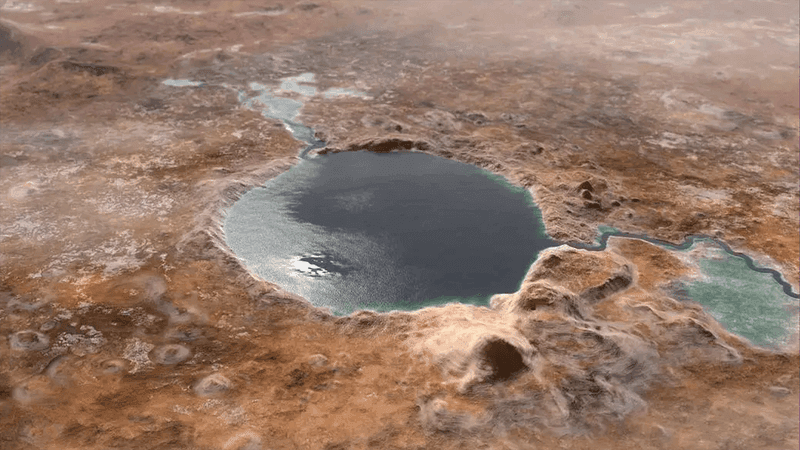
“Life as we know it, on Earth at least, water is one of the key ingredients,” Goudge said. “It’s not the only ingredient, but it’s one that, as we understand it, life everywhere requires.”
Why water on Mars matters
One of the biggest questions scientists are trying to answer is whether life ever existed on Mars.
Water could provide an important piece of that puzzle.
“Life as we know it, on Earth at least, water is one of the key ingredients,” Goudge said. “It’s not the only ingredient, but it’s one that, as we understand it, life everywhere requires.”
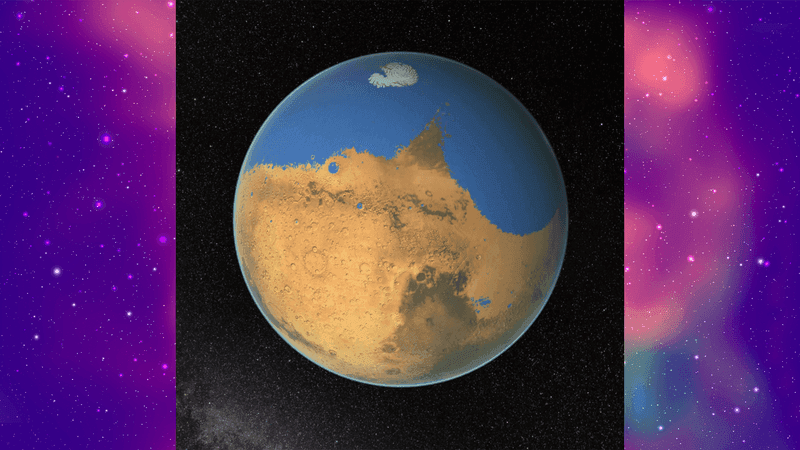
Scientists believe Mars had water on its surface around 3.5 billion years ago. Goudge said evidence suggests the planet was once habitable, but he stressed that being habitable is very different from being inhabited.
“That does not mean there was life there,” Goudge said. “The conditions were right for life, but we still don’t really know if there ever was life.”
Understanding the history of water on Mars can help researchers determine whether the planet once had the conditions necessary for life to develop and survive.
Dr. Timothy Goudge and Kristen Batalia with UT Austin’s Environmental Science Institute joined Sierra Waggoner and Trevor Scott on We Are Austin to preview “Big Rivers on Mars!,” the latest edition of Hot Science – Cool Talks.
Reading the rocks from millions of miles away
Scientists don’t have to stand on Mars to study its ancient rivers.
Goudge said much of his research relies on data collected by satellites orbiting the planet. He compared the process to switching on satellite view while using Google Maps.
Instead of searching for roads, buildings or parking lots, researchers examine rocks exposed across the Martian surface.
“The history of Earth and other planets is recorded in its record of rocks,” Goudge said. “We use those rocks to try and reconstruct those past environments.”
Those observations can help scientists identify evidence of ancient waterways and piece together what Mars may have looked like billions of years ago.
So, was there ever life on Mars?
Friday’s event begins with hands-on, interactive activities where guests can engage with scientists and get a taste of what it’s like to do the work themselves.
That question remains unanswered.
“If I had the answer to that, I would be much richer than I am right now,” Goudge joked.
Researchers hope future exploration, including efforts to bring Martian samples back to Earth for laboratory analysis, can provide more answers.
For Goudge, either possibility would be fascinating.
“It tells us: is life unique on Earth or is it kind of just the normal thing that happens?” he said. “The answer either way is super fascinating about what it means for life in our solar system and potentially beyond.”
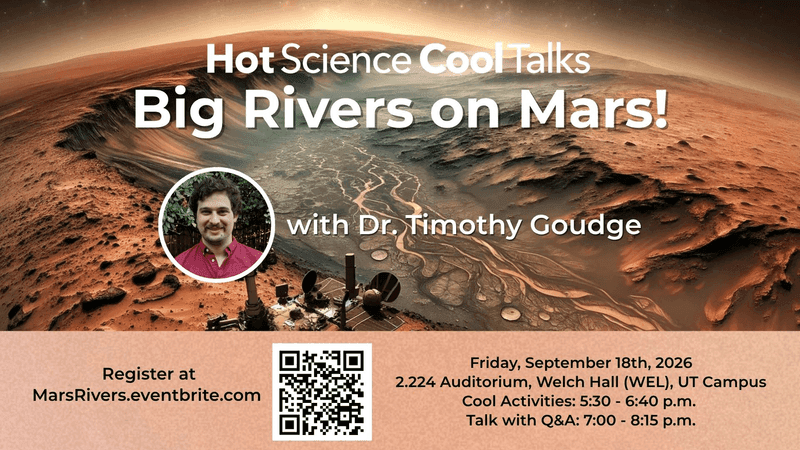
“Big Rivers on Mars!” takes place Friday, Sept. 18, as part of UT Austin’s Hot Science – Cool Talks series.
The event is free, but Batalla recommends reserving a spot in advance because tickets can go quickly.
Visit HotScienceCoolTalks.org for tickets and more information.
Watch the interview above to hear Dr. Timothy Goudge and Kristen Batalia explain what Mars’ ancient rivers could reveal about the Red Planet and the possibility of life beyond Earth.

Visit HotScienceCoolTalks.org for tickets and more information.