
Gerald Kuhlman smiles no matter how the ninepins fall.

Beaming like a Santa Claus in blue jeans with a shave and a haircut, the rosy septuagenarian sauntered up to his team’s lane at Bexar Bowling Society, a private club in Marion, east of San Antonio. Here, Bexar is pronounced “bex-ar,” as German immigrants once pronounced the name of the county.
While his teammates huddled around their beers, Kuhlman rolled a thunderous strike, make that a “ringer,” knocking down all nine pins. They were arranged in a diamond with a red pin at the center like the eye of a storm.
Article continues below this ad
A teenage pinsetter with long, dark hair hopped down from his perch between the lanes to reset the fallen pins and roll back Kuhlman’s ball for his next turn. Meanwhile, one of Kuhlman’s teammates scribbled the score on a schoolroom chalkboard near the bowling pit. Dark wooden benches ringed the pit and complemented the khaki walls and ceiling.
MEMORIES TO SPARE: The bowling alley legacy of San Antonio’s Deco Ballroom
Throughout his life, Kuhlman has played to win at just about every recreational sport from softball to snow skiing. But when it comes to ninepin …
“I just enjoy the game and I try my best,” the former cattle runner and train engineer said. He then nodded toward a table of young men in mesh trucker hats.
Article continues below this ad
“We all want to win,” Kuhlman said. “But it’s like … I told them when they come out here. Come and enjoy the game. Enjoy your friends, and have a good evening.”
That’s the charm of ninepin bowling, an older spin on the modern game that takes you back to a simpler time.
Gerald Kuhlman laughs while talking with his bowling teammates at Bexar Bowling Society in Marion.
Andrew J. Whitaker/San Antonio Express-News
A German import two centuries old, ninepin bowling was once a national pastime before baseball even vied for the title. It’s a precursor to the tenpin bowling we know today, one whose colorful past some say led to the addition of the extra pin to bring the game out of the metaphorical gutter. It’s also a recreation steeped in community and social gathering, where generations of players and pinsetters light up both ends of the lanes to the cheers and cheerful ribbing of their friends and loved ones.
Article continues below this ad
“There’s just a different feeling,” said Bexar Bowling manager Shelly Grunewald between beer orders at the front counter. “It’s nostalgic. It’s family.”
And a tight-knit family at that. Ninepin bowling is now limited to just a cluster of clubs north and east of San Antonio.
But make no mistake. The game that most of the nation and state forgot still has plenty of frames left to rekindle old memories and make new ones.
Blake McCall slides while bowling during league night at Bexar Bowling Society. Ninepin bowling was once a national pastime before baseball even vied for the title.
Andrew J. Whitaker/San Antonio Express-News
The lone state of ninepin
Texas is the only state in the country with organized ninepin bowling clubs, which number only around 18. A bowling pin for each club overlooks the Bexar Bowling Society’s four lanes.
Article continues below this ad
Most of the clubs dot rural outskirts within a 30-mile radius from San Antonio. Around half occupy Comal County around New Braunfels, no surprise given the city’s rich German heritage. Another three triangulate just north of Canyon Lake. And three others inside Loop 1604 — Highland Social Club (2929 S. W.W. White Road), Martinez Social Club (7791 FM 1346) and Turner Bowling Club (5555 Duffek Drive in Kirby) — split their ninepin offerings with other amusements.
REMEMBER WHEN: Readers respond with memories of Stowers store, ranch
Then there are two of the oldest ninepin alleys in the country, divided by a winding bend of Cibolo Creek.
One of them is Bexar Bowling, established in 1895 in the county that bears its name. The other is Germania Bowling Club, established in 1889 in neighboring Guadalupe County, less than a half-mile away on the other side of the creek.
Article continues below this ad
The oldest alley with a modern touch
Like Bexar Bowling, Germania also celebrates its German roots in both phonetics (Germania is pronounced “grr-mah-nia”) and in its original name, Germania Schuetzen Verein or “German Shooting Club,” a nod to the site’s origins as a rifle club. Germania also employs teenage pinsetters, who sit behind a fenced partition over the pin decks that looks like a long carnival dunk tank.
Even the country’s oldest operating ninepin club has moved a little with the times. Germania uses giant flat-screens for scoreboards and touchscreen tablets to input names and numbers. A few years ago, it even began accepting credit cards—a big change in a sport where most clubs remain cash-only.
Article continues below this ad
GAME ON: How San Antonio arcades keep classic gaming culture alive
And like Bexar, Germania also has its share of lifelong players.
“I was born into it,” said Germania bowling alley manager Tammie Zook. “Mom and dad bowled. Ever since I could pick up a ball I have bowled. As long as I can remember, I’ve always been here.”
Zook grew up knocking down pins and setting them up at ninepin clubs such as Cibolo and Marion but calls Germania home. It’s where her father, 83-year-old Ralph Reininger, still bowls. And where her granddaughter, 16-year-old Kay Zook, now picks up pins after every roll.
Article continues below this ad
Brylie Brietzke, 16, sits in the back of the lanes at Germania Bowling Club. In ninepin, families and teenage pinsetters keep the Texas tradition alive.
Andrew J. Whitaker/San Antonio Express-News
Colton Krueger, a pinsetter at Germania Bowling Club in Marion, watches as bowling pins tumble during a game. Germania is the country’s oldest operating ninepin club.
Andrew J. Whitaker/San Antonio Express-News
Understanding the game
To understate the obvious, ninepin is different from its popular tenpin cousin.
Article continues below this ad
In ninepin, eight pins are arranged in a diamond pattern instead of a triangle, with the red ninth pin or “king pin” set in the center. The pins are also placed farther apart, which means more dreaded splits than in tenpin bowling.
A ninepin game has six frames instead of 10 with teams of up to six players. Each team has its own lane, and each bowler rolls twice no matter what they score with the first ball. The team’s captain or “caller” declares the rotation for each frame. The lineup is not fixed, so a bowler who started the first frame could roll last in the next if it helps the team rack up more points.
Which brings us to scoring. The team with the highest combined score wins in ninepin, though it pays to keep the red pin standing.
A strike in ninepin is called a “ringer” for nine points, while a roll with just the red pin left is a “ringer 12” for 12 points. If the bowler does not “ringer” in the first turn, the bowler rolls the second ball for a spare. A spare could be nine points if all the remaining pins fall or 12 points if only the red pin remains.
Article continues below this ad
Here’s where teamwork comes into play: If a bowler does not roll a spare on the second turn, the next bowler must clean up the remaining pins or “dead wood” before all the pins are reset. Hence the strategy to switch players around based on their strengths and weaknesses to take care of what’s left.
Left, Parker Atzenhoffer, a pinsetter at Bexar Bowling Society, sets up the pins during league night. Top right, Reagan Sikes kisses his ball before he throws his frame at Germania Bowling Club. Bottom right, Gerald Kuhlman puts on his bowling shoes before league night at Bexar Bowling Society.
Andrew J. Whitaker/San Antonio Express-News
BATTER UP AND BOWL: Taroko Sports sets San Antonio opening of massive baseball entertainment venue
There is no perfect game in ninepin bowling. (“Most of us think the red pin has a magnet in it,” Grunewald said with a giggle.) But a perfect frame can happen.
Article continues below this ad
Behold, Donald Engelhardt, a 71-year-old bowler at Bexar who has been playing since he was the same age as the number pins in the game.
At one point, Kuhlman left four pins standing for Engelhardt to clean up. Engelhardt stepped forward and swept away the stragglers with ease.
Engelhardt once scored back-to-back 12 ringers. He noted when he and his fellow players were younger, maybe 18 or 19 years old, everybody played for “blood and guts.” One time he punched a wall after a botched roll and nearly broke his knuckles. Nobody missed back then, he said.
“Now we miss, it don’t matter,” he said. “It used to be a serious game. The older you get, it’s not as serious.”
Article continues below this ad
Back at Germania, teammates Marc Castilleja and Josh Guenther peppered the scoreboard with 9s between swigs and snacks. Guenther, a bearded 45-year-old, started bowling ninepin at 20. Eight years ago, he introduced his friend Castilleja, 49, to the sport.
“It’s been fun ever since,” Castilleja said.
Castilleja and Guenther, along with teammates including veteran bowler Kimberly Doege, 63, noted most teams play for drinks and laughs. Some pool quarters for the next round, while others pick a card from a standard deck. Sure, it’s a sport with leagues and competitions. But most nights?
“I mean, when I started I was just here for the beer,” Guenther said to laughs around his team’s table.
Article continues below this ad
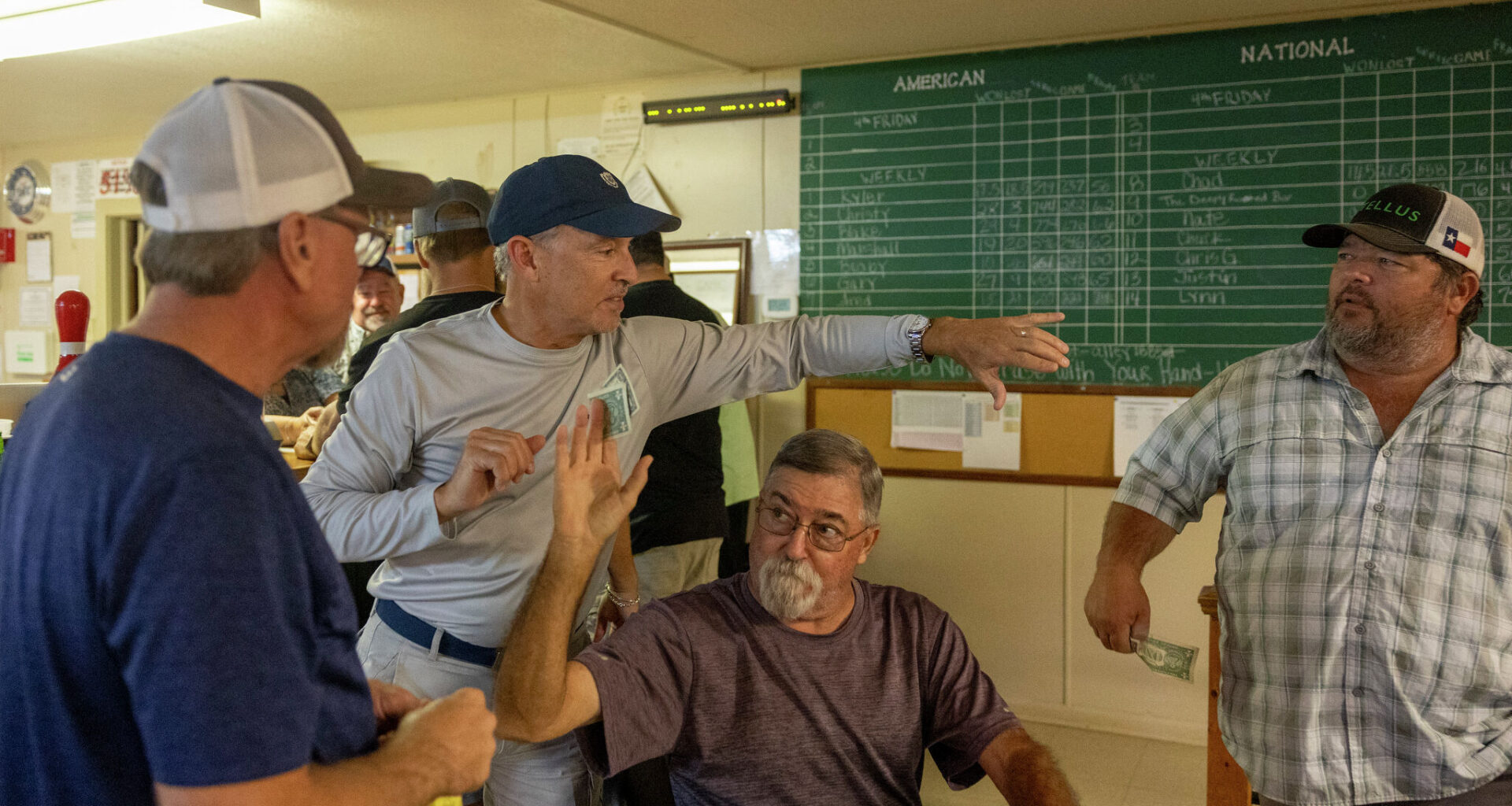
Mark Jupe, center left, reaches for cash from Ryan Koltermann and Rodney Ewald after his turn to bowl. Some states banned the popular tavern game in the 1840s because of its association with gambling.
Andrew J. Whitaker/San Antonio Express-News
DIG IN: New Witte Museum exhibit is a feast for Texas foodies
History and lineage
How did ninepin even become a thing in the United States? It helps to uncover its history.
Article continues below this ad
Bowling at pins likely originated in ancient Germany, not as a sport but as a religious ceremony, according to the United States Bowling Congress, with Martin Luther credited as settling on the divine number of nine pins. It then spread as a game through Europe before settling in the United States in the early 1800s with European immigrants.
Soon ninepin was the most popular kind of bowling in America, with references as early as 1819 with Washington Irving’s classic short story “Rip Van Winkle.” It also became a popular tavern game associated with gambling and vice. By the 1840s, states such as Connecticut started banning ninepin alleys as dens of crime and impropriety. Historians often cite the ban as the shift to tenpin bowling to reinvent the game and circumvent restrictions, though the origins of the extra pin remain unclear, according to History.com.
One future state that didn’t ban ninepin outright was the Republic of Texas, which chose instead to tax ninepin alleys rather than shutter them. The move saved ninepin bowling in Texas, and ultimately the nation, but only just. By the mid-1800s, an increase in indoor lanes and in women players elevated the popularity of tenpin bowling.
But like all traditions, ninepin will only carry on with new blood.
Article continues below this ad
Virginia Brietzke, who has been bowling at Germania Bowling Club for decades, walks up to her frame during league night.
Andrew J. Whitaker/San Antonio Express-News
Cassie Kunde reacts to her frame while writing her score during league night at Bexar Bowling Society.
Andrew J. Whitaker/San Antonio Express-News
Clockwise from top left. Parker Atzenhoffer, a pinsetter at Bexar Bowling Society, resets the pins. Brittney Brietzke plays with Jaxson Corkran in the bowling ball and shoe room at Germania Bowling Club. Jaxon Meredith, 17, plugs in the lane oiler machine before league night at Bexar Bowling Society. Parker Atzenhoffer, a pinsetter at Bexar Bowling Society, watches the bowling ball during league night.
Andrew J. Whitaker/San Antonio Express-News
SAN ANTONIO EXPLAINED: How Historic Market Square evolved as city’s signature site
Article continues below this ad
The future is family
If anything, the future of ninepin is in the hands of its teen pinsetters.
At Bexar, Pam Luensmann started setting up pins at age 13, then joined team bowling at age 18 and hasn’t missed a league since. Her husband, Carl Griffin, said he’s seen plenty of bowlers who once played around the bowling alley as kids, then took a pinsetter job that made them fall in love with the game. And at Germania, Castilleja noted pinsetters practically keep ninepin bowling alive. It helps that they can earn a good $60 a night for maybe three hours of pinsetting plus tips — a far cry from the $1.50 a night Engelhardt pulled in as an 8-year-old pinsetter back in the day.
So how about it, Kay Zook? See yourself as the future of ninepin bowling?
Article continues below this ad
“Um, I’m not sure,” the teen said as she tiptoed between thunderous clacks of pins. “I’m not great at bowling, but I’ve definitely grown up here.”
Tammie Zook noted fundraisers such as sausage suppers help keep the lanes open. (Bexar has one Sunday.) And there are youth leagues as well.
Then Kay Zook shared a simple but brilliant insight into how ninepin can and always has carried on.
Article continues below this ad
“I think it’s more like everybody’s family, so you just really have to get connected,” the teen said. “That’s how you bring new people in.”
Lucy, the neighborhood dog, waits for table scraps outside of league night at Bexar Bowling Society in Marion.
Andrew J. Whitaker/San Antonio Express-News