
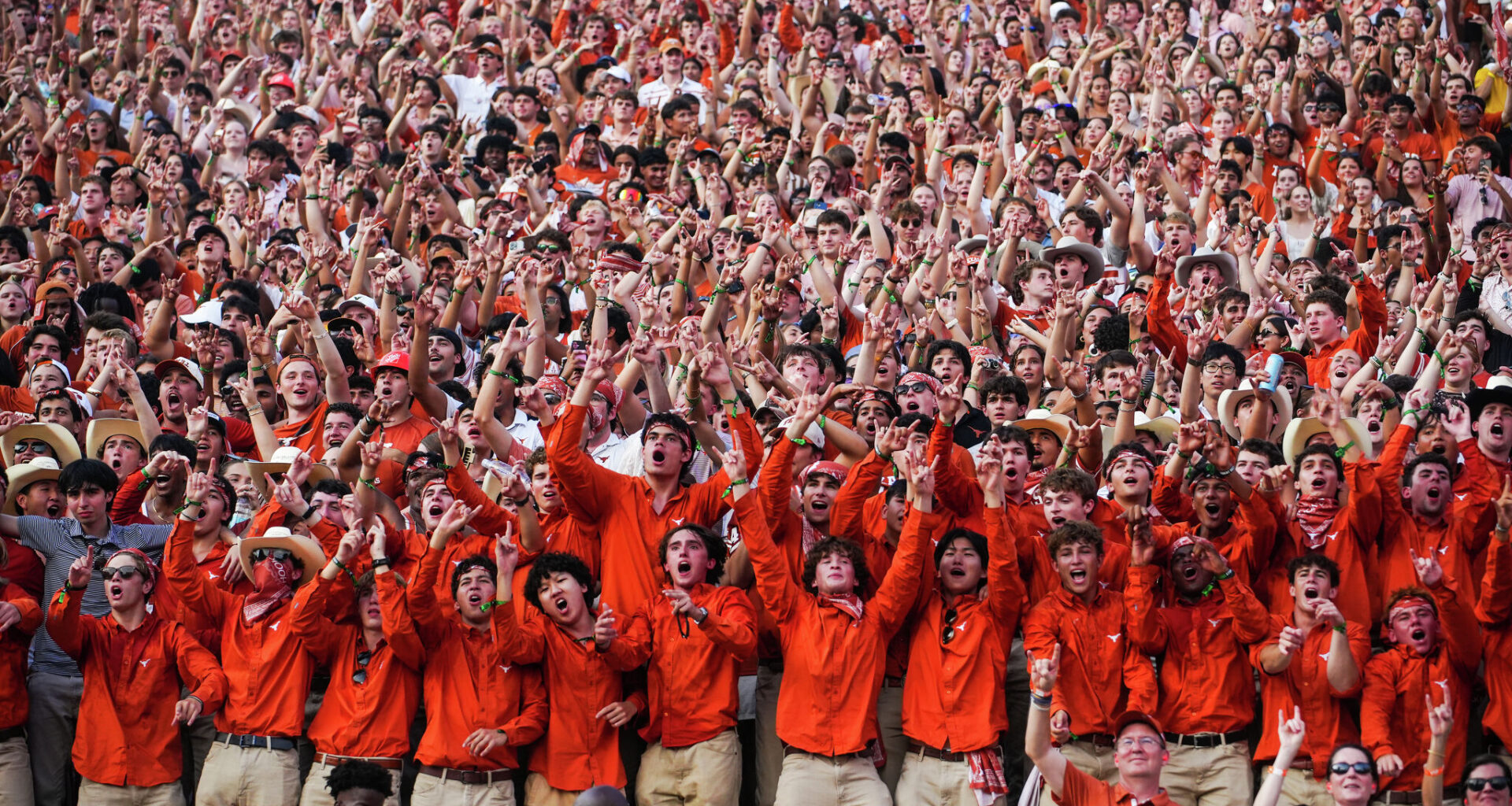
Texas Longhorns Fans cheer on during the Longhorns’ game against the Ohio State Buckeyes at Royal-Memorial Stadium in Austin, Sept. 12, 2026.
Ricardo B. Brazziell/Austin American-Statesman
Bo French’s statements about a photo of presumably South Asian football fans at the University of Texas at Austin have received widespread condemnation from across the political spectrum, including outgoing Republican senator John Cornyn, Ben Shapiro and even Karl Rove. Amid the criticism, French has doubled down on his remarks as Republicans both in Texas and beyond scramble to contain the potential fallout in advance of the upcoming midterm elections.
Others have and will continue to talk about how inappropriate, awful and racist French’s comments were, and that is, of course, true. But why, in a political environment defined by constant scandal and outrage, has this specific episode struck such a nerve?
It’s because Bo French came for football.
Article continues below this ad
In the interest of full disclosure, we, the authors of this piece, are a University of Oklahoma Sooner and a Texas A&M Aggie. We unapologetically wish nothing but sports-related misery, failure and devastation upon the University of Texas at Austin (and, sometimes, upon each other’s alma maters, too). We want the grass at Texas Memorial Stadium sown with salt from Longhorn tears.
After all, the Sooner/Longhorn rivalry is infamous, with “Beat Texas” and “Horns Down!” being as central to OU’s sports culture as our more official cry of “Boomer Sooner!” Meanwhile the Aggies, not content just hating UT, once went so far as to brand the Longhorns’ mascot, one of the most legendarily petty actions in the history of college sports (save perhaps for their kidnapping of Rice University’s Sammy the Owl). The sheer sadistic joy of rivalry is central to college football, especially in Texas.
But however fierce the rivalries may get, American college football also represents something fundamentally valuable. It is, in many ways, a microcosm of the American experiment.
Yes, we root for our teams and boo our rivals. However, throughout all that, we also all belong to something bigger: the institution of college football.
Article continues below this ad
Many Americans bemoan the rise of polarized, us-versus-them thinking in our current cultural milieu. Some have even argued that politics has become our new national sport. However, actual sports, especially college football, demonstrate a principle that politics has increasingly struggled to exemplify: the room for rivalry within a shared social order.
There is a categorical difference between the pride we feel for our alma maters, the joy we feel at their successes and the defeat of their rivals, and the kind of animosity French displayed toward the UT students in that photograph. The premise of a rivalry is this: We both belong to the same social order, but within that order, I don’t like you.
Belonging to that same order matters. It is why the Longhorn band played “Amazing Grace” and “Taps” at the first A&M/UT game following the Aggie Bonfire Disaster. It is why the first Red River Rivalry game after 9/11 was a patriotic affair. It is why, after devastating tornadoes ravaged Oklahoma, Houston alumni of both OU and UT- Austin came together — even wearing each other’s team colors — to raise money for tornado relief. Those philanthropic efforts continue as those same alums still volunteer in the Houston community. And it is why Aggies and Longhorns team up every other year to help students learn more about the Texas Legislature.
Bo French fundamentally violated that premise. He raged against “DEI” and Americans being “displaced by foreigners” (despite not knowing the national origins of the students in the picture, meaning he was going by skin color alone). But what were the students in the picture doing?
They were wearing (hideous) burnt orange and cheering for Texas — some were even wearing cowboy hats — as they celebrated UT’s incredible comeback against Ohio State. They were overjoyed that their team erased a 23-3 fourth-quarter deficit and scored the winning touchdown with 25 seconds left on the clock. How much more American — let alone Texan — can you get than screaming your lungs out for your college team?
Article continues below this ad
This is why we need institutions like college football. It is the place where Americans who might otherwise have very little in common come together to form a civic society in miniature. It doesn’t matter whether someone’s family came from India, Mexico, Nigeria, Vietnam or right down the street. They have learned to say “we” about their university community — to celebrate its successes and mourn its failures. That is what the students in that photo were doing. That is what Bo French’s comments attacked.
Ironically, politics could stand to be a little more like football. Not because elections are games, and not because civic institutions should be entertaining, but because football shows that strong identities and strong disagreements do not require exclusion from the larger social order.
We can passionately support our own side. We can hope our leaders succeed. We can argue, compete and fundamentally disagree with each other’s political parties and perspectives. However, we must also recognize that all Americans have a place in this country.
College football works because the Aggie, the Sooner and the Longhorn can hate one another on Saturday while still understanding that all three belong on the field.
American politics could stand to learn that same lesson.
Article continues below this ad
Aaron Pomerantz is a research psychologist and serves as the assistant director of research and evaluation at Rice University’s Doerr Institute for New Leaders.
Garion Frankel is editor at the James G. Martin Center for Academic Renewal. He is also a Ph.D candidate in PK-12 educational leadership at Texas A&M University.