

One month into the first full school year under state control, Fort Worth ISD parents are still clashing with state-appointed district leaders over how the district is run, both inside and outside the classroom.
Superintendent Peter Licata and the Board of Managers, who were appointed by the Texas Education Agency in March due to Fort Worth ISD’s prolonged academic underachievement, have spent the last several weeks and months hosting community listening sessions at campuses across the district. The purpose of those meetings is to inform their decision making moving forward and to establish guardrails in the process.
At the meetings, dozens of parents have raised concerns about the district’s new Elevate model, scripted curriculum, dual-enrollment program decline, and a lack of communication and transparency from district leaders.
A month into the school year and six months under TEA control, here are some of the biggest areas of concerns Fort Worth ISD parents and teachers have raised.
Impacts of staff cuts
Fort Worth ISD’s Board of Managers voted to enact a sweeping reduction in force to hundreds of positions across the district as part of its restructuring plan and to shave off areas of its budget.
Licata told the Star-Telegram at the time that the reasoning for the cuts was because staffing numbers did not match the overall enrollment decline Fort Worth ISD had experienced in recent years. While student enrollment had dropped by more than 12,000 over the last five years, staffing numbers had remained the same.
“We can’t change what we’ve been doing by moving pieces of the furniture around the room,” Licata said. “We have to do massive program changes, and that doesn’t mean less services for students. What we’re doing is more targeted, but we have to do a massive program change. We have to give them an ability to get the resources that we’ve been paying for students that we don’t have.”
But Ale Checka, a former Fort Worth ISD teacher who left the district following the state takeover, told the Star-Telegram that programs have gotten worse as a direct result of decisions made by the district’s leadership.
As part of the reduction in force, high school dual-credit coordinator positions were eliminated, with no specific employee assigned the handoff tasks, she said. As of Thursday, the district did not respond to the Star-Telegram’s request for comment on cuts to dual-credit coordinators and how responsibilities have been delegated.
“Nobody asked any kind of relevant questions before they cut that position,” Checka said. “And then they cut the position anyway. Nobody delegated the tasks that needed to be done between the two institutions. They have come in hot, they’ve broken things, and they did so with no guardrails, no kind of curiosity or planning.”
Other positions that were eliminated or cut include: dual language coordinators; emergent bilingual directors; career and technical education instructors; college, career and military readiness directors; literacy directors; and speech therapists. Since then, the district has voted to hire contracted workers to serve in roles including speech language pathologists, psychologists and occupational therapists, but they are not full-time district employees.
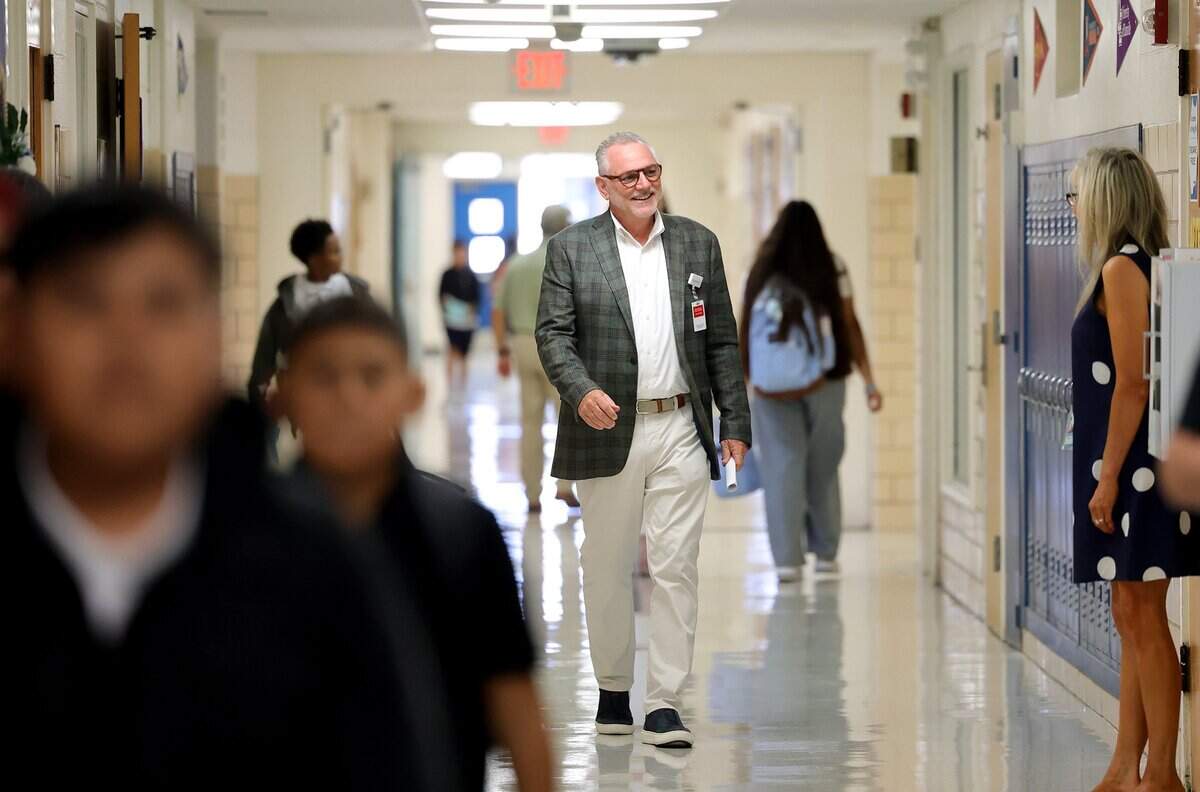 Fort Worth ISD Superintendent Peter Licata tours William Monnig Middle School during the end of the first week of school on Friday, Aug. 14, 2026, in Fort Worth. Amanda McCoy FORT WORTH STAR-TELEGRAM
At a Superintendent Strategic Action session at Diamond Hill-Jarvis High School in August, several parents pressed Licata about cuts to dual-credit positions, and said the number of students who are in dual-credit courses has dropped as a result.
“What do you mean when you say accountability?” an attendee asked Licata and other district leadership present at the meeting. “Is that when you are micromanaging somebody on how sharp their pencil is, but nobody has oversight over high school dual-credit programs?”
Concerns over AI-infused lessons, classroom slides
Shortly after OpenAI announced Fort Worth ISD was one of 55 school districts in the country that will take part in its ChatGPT for Teachers program, dozens of parents, community members, and students voiced their concerns with AI-infused curriculum at a school board meeting earlier this month.
“We have seen students and teachers demoralized and have seen multiple instances of mistake-riddled curriculum clearly written by AI without any significant response from the district,” said Sabrina Ball, co-leader of Indivisible 12, a grassroots advocacy group. “What we have seen in the takeover is not an improvement; it is a massive step backward.”
Students and parents also raised concerns at the board meeting about graphics used in class instruction that were generated with AI. Those included incorrect diagrams on science class slides, AI-generated humans with six fingers, and “unrecognizable animal pictures.”
“To sit in class and be handed materials that are riddled with mistakes, to be told that this is my rigorous education is infuriating and demoralizing,” said Jordan Grimsley, a junior at Arlington Heights High School. “It is demoralizing to students who strive for excellence and disrespectful to teachers who have spent years perfecting their craft. Our teachers know us and know the content better than any robot.”
A spokesperson for Fort Worth ISD did not respond to the Star-Telegram’s request for comment on AI-infused classroom slides, but previously said district leaders are still figuring out how they will utilize being involved in OpenAI’s ChatGPT for Teachers program.
“FWISD is in the early stages of exploring opportunities to leverage OpenAI’s ChatGPT technology to support innovation, efficiency, and productivity across the district,” the spokesperson wrote.
“We are taking a thoughtful and deliberate approach as we assess the role of AI in supporting our mission. At this phase, our focus is on evaluating potential use cases and establishing the appropriate governance, security, privacy, and instructional guardrails needed to ensure any implementation aligns with district policies and priorities.”
In a news release last week, Licata said that district leaders used feedback from parents at community listening sessions to establish “quality-control measures” for curriculum presentation slides. Those measures will ensure materials provided to teachers are accurate, aligned and ready for classroom use, he said.
“We came to these sessions to listen — not to defend,” Licata wrote. “Not to explain away concerns and certainly not to tell people what they should be experiencing. “We heard people. We heard frustration. We heard good ideas… Most importantly, we heard specific things that we can change, and we have the responsibility to act on what we heard.”
Licata also said that teachers who volunteer for classroom recordings will have a lesson videotaped to showcase “high quality instruction” in order to share with the community what a typical instructional block looks like. Those videos will eventually become public, he said.
Parents question district’s ‘one-size-fits-all’ curriculum style
As part of Fort Worth ISD’s effort to overhaul the way instruction is delivered, state-appointed leaders have developed a stricter scripted curriculum model for its campuses. Higher-rated schools have gained more autonomy, while campuses that have underperformed are required to strictly follow the model, with little tolerance for going off script.
While acknowledging lower performing schools may benefit from scripted curriculum, campuses that have performed well should not be subject to the same standards, said Angie Still, a mother of two Fort Worth ISD students.
Still, who has a third-grader at Rolling Hills Elementary and a ninth-grader at Benbrook Middle-High School, both highly-rated campuses in TEA’s Accountability rating system, said her children’s education experience has worsened this school year. Still is just one of several parents interviewed by the Star-Telegram who shared concerns about scripted learning.
“The one-size-fits-all mentality just does not work,” Still said. “People are not airplanes; they’re not cars. They’re human beings. And they aren’t even adult human beings — they’re children. Having scripted learning takes the flexibility and creativity out of it and you’re making them lose education. How I learn may be different than how you learn.”
In Fort Worth ISD’s current autonomy tier system, schools are allowed to go “off-script” at increasingly higher levels. Elevate, the lowest tier, has little room for autonomy, while the Emerge and Exemplar tiers have increased autonomy when delivering instruction.
The district’s overall instructional framework, Cowtown 12, is followed district-wide. It includes first-teach lessons, and “demonstrations of learning” intended to prove students are absorbing content by testing their knowledge at the end of lessons.
Licata and other district leaders say data backs up their approach. The district announced Thursday that Fort Worth ISD students performed better on the beginning-of-year MAP tests this school year than they did last year in every STAAR-tested grade level.
While he is confident in the district’s curriculum and instructional decisions, Licata admitted at a listening session earlier this month that the district can always improve when it comes to informing parents about changes and taking their feedback into account.
“Our communication can always be better,” Licata said. “I hear about transparency a lot. So when you say we aren’t communicating well, you’re right. I don’t know how much more you want to get out of me, but you’re right and I hear you. That’s why we are sitting here [at the listening session] right now.”
FWISD leaders expected early pushback, hope to earn support over time
As the school year gets further under way, Licata and other district leaders still remain hopeful that they will gain more community support over time, especially as they see improved student outcomes in the months ahead, Licata said.
District leaders prepared over the summer to be met with pushback over some of their decisions. Licata in particular prepared for apprehension from the moment TEA Commissioner Mike Morath appointed him as the district’s leader. He previously told the Star-Telegram that he understands where concerned parents are coming from and believes their hearts are in the right place.
Results will come, but it will take time, he said. But in the meantime, the district’s focus should remain on student outcomes and not outside noise, Licata added.
“Turnaround work is hard because you have to change people’s thinking and people’s comfort zone,” Licata said. “But we have an objective to do. We know this works, but we also know that a lot of people are anxious about what it’s going to be. There is always going to be some angst against it because it’s an intervention. That’s not something I can change.”
This story was originally published September 18, 2026 at 5:00 AM.
Related Stories from Fort Worth Star-Telegram

Fort Worth Star-Telegram
Samuel O’Neal is the K-12 Education Reporter at the Fort Worth Star-Telegram, covering public schools and policy that impacts them. He previously worked as a staff writer at the Philadelphia Inquirer and is a graduate of Temple University.