
Dominic Anthony Walsh / Houston Public Media
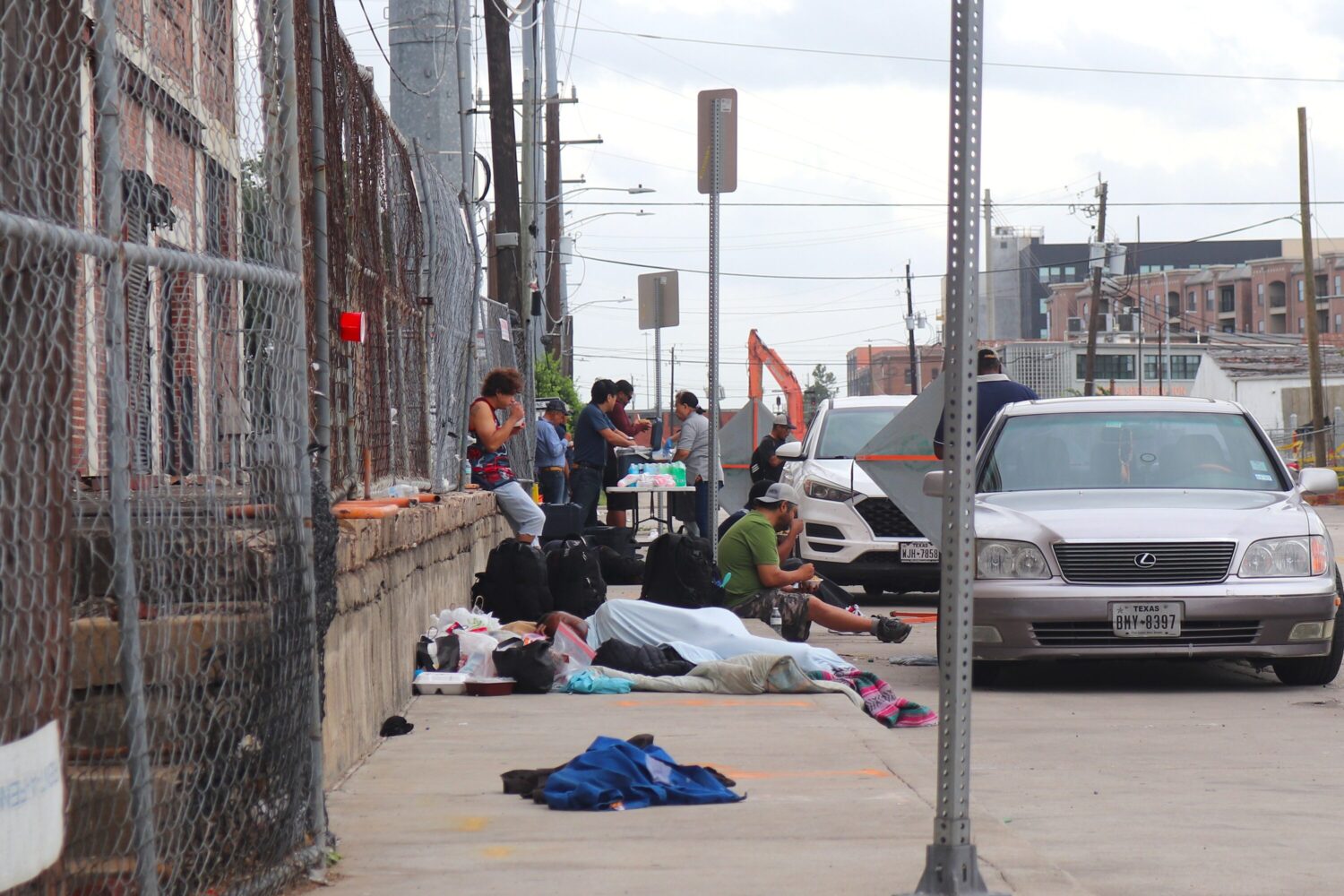
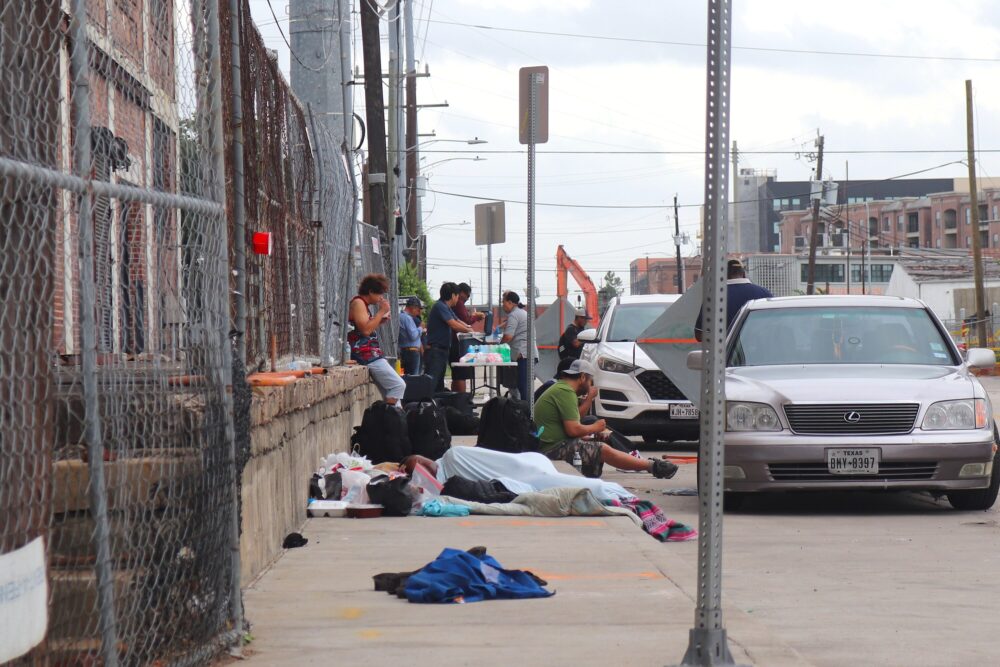
Homeless people wait in line for meals provided by a church group in East Downtown, a few blocks from a new service center at 419 Emancipation Avenue.
In Houston’s East Downtown, a new residential service center for homeless people — known simply as “419” by local officials — sits on the bustling Emancipation Avenue, near a light rail stop.
Early in the morning, people walk to and from the residential service center, across four lanes of traffic.
Sign up for the Hello, Houston! daily newsletter to get local reports like this delivered directly to your inbox.
Not everyone served there has rave reviews.
“It’s like jail,” Tawanne Williams said.
Click here for more inDepth features.
Standing on a sidewalk near the facility, Williams said she’s homeless because she fled domestic violence. She had harsh complaints about the food, bugs and the attitude of facility staffers.
“They treat us like s—,” Williams said. “They feed us nasty ass food. It be cold. They don’t give a f— about us in there.”
“They wasn’t doing that when I was in there,” Calandra Brown interjected.
Dominic Anthony Walsh / Houston Public Media
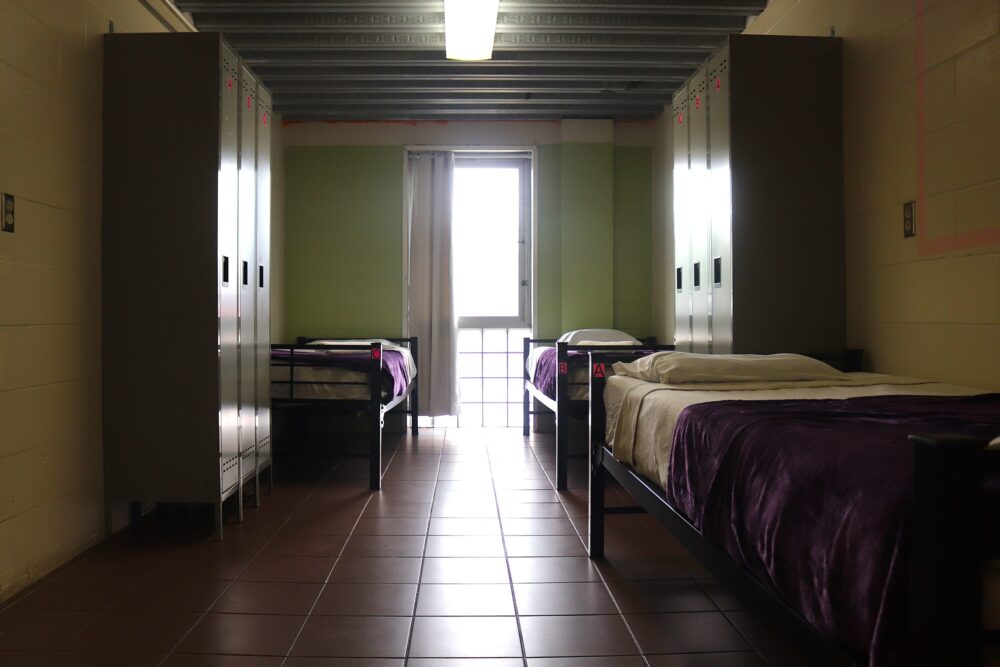
Each room at 419 Emancipation Avenue contains three beds and a set of lockers.
It was unclear why Brown became homeless, or how long she lived on the streets before arriving at 419. She said the food was hot, and the staffers were kind.
“I asked the Lord to get me in because I’m tired of sleeping outside,” Brown said.
Brown said staff removed her from the facility after a screening process found an active warrant. According to Harris County criminal court records, she had an active misdemeanor theft case.
Still, she enjoyed her time there — and wanted to get back in.
“It was cool,” Brown said. “They would feed a hot meal every day. It was cool with me.”
Related: A 222-bed homeless services hub is set to open in Houston in the coming weeks.
The Harris Center, which operates the facility, declined to allow Houston Public Media inside the building while it was in operation, so a reporter spoke with people outside.
For the most part, they painted a positive portrait of 419, which serves as the cornerstone of Mayor John Whitmire’s initiative to reduce street homelessness in Houston.
Dominic Anthony Walsh/Houston Public Media / Houston Public Media
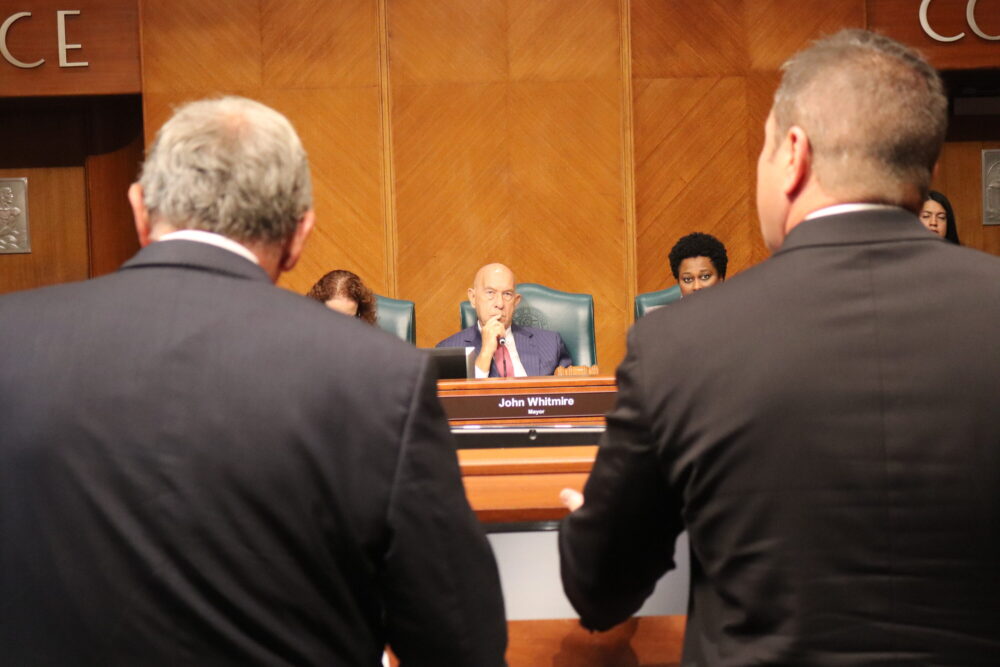
Houston housing director Mike Nichols and public safety director Larry Satterwhite speak to the Houston City Council and Mayor John Whitmire about the city’s initiative to address homelessness in Oct. 2025.
Whitmire’s administration has an ambitious goal — cutting the unsheltered population living on the streets in half within two years — but three and a half months after 419 opened, it’s unclear how much the new facility has moved the needle.
Bruce Brown, no relation to Calandra, said he landed on the streets after a dispute with his former landlord led to an eviction. He was on his way to a dentist appointment from the facility.
“It’s been a blessing, and there’s opportunity here,” he said. “You’ve got a base of operations where you can think, and you can plan.”
People can use the time to find work, receive psychiatric care and medical services, get their papers in order — and get on the path to permanent housing.
“It’s kind of like going to prison,” he said. “You can use the time to your advantage. It can work for you or against you.”
The city has an ambitious goal. What progress has been made?
In response to a public records request, the city’s housing department withheld performance metrics showing how many people have been sheltered and where they’ve landed.
In a statement, a spokesperson for the city’s housing department said more than 420 people have been served, but they didn’t answer questions about how many of them have moved into permanent housing.
Some of them have taken one step in that direction — by moving onto the city’s Navigation Center.
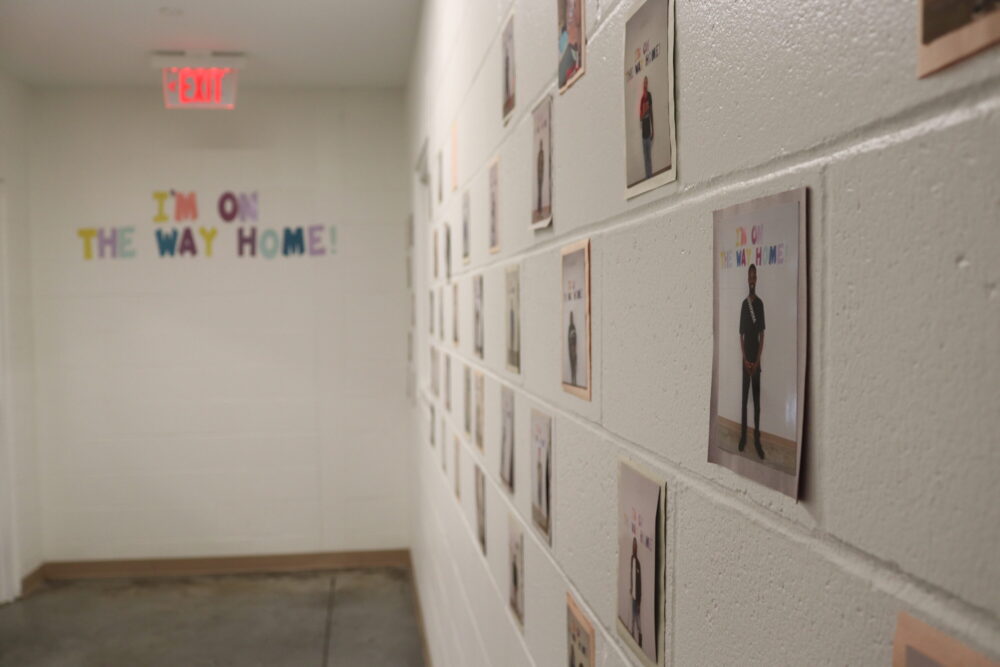
Dominic Anthony Walsh / Houston Public Media
In Houston’s Navigation Center, a wall shows people who have successfully moved from homelessness into housing.
This is the other city-owned shelter and service center, which opened in 2023. It’s half the size of 419, with about 110 beds. And it’s harder to get in because residents must have a referral to a housing program — which means they must be on a waitlist for an apartment.
In July, Robyn Rame was waiting for an apartment at the center. She had just gotten her housing referral at 419.
“It’s not a ‘shelter’ shelter,” Rame said. “It’s totally different.”
Rame said the facility at 419 is just a larger version of the Navigation Center, and they’re both unlike any shelters she stayed at during her three years on the streets in Houston.
“They have classes. They have medical on site,” Rame said. “They have counselors. They have all this stuff. I mean, it’s not just somewhere to go to and go to sleep and then leave again.”
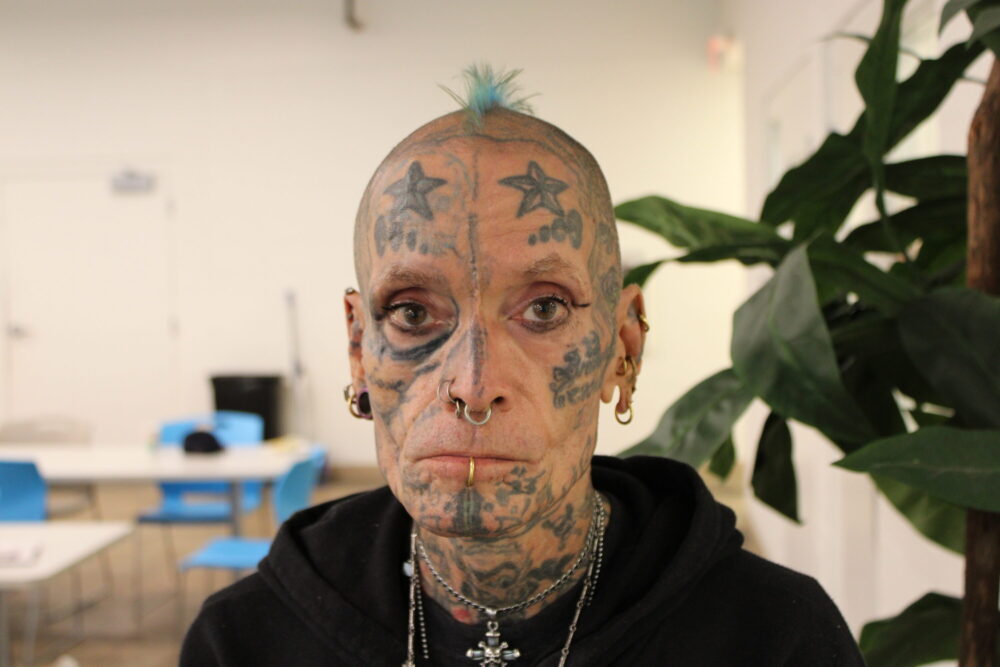
Dominic Anthony Walsh / Houston Public Media
Robyn Rame was served by the city-owned Navigation Center in July, 2026.
She said she struggled with substance abuse before becoming sober while living on the streets of Downtown Houston.
Substance abuse continued among the shelter population at 419 Emancipation, she said.
“People go out, they come back high and drunk, and somehow they get back in,” Rame said. “But that’s neither here nor there. That’s on them. You do you, keep you clean and move on.”
In a statement, a spokesperson for the Harris Center said, “If a guest is determined to be intoxicated to the extent that they cannot safely remain at the facility, staff coordinate with the Houston Recovery Center and, when appropriate, law enforcement to facilitate transport to the Houston Recovery Center’s Sobering Center or another appropriate level of care.”
Rame said she was able to move to 419 from a treatment program. Many others have been dropped off by law enforcement, according to officials. But because of the 222-bed capacity, people have had trouble getting in at the front door.
In a police report obtained by Houston Public Media, an officer described seeing a man “upset, crying and frustrated,” because, the man told the officer, “he was refused from [419] because it was full.” The officer took him to Houston Recovery Center — a sobering facility.

Dominic Anthony Walsh / Houston Public Media
Outside the facility at 419 Emancipation Avenue, a volleyball field and basketball court await residents.
“I am thrilled that people want to be there,” Mike Nichols, director of the city’s housing department, said. “I’m thrilled that people want to stay there … People want to be there because they feel safe. The food is good. The programs are important. And that’s good.”
But, he said, 419 is intended to act as a “front door” to the region’s homeless response system, and the city and its partners need to move people through that door — into treatment or housing — more quickly.
“There’ll never be a possibility for a place that’s so big that takes care of all of this,” Nichols said, “But now we have to find what we promised, which is a system of moving on.”
According to local officials, about 40,000 people have been moved off the streets into permanent housing in the Houston area over the past 15 years, but the unsheltered population living on the streets has held steady at around 1,200 since 2023.
If Nichols and Whitmire’s administration meets their goal with the new facility, the population will reach a historic low — about 600 — sometime in 2028.
Moving forward
Last year, city officials said they got more than 200 people off the streets. One of them was Thomas Romero. Now, every day, he turns a key to open the door of his apartment.
During a decade of living on the streets, he said he spent a lot of time thinking about an apartment unit — about the key to the door.
“My keys was in my mind already,” Romero said. “Because I prayed about the keys. I prayed about the doorknob. I prayed about the door.”
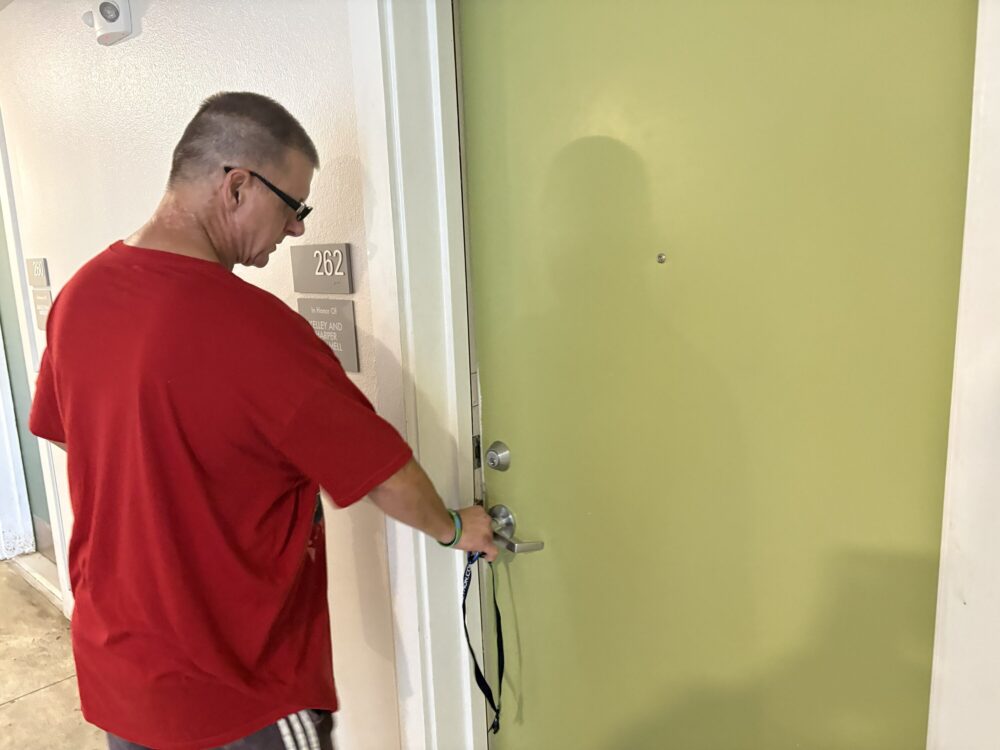
Dominic Anthony Walsh / Houston Public Media
Thomas Romero opens the door of his apartment at a New Hope Housing complex in Houston.
The apartment came with a bed, and churches have provided pots and pans, an air-fryer and a microwave.
It’s a cozy studio unit — not big, but it has enough room for guests, who he loves to feed.
“I don’t have enough kitchen space, but the space I have is mine,” Romero said, “and when people come, they pull up, and they bring their own plates.”
They have a narrow selection of condiment options — Tabasco, Valentino and salsa.
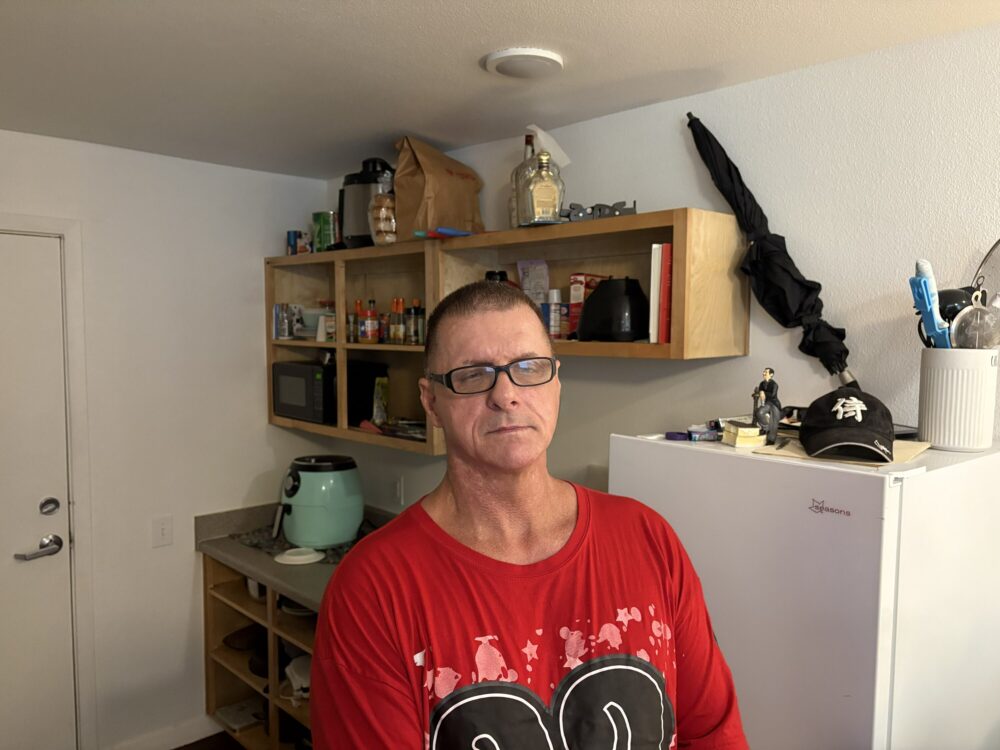
Dominic Anthony Walsh / Houston Public Media
Thomas Romero stands in his rent-free studio unit at a nonprofit apartment complex operated by New Hope Housing in Houston.
“I could get rid of everything else, but if I ain’t got hot sauce — I got to stay with my hot sauce,” Romero said. “You see all the different hot sauces. You know, I eat a jar of hot sauce a week.”
He’s on a rent-free, one-year lease at an apartment complex operated by the nonprofit New Hope Housing in Houston.
A Houston Public Media reporter first met Romero in December 2025 at the Navigation Center, where he arrived after sleeping on the streets of Downtown Houston. He said he had struggled with substance abuse after a series of deaths in his family.
Since getting the unit in January, he’s been working as a part-time driver and looking for a steady job, saving up for a car and a house.
“I’m not going back,” Romero said. “Why go backwards when you can go forward?”
Going forward, city officials hope, 419 will help more people follow in Romero’s footsteps.