
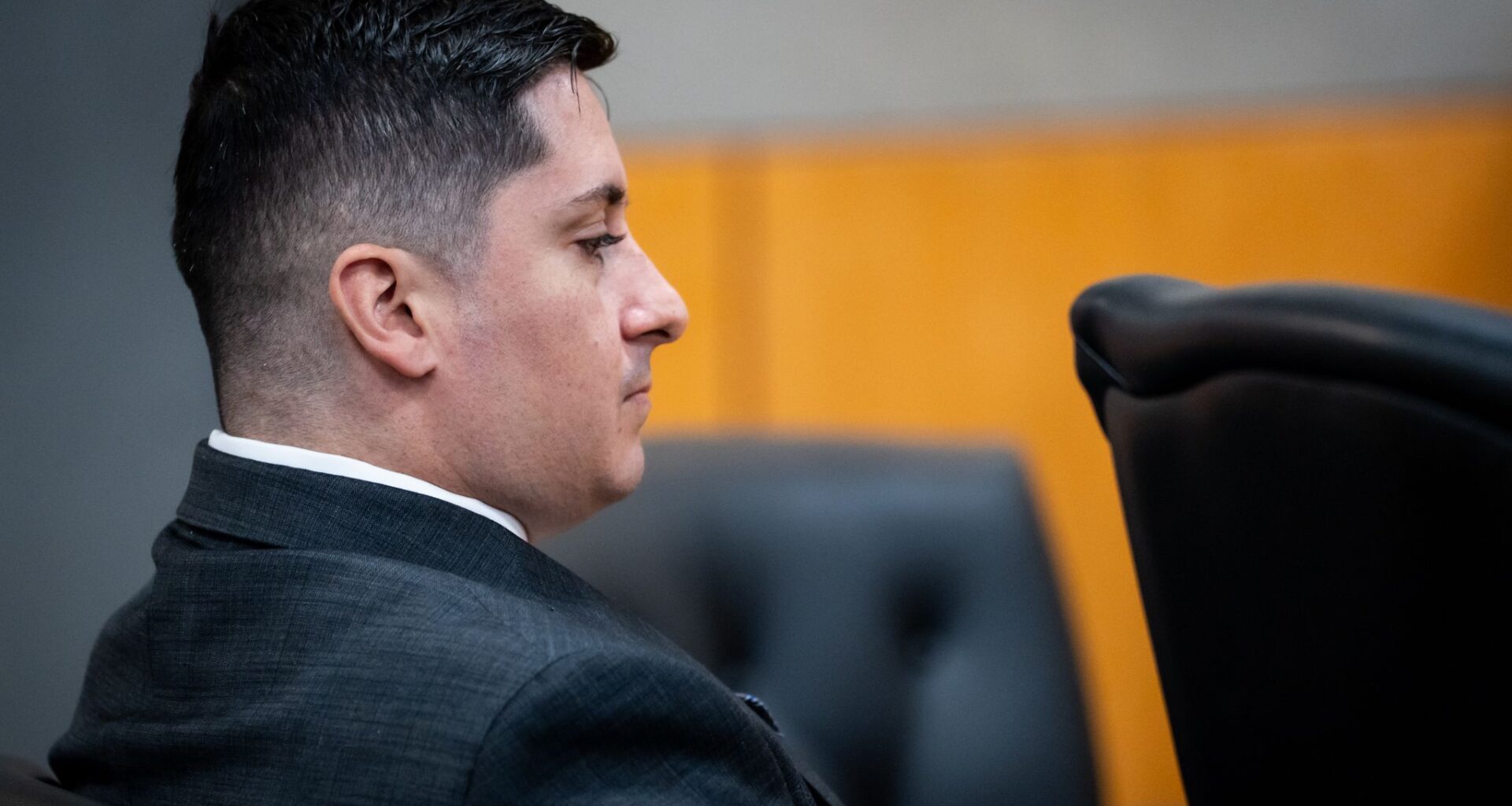
Austin Police Officer Daniel Sanchez, who is accused of deadly conduct in the fatal 2022 shooting of tech entrepreneur Rajan Moonesinghe, watches opening statements in his trial at the Blackwell-Thurman Criminal Justice Center, Nov. 6, 2025.
Sara Diggins/Austin American-Statesman
A courtroom packed with jurors and spectators on Monday listened as Ruth Moonesignhe told stories of her family doting on her youngest son. She was the final witness in the prosecution’s case against Austin police officer Daniel Sanchez, who is facing felony deadly conduct charges in the 2022 shooting death of Rajan Moonesinghe.

The state built its case around video and forensic evidence, but framed it through the voice of a mother reminiscing about the son taken from her. Sanchez’s defense team will begin presenting its case on Wednesday.
Article continues below this ad
“He was a star,” Ruth Moonesinghe said while recalling how her son stood out during a high school mission trip to Africa when he was just 15, soliciting donations for soccer gear ahead of time to distribute to orphaned children whose parents had died of AIDS.
While in college at the University of San Diego, Rajan Moonesinghe won a technology start-up competition with his older brother – a success that spurred his move to Austin in 2018.
The tech entrepreneur settled into a duplex in the Bouldin Creek neighborhood, where he encountered Sanchez shortly after midnight on Nov. 15, 2022.
That night, a security guard called 911 to report that a man – later revealed to be Moonesinghe – was standing outside his residence pointing an AR-15 rifle down the street.
Article continues below this ad
When Sanchez and other officers arrived, they witnessed the 33-year-old fire two rounds into his house from the front porch. Video footage shows Sanchez commanding Moonesinghe to drop the gun while almost simultaneously shooting at him.
Two prosecution forensic experts, Kypress Stavrou and Mike Johnson, created and analyzed three-dimensional renderings to show where Moonesinghe and Sanchez were positioned. Using time-synced police body-camera and Ring doorbell videos, they testified that Moonesinghe had dropped his gun by Sanchez’s third shot, but Sanchez continued firing afterward. Moonesinghe was hit six times.
In cross examination, the defense called into question whether Sanchez had seen Moonesinghe drop the gun – even if that’s what video footage showed.
People watching the trial react to Ring doorbell camera footage showing Rajan Moonesinghe being shot during the trial of Austin Police Officer Daniel Sanchez, who is accused of deadly conduct in the fatal 2022 shooting of Moonesinghe at the Blackwell-Thurman Criminal Justice Center, Nov. 6, 2025.
Sara Diggins/Austin American-Statesman
Moonesinghe died of gunshot wounds later that night, according to Dr. Lucas Wreck, the medical examiner who performed the autopsy.
Article continues below this ad
Wreck testified that Moonesinghe’s toxicology report showed recent use of alcohol and cocaine — substances the defense argued can impair judgment, affect self-control and heighten agitation.
His blood alcohol level was at a potentially dangerous .33%.
Luis Brito and Stephen Markert, two other officers who responded to the scene, took the witness stand Friday. Attorneys from both sides questioned the officers about how they responded to the 911 call about Moonesinghe walking down the street with an AR-15.
Read More: Video provides crucial details about the Austin Police shooting of Rajan Moonesinghe
Article continues below this ad
Both officers said they turned off their headlights and sirens as they approached the street where Moonesinghe’s house is located – a tactic they described as common when officers are approaching a scene where someone is armed and the danger level of the situation is unknown.
Markert, the first officer to arrive after Sanchez, said he was still in his patrol car when he heard the two gunshots fired by Moonesinghe into his own home. When Markert exited his vehicle, he testified to grabbing his own rifle because he “was preparing for a gun fight.”
But when the officer approached the scene, he saw that Sanchez had already shot Moonesinghe.
Markert’s and Brito’s body-cam video, played by prosecutors, showed a bleeding Moonesinghe laying prone on his front porch. As the video showed the officers administering first aid to Moonesinghe, members of Moonesinghe’s family – who have been watching most of the trial – left the courtroom.
Article continues below this ad
Charles Joyner, the first witness and an expert in police use-of-force, points out Austin Police Officer Daniel Sanchez on Ring doorbell camera footage showing Rajan Moonesinghe holding a rifle on his porch as the footage is displayed during the trial of Officer Sanchez, who is accused of deadly conduct in the fatal 2022 shooting of Moonesinghe at the Blackwell-Thurman Criminal Justice Center, Nov. 6, 2025.
Sara Diggins/Austin American-Statesman
Sanchez’s defense has focused on how high Moonesinghe’s rifle was raised when Sanchez encountered him – in what several experts testified to be at the “low-ready” position – and whether it was reasonable for the officer to interpret that as a threat. Markert said he believed Sanchez’s decision to shoot Moonesinghe was reasonable based on what Sanchez likely saw.
“If an individual is oriented to us with a weapon, even if it’s not pointed at us, the time needed for us to ready our weapon is a significant gap and a significant safety risk,” Markert said.
Article continues below this ad
The trial will resume Wednesday after the Veterans Day holiday.