
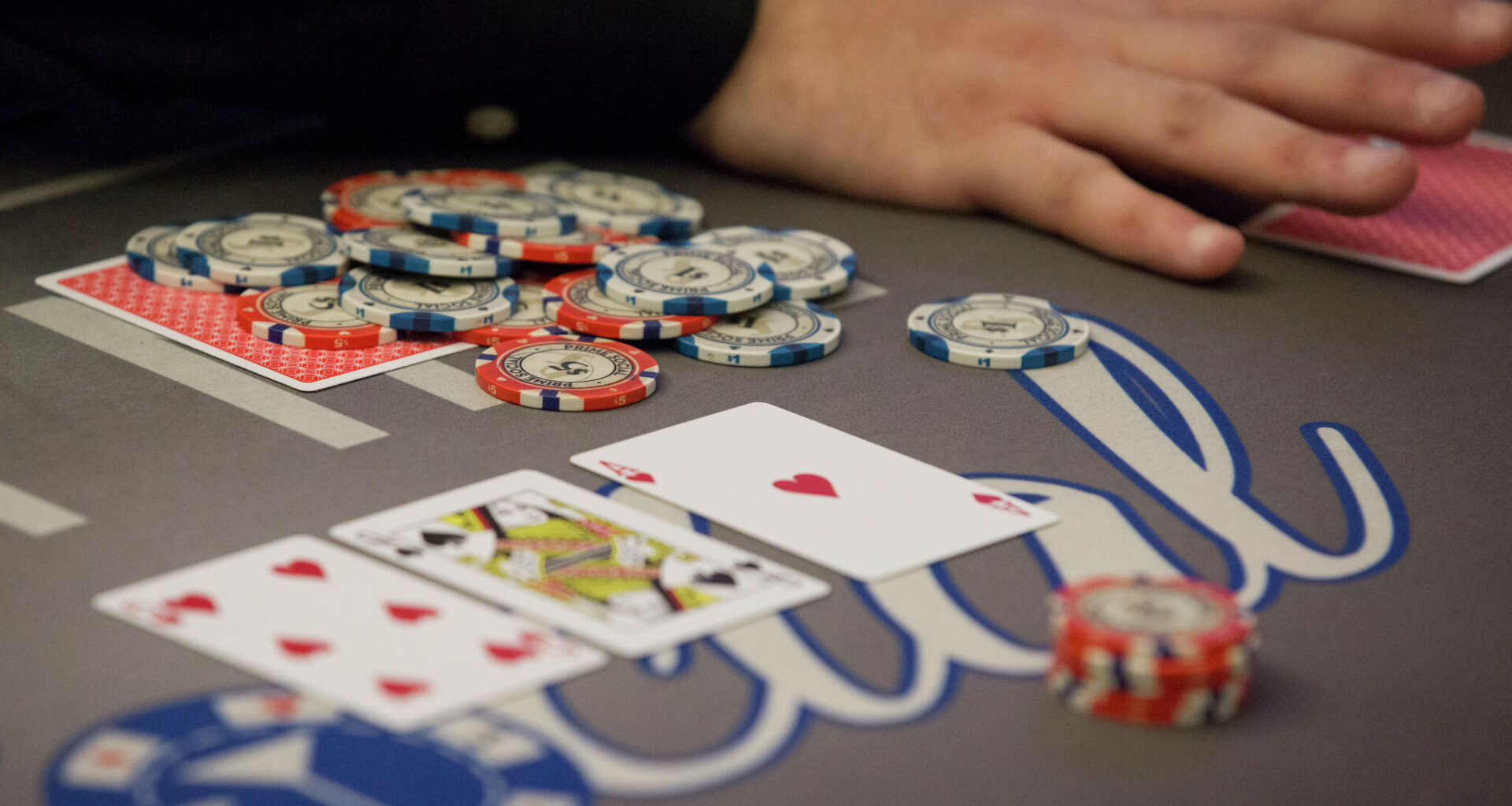
Texas law prohibits most forms of gambling. Private businesses operate poker rooms through a legal loophole. These poker rooms charge a monthly membership fee and an hourly fee that members pay upon entering the club. (Photo by Yi-Chin Lee/Houston Chronicle via Getty Images)
Houston Chronicle/Hearst Newspap/Houston Chronicle via Getty Imag
Got a poker game you want to host at your house?

A friendly game of Texas Hold ‘Em can be fun, but Texas has some of the nation’s strictest gambling laws. Most forms of gambling are illegal under state law, although there are limited exceptions, such as certain charitable gaming and the state lottery.
Article continues below this ad
Many private poker clubs in Austin and elsewhere in Texas operate under a disputed legal interpretation, relying on an interpretation of Texas law that allows gambling in a private place if no one other than the players receives an economic benefit from the game.
Whether some clubs’ membership-fee and seat-fee models satisfy that requirement has been the subject of legal disputes and varying enforcement.
But can people have private poker games in their home?
Here’s what the law says.
Article continues below this ad
Is it legal to host a private poker game at your house?
Gambling is illegal in Texas. Under Texas Penal Code. § 47.02., gambling is a criminal offense. A violation under the provision can be classified as a Class C misdemeanor.
A private poker game can operate through this exception within the law, as long as the house (the host of the game) isn’t profiting from the game. This means that the house isn’t taking a percentage of every pot, booking bets, or otherwise having a financial stake in who wins.
If people are playing a private game of Texas Hold ‘Em, the competition is only for their own money. The host can’t collect a fee before the game or shave money from the winner’s purse after.
Article continues below this ad
Dealers also cannot accept tips. A private poker game could be shut down if the host or dealers profit directly from games or tournaments.
How does a private poker game work?
Under Texas law, a social poker game may qualify for a defense to prosecution if it meets the proper conditions. The problem is that public advertising can undermine the “private place” requirement. Photo: Annette Riedl/dpa (Photo by Annette Riedl/picture alliance via Getty Images)
picture alliance/dpa/picture alliance via Getty I
During a private poker game in Texas, including in Austin, you compete only against the other players at the table, not a house with a financial stake in the outcome.
Article continues below this ad
Win or lose, the money in the pot stays with the players. Under Texas Penal Code §47.03 no outside party may receive an economic benefit from the game beyond a player’s own winnings.
This principle is reflected in Texas Penal Code § 47.02, which provides a defense to prosecution when:
“The actor engaged in gambling in a private place.”
“No person received any economic benefit other than personal winnings.”
“Except for the advantage of skill or luck, the risks of losing and the chances of winning were the same for all participants.”
Can you advertise a private poker game at your house in Austin?
Under Texas law, a social poker game may qualify for a defense to prosecution if it meets the proper conditions. The problem is that public advertising can undermine the “private place” requirement.
Article continues below this ad
Inviting a group of friends or people you know through private texts, email, or invitation-only groups generally aligns more closely with a private game.
But posting “Poker game at my house this weekend. Everyone welcome!” on Facebook, Reddit, or other public forums could make the event look like a public gambling operation rather than a private social game. Texas law defines a “private place” as one to which the public does not have access.
If the goal is to simply get enough players for a friendly home game in Austin, using private invitations or an invite-only group is generally much less legally risky than openly advertising to the public.
Article continues below this ad