
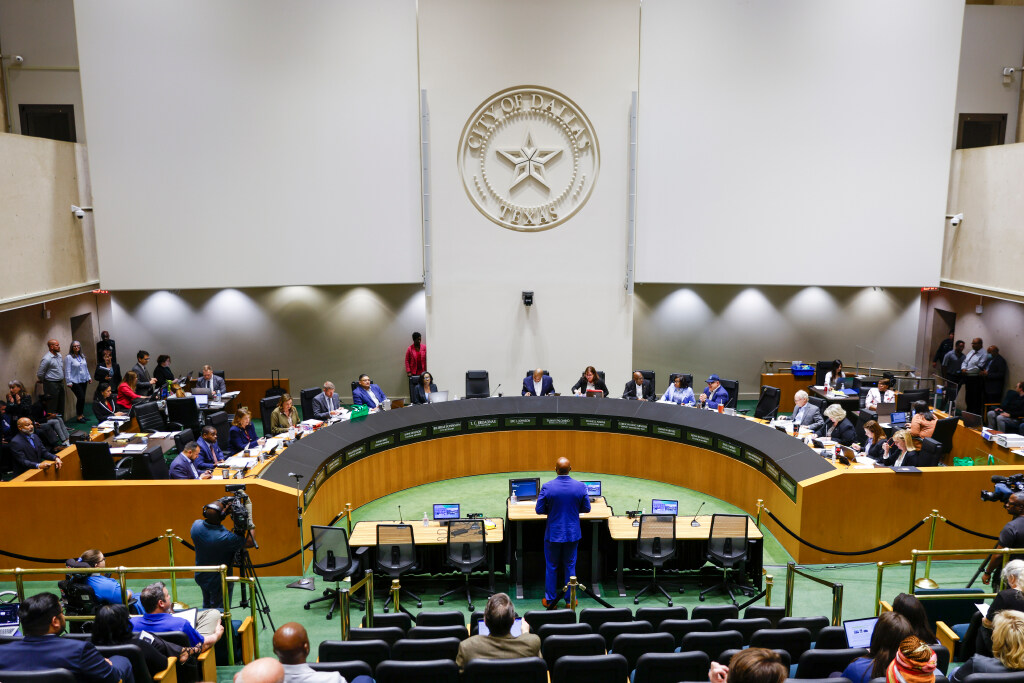
After 12 hours of debate, council members preserved libraries and other community services with reserve funds — but left deeper fights over taxes, pensions and growth unresolved.
Shafkat Anowar/The Dallas Morning News
It was late when Dallas City Manager Kimberly Bizor Tolbert got into the elevator.

“Everybody take a deep breath,” she said to her top leadership team moments after the City Council approved a record $6 billion budget.
Residents have been wondering for three years whether their beloved neighborhood pool or library will survive another year. City leaders have repeatedly highlighted that the economic conditions and rising costs were only going to make managing finances harder.
Article continues below this ad
Revenues have increased but not enough to match the ambitions of a city that now competes with suburban peers that are a quarter of its size.
Tolbert said city staff’s goal was to stop talking about cutting hours, but to create some stability and consistency in services. Some hard choices would have to be made. “Budgeting is not an easy exercise,” she said.
Come Wednesday, the council itself was split over what “hard choices” meant.
Was it rejecting pool closures despite it being part of a city plan? Was it reducing the tax rate any more than they already had? Or was it raising it so the city could collect more money to fill holes in the pension system?
Wilonsky: Did I run into the city manager at the future Dallas City Hall?
Article continues below this ad
Some wanted to stop quibbling over small pots of money, look at the bigger picture and focus on things that can add more to the city long term. Others were trying to save programs that some thought were beyond saving.
Mayor Eric Johnson said the reality was the council members represent a spectrum of political beliefs that makes it hard to reach consensus.
“I think you did about as good as you were going to do with this cast of characters,” Johnson told Tolbert.
After more than 12 hours of debate, council members kept just a few of the city manager’s planned cuts, including an employee healthcare PPO program.
Ultimately, the 2026-27 budget, which goes into effect Oct. 1, is 15% higher than the current fiscal year’s $5.2 billion plan.
Article continues below this ad
The City Council wrangled with Tolbert’s proposal for weeks, ensuring in the end that some of the city’s community assets survive this year’s culling.
The budget is a declaration of what the city wants to do for its residents. In its own words, the city highlighted its new policy to improve housing in Dallas. The tax base, after all, is where it gets its money to keep the lights on.
In their words
A divided council voted 10-5, each wearily saying yes and no when it was their turn to speak.
Council member Jesse Moreno said he wished the council had cut the aging community pools once and for all.
Article continues below this ad
Council member Kathy Stewart and Deputy Mayor Pro Tem Maxie Johnson said it was hard to find the right balance between the city’s wants and needs.
Dallas City Council members Chad West (L) and Jaime Resendez listen to individuals speak about repairs on the aging Dallas City Hall in May.
Steve Nurenberg/The Dallas Morning News
Mayor Pro Tem Jaime Resendez said he would’ve made some decisions differently if he were making them alone. “But that’s not how a city budget works,” he said.
A voter mandate to hire cops faster meant other amenities had to take a cut. The City Council pulled money from reserves to give some of the city’s cherished assets a short lifeline.
Related: Dallas City Council approved a record $6 billion budget, boosting police, saving libraries
Article continues below this ad
Council member Chad West said it wasn’t a perfect budget. “But it’s also not doom and gloom,” he said, considering a litany of challenges confronting the city.
Others were thinking ahead. Council member Gay Donnell Willis said she wanted to make sure the council wasn’t just “living in a cut mentality” but to also follow “a growth mentality.” She reminded the council that projections of slower revenue were unlikely to let up anytime soon.
Five council members voted against the budget and their reasons were rooted in opposing ideas — the budget either didn’t cut enough or cut too many community programs.
Council member Bill Roth pleaded with the city to not “spend all the money that we’re allocating here.”
Council member Cara Mendelsohn pushed for cutting more and slammed the council for not showing the “courage to make the very hard decisions that need to happen.”
Article continues below this ad
Post-approval budget change
The debate took another turn when the council rejected restructuring departments despite approving a budget that had those changes included. This meant the City Council had to go back and reconsider the budget all over again, opening it up to amendments.
Council members Mendelsohn, Laura Cadena and Paul Ridley threw amendments in to revive library funding. Paula Blackmon and Adam Bazaldua, who wanted to find money to repair City Hall, banded with the others to push for the libraries.
Blackmon, who lost the Skillman Southwestern Library last year, would not budge. “Everyone loves libraries,” she said.
Council members spent hours digging through whatever they could. They took money from a reserve fund to keep all libraries open. Took more from laundry services and money set aside for outside lawyers.
Related: Last-minute changes to city budget return $2.8 million – and 72 jobs – to Dallas libraries
The move to save the libraries mirrored earlier debates, with council members looking to move money from one pot to fill another.
Johnson remarked a lot of time was spent arguing over a $17,000 draw from the youth commission’s travel funds.
Council members debated giving that money to the inspector general’s office, prompting discussions of local events commissioners could work on, instead of going to long distance conferences. Willis urged the council to consider “purse strings instead of our heart strings.”
Blackmon fielded making similar cuts to trips other groups like planning commissioners would make. But she couldn’t because the money was from an enterprise fund.
“I give up,” she said as light laughter broke out. “I told you I didn’t want to play the game today.”
Some just turned to the city manager to ask if any of it was even possible.
“It’s a matter of just telling me what you want,” Tolbert said.