
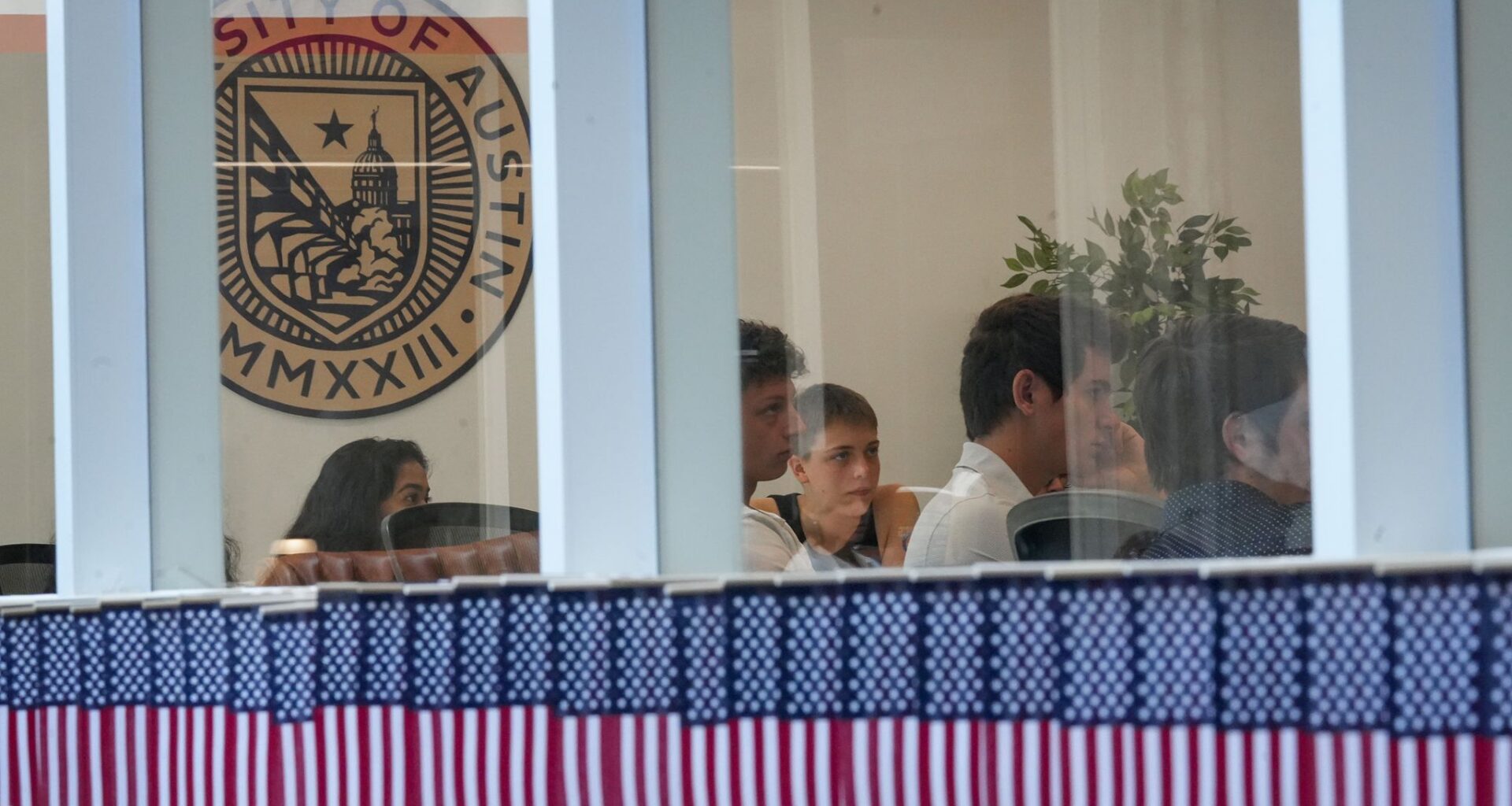
University of Austin students listen in class on Monday, Sept. 15, 2025. The school is planning on launching a new law school in 2028.
Jay Janner/Austin American-Statesman
In the next chapter of Austin’s newest higher education institution, the University of Austin is taking on the American Bar Association.

With an $11 million donation from Austinites Steven Kenninger and his wife, Gail Jaquish, the university, often called UATX, announced plans on Thursday to open its own law school as soon as fall 2028. The university plans to sidestep the American Bar Association, which acts as the national accreditor for legal education. The organization has been criticized by conservatives for having a monopoly over legal education and pushing a woke agenda.
Article continues below this ad
The budding university, which welcomed its first class in 2023 with the goal of pursuing truth and rebelling against the current state of higher education, wants to reimagine a legal education. The school will be led by practitioners instead of academics, cut the time to obtain a degree, and offer law degrees free of charge.
“We are building the future of legal education,” said Adam Biggs, the University of Austin’s general counsel, who previously served as a senior official in legal affairs at the University of Texas at Austin.
Going around the ABA
The ABA is the national entity in charge of accrediting law schools. It has accredited law schools since 1952 and requires programs to employ full-time faculty, meet specific success rates and uphold admissions policies and curriculum requirements. Biggs said some of these requirements can drive up the cost of a legal education.
Article continues below this ad
Texas has 10 ABA-approved law schools, including the University of Texas School of Law, located just up the road from UATX’s headquarters in downtown Austin.
Earlier this year, the Texas Supreme Court ended the requirement that Texas law schools be ABA-accredited, meaning Texas lawyers no longer need to have graduated from an ABA-approved law school to practice law in the state. In doing so, the court reasserted its authority over law schools.
When the state seemed poised to make the change in 2025, eight Texas law school deans opposed the shift, saying it would make it harder for law school graduates to practice out of state and create an expensive administrative burden on the court. Lawyers have to pass the bar exam to practice law, and most states limit tests to graduates of ABA-accredited programs.
Others warned that giving accrediting power to supreme courts could politicize law school approval, as all of Texas’ Supreme Court judges are Republicans, Reuters reported.
Article continues below this ad
But the Trump administration has harangued the ABA as too progressive. Last month, the president suggested the ABA should lose its power to approve law schools.
A new legal education
Without the ABA, UATX could invite federal judges or other legal practitioners to teach courses, shorten the program and reduce costs to offer law degrees for free, making legal education more affordable and accessible, Biggs said.
In addition to the new law school, UATX leaders hope to develop a comprehensive pre-law program and launch a think tank to research what the future of legal education would look like without the ABA.
Article continues below this ad
The university is partnering with the Federalist Society, a conservative national legal group, to allow students to access a large network of federal judges, practitioners and mentors, Biggs said. The group formed in response to perceived liberal ideology in the legal profession and advocates for a focus on individual liberty, traditional values and a strict interpretation of the law, according to its website.
In Texas, the Texas Higher Education Coordinating Board, the Texas Supreme Court and an institutional accreditor can certify UATX’s new law school, Biggs said. UATX is in the process of getting accredited as a university by the Middle States Commission on Higher Education, which would also have to sign off on the law program, Biggs said.
Biggs said all partners seem to be supportive. Despite the potential hurdles ahead, he insisted there is a future without the ABA, “whether they like it or not.”
UATX’s law school won’t be for everyone, Biggs said. Though he insists the school is not partisan, he said it is for “risk takers” who are passionate about improving the country and defending the U.S. Constitution.
Article continues below this ad
“We are looking for people who are optimistic about the future and want to get out there and build and fight for our Constitution and our legal order and the rule of law,” Biggs said.
The $11 million donation from Kenninger and Jaquish will primarily provide salary support, including hiring a new leader to head the law programs, Biggs said. UATX will also begin hiring federal judges, lawyers, and practitioners for the think tank and launching debates on relevant legal issues from birthright citizenship to state regulations on artificial intelligence, Biggs said.
The university, which just welcomed its third class to its downtown campus, now enrolls more than 200 students. The law programs will be a natural extension of the school’s humanities focus, Biggs said.
Article continues below this ad
“It’s pretty clear over the last couple decades that the law is going to be a focal point on a lot of different levels, culturally, politically,” he said. “We need to have a lot more really great lawyers out there that are free to take up causes that are about helping not just corporations, but people.”