
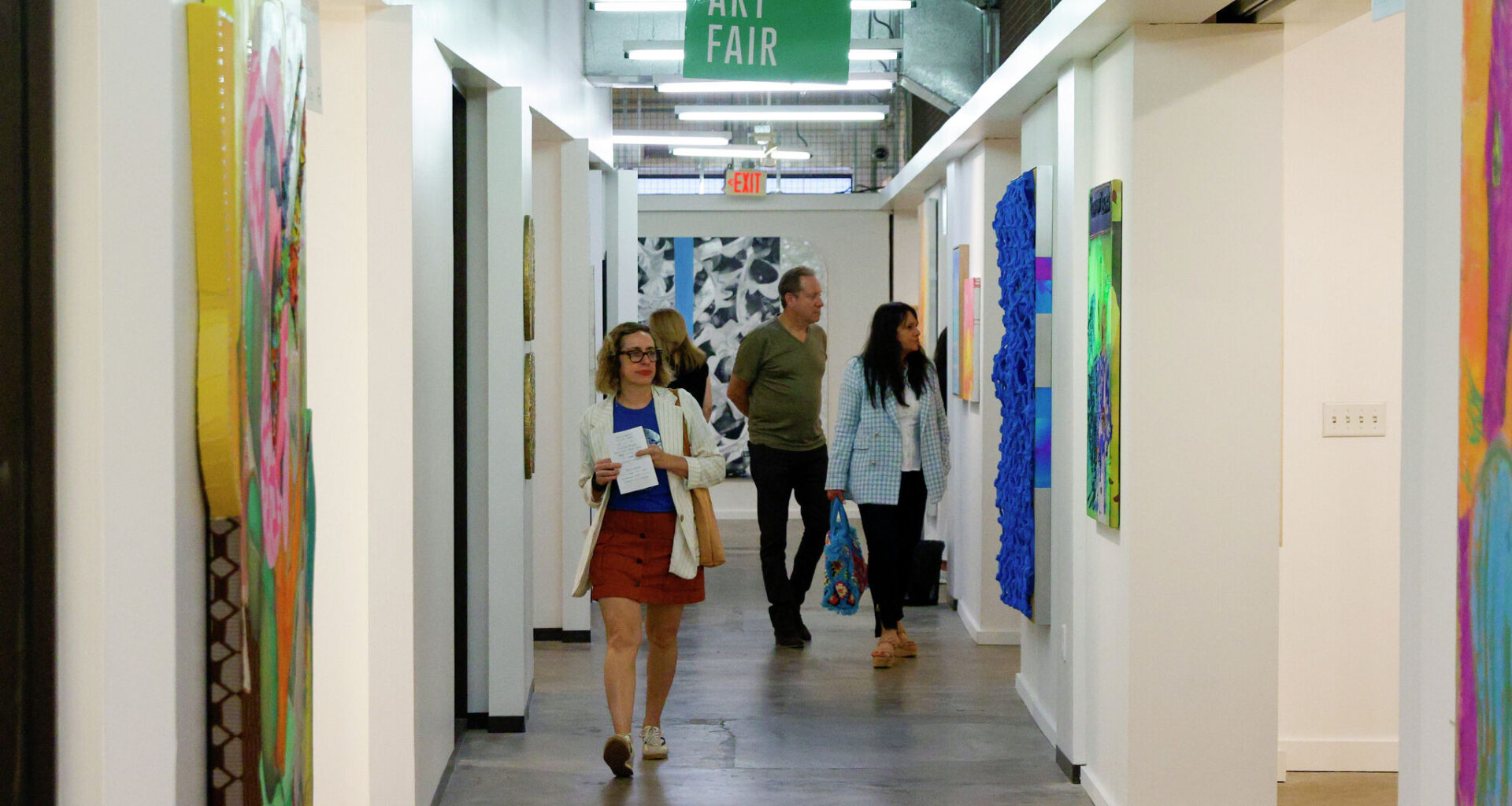
People view various pieces and galleries at the Dallas Art Fair at Fashion Industry Gallery on Thursday, April 20, 2023 in Dallas. Texas ranked high in Bank of America and ArtTactic’s first report on the U.S. art market.
Elias Valverde II/Dallas Morning News
It came as no surprise to auction houses, art collectors and others in Dallas that Texas ranked high in Bank of America and ArtTactic’s first report on the U.S. art market.

The report, released earlier this year, showed that Texas joined California, Florida and New York in making up 46% of the country’s spending on art. Texas also ranked fourth in 2025 for art purchases of at least $1 million and at least $50,000.
As the global art market slowly recovers from a slowdown felt by the economy at large, according to reports such as Art Basel and UBS’ 2026 Global Art Market Report, Dallas is becoming a more prominent player. Bank of America Dallas president Jennifer Chandler said the phenomenon is a product of a broader story: The city has grown as a wealth hub.
Article continues below this ad
“When you think about how attractive North Texas is for business leaders and economic growth,” Chandler said, “many of those people succeed in their careers, and they want to become collectors.”
Related: From the coasts to Texas: Meet the wealthy executives moving to do business in Dallas
A host of wealthy Texans and the wealthy executives, companies and employees moving in from other states are giving the art market a boost. More seasoned buyers, meanwhile, have become comfortable purchasing pricier pieces, Dallas Art Fair founder John Sughrue said.
Regional growth
Texas still ranked below the three other top states for art purchases in some measures. For example, New York, California and Florida each accounted for more than 20% of art purchases of at least $1 million, compared to Texas’ 6%. But that was up from 1% in 2015.
Article continues below this ad
Prominent auction houses that connect wealthy art collectors with the blue-chip art market have noted significant growth in their Texas sales.
The number of Dallas-region buyers working with Sotheby’s more than doubled over the last decade and the number of Dallas-area sellers increased by 75%, Sotheby’s told The Dallas Morning News.
The total value in items Christie’s Auction House sold to Texas buyers increased by 74% between 2023 and 2025, according to data from the company.
When Aviva Lehmann began working at Dallas-based Heritage Auctions in 2013, she estimated it had about 350 employees and annual sales of more than $835 million.
Now, Heritage Auctions has more than 900 employees worldwide and already sold $1.41 billion halfway through 2026 to its international client base.
Article continues below this ad
“We see people coming in on private jets, just for the day at Heritage, just to see something they’re interested in,” Lehmann, Heritage Auction’s deputy chairman of fine art, said. “The fact that Dallas and Heritage has become a destination for seasoned collectors and new collectors from all over the country and the world is incredible.”
Heritage Auctions’ headquarters in Dallas.
Heritage Auctions
A growing asset class
Art can be more meaningful than other assets, Charlie Adamski Caulkins, head of the Dallas office for Sotheby’s, said.
“Art has this really cool duality to it that a lot of investments don’t,” Adamski Caulkins said. “I know plenty of collectors who maybe start getting interested when they hear about the high numbers and the possibility to make money, and then they start buying art and they get really drawn into the stories behind the artists or certain styles.”
Article continues below this ad
One of Dallas’ most prominent collectors is Craig Hall, founder of Dallas-based investment and real estate development firm Hall Group.
The son of an art teacher, Hall began buying art as a teenager. What started as a hobby is now a key part of his commercial real estate business.
“Art was always a part of my life,” Hall said. “I never did it with the idea that it was a business thing, but I started putting art in buildings, and I think there’s no doubt that it’s helpful in a commercial sense. It really does enhance and make a huge difference.”
Related: Inside the world of family offices: How ultrarich dealmakers invest billions
Hall has bought primarily modern art and sculptures from Texas and across the U.S. that Hall Group displays in its buildings and outdoor areas, including the Hall Arts Hotel in downtown Dallas’ Arts District and Hall Park in Frisco.
Article continues below this ad
Although his passion for art collecting is more personal than financial, he says the “K–shaped” economy with a large accumulation of wealth has helped fuel the art market’s growth. He has watched more people buy art for themselves and for commercial buildings.
“Art has become an investment class,” Hall said.
New collectors
The luxury market is also booming and helping to draw young people to the art scene, Lehmann noted. In an age dominated by the digital world, Lehmann said it seems more of the young wealthy buyers crave assets they can enjoy without a screen.
Young people may start with coins, comic books, sports and entertainment memorabilia, Pokémon cards or furniture, Nick Nicholson, deputy chairman of decorative arts at Heritage Auctions, said.
Article continues below this ad
Aviva Lehmann, chairman of fine art at Heritage Auctions, and Nick Nicholson, deputy chairman of decorative arts at Heritage Auctions.
Heritage Auctions
“They start buying jewelry and then suddenly it’s the engagement ring, and then it’s the first real painting that they buy together as a couple and they grow and change with us and develop their tastes,” Nicholson said. “No one ever thought a 24-year-old was going to have a billion dollars.”
Capera Ryan, the North Texas-based deputy chairman of Christie’s, has noticed younger millennials and members of Generation Z participate in auctions. Christie’s most recent reports show that 47% of its global bidders and buyers were millennial or Generation Z, Ryan said.
“They’ve been successful in creating these companies and businesses,” she said, “and then they start diversifying what they’ve made and their respective businesses into collecting and other areas, whether it be the luxury market or art.”
Christie’s, a national auction house, has offices in Dallas.
Christie’s
Dallas’ gallerists and artists make the art market less intimidating, said collector Nadia Dabbakeh, 38. Many of them are young, and can guide each other, she said. People attend art openings and meet artists and collectors who can advise them on what pieces and price ranges to start with.
Dabbakeh got into collecting when she was working at Modern Luxury in her 20’s and got invited to art events such as openings and the Dallas Art Fair.
With time, pieces from those local artists become more valuable. Dabbakeh said art brings her more joy than an old Birkin bag or a $5,000 table at a night club referencing how other millennials might choose to spend money.
“Being able to buy something that you love and that you can put in your home and it brings you joy, puts a smile on your face, and then also learn that in this person’s art has doubled in price is kind of like a little pat on the shoulder,” Dabbekah said.
“Being able to buy something that you love and that you can put in your home and it brings you joy, puts a smile on your face, and then [to learn] this person’s art has doubled in price is kind of like a little pat on the shoulder,” Dabbekah said.
Following in the footsteps
North Texas’ big-time collectors — from Howard and Cindy Rachofsky, Harlan Crow and the Bass family to Alden Pinnell and Hall — are shaping the arts scene, with some of them establishing new galleries such as The Power Station and The Warehouse Dallas, both nonprofit initiatives. Others are leaving behind major collections when they die for auction houses to sell, Adamski Caulkins from Sotheby’s said.
With his legendary collection, modernist art house and annual galas as a pinnacle of Dallas’ contemporary arts scene, Howard Rachofsky “made it sexy to buy art” said Hannah Fagadau, owner and co-founder of 12.26 gallery in Dallas. Rachofsky’s galas showcased top-notch pieces from around the world, inspiring people to explore what else they might be able to find in the art world, Fagadau said.
Fagadau said North Texas families who grew up here, and others moving from the coasts, are buying homes they want to decorate with unique pieces from artists with interesting stories. She credits Dallas Art Fair founder Sughrue for making people aware that Dallas “is a great place to buy art.”
“You don’t have to go to New York or LA,” Fagadau said.
The 18th annual Dallas Art Fair, which happened in April, was a bustling event founder Sughrue described as a proxy for the city’s economic state.
“There’s a correlation between wealth and art collecting,” Sughrue said.
Sughrue said Dallas’ growth is distinct from the global art market’s rebound: More wealthy people are buying more expensive art.