
Most mornings, Maylen Rondón begins the day with a cortadito.
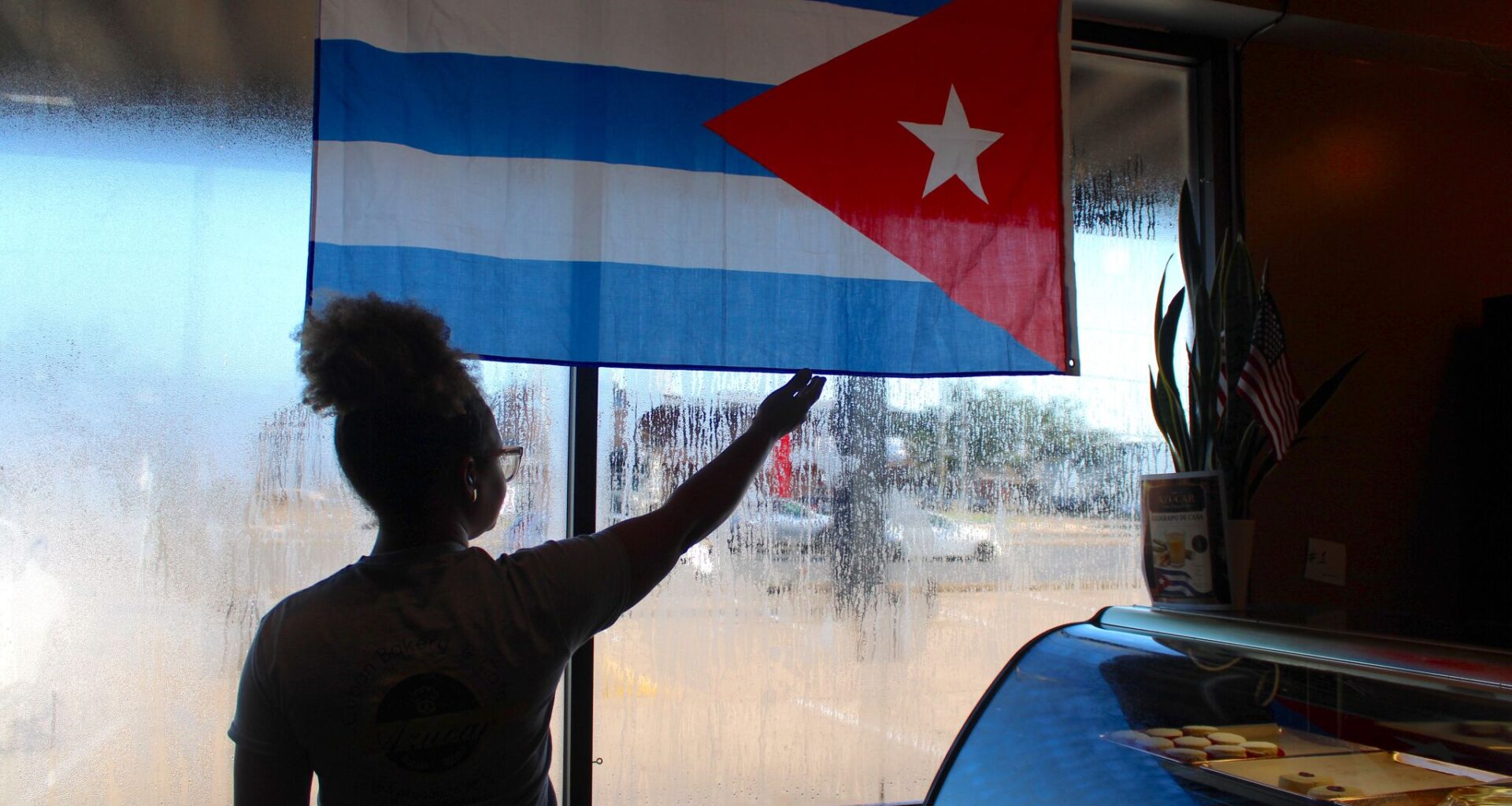
Along Westheimer in the heart of Houston, a Cuban flag hangs in the front window of Azúcar, a Cuban bakery where Rondón begins her day at 8 a.m. sharp. Behind the counter, memorabilia from the island lines the walls, from a framed image of the Cuban flag to a painting of Celia Cruz smiling with her signature turbante, a headpiece associated with salsa rumba dancers.
The scent of freshly baked Cuban bread and guava pastries fills the bakery, drawing regulars back day after day.
But there was a time, Rondón said, when none of this felt familiar.
Article continues below this ad
Before Houston, she had left the island to stay in Bolivia for a few years. She never imagined Houston would become the city where she would eventually settle in 2022. It was simply a place where she had friends who could take her in. A friend who frequented Azúcar told her they were hiring, and the owners welcomed her “as if she were family,” giving her ese rinconcito — the small corner she felt she needed.
Maylen Rondón stirs a freshly prepared cortadito behind the counter on Sept. 10, 2026.
Daniella Jiménez/Houston Chronicle
“When I started working here, that’s when I started reconnecting again with my people,” she said. “But in the four years I’ve been here, the Cuban community has grown enormously.”
Rondón, 30, is part of a broader shift unfolding across Houston. Among Harris County’s 10 largest foreign-born groups in the latest Census Bureau estimates, the Cuban population had the second-fastest growth rate, behind only Venezuelans.
Article continues below this ad
The reasons are layered. Economic hardship pushed more Cubans to leave the island, while changes in U.S. policy and migration routes brought more through the Southwest border instead of entry points like Florida. For some, Houston became more than a stop along the way, offering jobs, affordable housing and a growing Latino community that made it appealing to stay.
READ MORE: How Hondurans created a Houston hub and are dealing with Trump’s deportation threats
The county’s Cuban-born population reached nearly 41,000 in the latest American Community Survey estimate, compared to 25,000 in the 2019 five-year estimate. Among the top 10 groups, only Venezuelans grew faster, with their population more than doubling over the same period.
Valerie Lacarte, a senior policy analyst at the Migration Policy Institute who has studied immigration trends in Greater Houston, says the rising numbers don’t surprise her. She points to her report in 2023 that showed how the “Walking Generation,” a new wave of Cuban migrants, contributed to this fast-growing group coming into Houston.
Article continues below this ad
The term was coined by Cuban journalist Rachel Pereda to differentiate the “walking” wave of Cuban immigrants through Latin America from those who traveled to the U.S. by sea — the balseros of the 1990s.
New immigration routes
After the Obama administration ended its “wet foot, dry foot” policy in 2017, Cuban migration patterns began to change. More Cubans began traveling through Central America and Mexico toward the Southwest border instead of Florida.
Another turning point, Lacarte explained, came in November 2021, when Nicaragua eliminated visa requirements for Cubans, allowing many to fly to Managua before continuing north.
The changing immigration route became especially visible after the pandemic. Cuba’s tourism-dependent economy was devastated by travel restrictions, adding to financial and social hardships that erupted into protests in 2021.
Article continues below this ad
Rondón, like others, fled to other countries in Latin America.
In 2018, she was in her early twenties when she took the step to build a better future for her family back in Jiguaní, a small town located in eastern Cuba. She left and spent four years in Bolivia, where she had her son. When she decided to continue north, Rondón said, she crossed the Darién Gap, a jungle on the border between Colombia and Panama. There, she traveled from country to country before reaching Houston in 2022.
READ MORE: More than 1 in 4 Harris County residents are immigrants. See what countries they come from
By then, what she wanted from the place she would later call home had become clearer: steady work, a way to help her family and the chance to build a better future for her son.
“I think when you become a parent, you set aside being yourself to raise your children,” she said, wrapping her arms around herself. “More than anything, we try to give him a future. The one that many of us couldn’t have.”
Article continues below this ad
Lacarte said this new route of migration was especially pronounced during 2022, with roughly 220,000 Border Patrol encounters with Cubans recorded along the Southwest land border, according to federal data.
“Once you have more people coming through the Southwest border through Mexico,” she said, “it kind of makes sense that you would see more people going to Houston.”
Maylen Rondón stirs a cup of cafecito while working at Azúcar Cuban Bakery in Houston on Sept. 10, 2026. Cuban coffee is a central part of her morning routine at the bakery.
Daniella Jiménez/Cuban Migration Coffee Houston
Why more Cubans stay in Houston
Houston has long drawn newcomers with job opportunities and comparatively affordable housing, Lacarte said. Miami remains the center of Cuban life in the United States, with generations of family and community ties that continue to pull newcomers to South Florida. But more recent arrivals do not necessarily have the same attachment to Miami.
José Rodriguez, a Cuban singer who performs as El Wishy, had Houston in mind before he ever arrived.
Unlike Rondón, he already had relatives in the city. Growing up in Cuba, Rodriguez consumed American pop culture through movies and became interested in cities such as New York, Las Vegas and Houston. Houston stood out, he said, because of its Latino culture and the possibility of continuing his music career while reaching new audiences.
Since he arrived, Rodriguez said he has seen a sizable Cuban presence stretching from southwest Houston to Katy.
A framed image of Celia Cruz with her signature turbante and graffiti art of the Cuban flag inside Azúcar Cuban Bakery located in Houston on Sept.10, 2026.
Daniella Jimenez/Houston Chronicle
“I think after Miami, Houston has the next-biggest Cuban community,” he said. “I think Houston is right up there in that sense, you know?”
Affordability is another part of the city’s appeal. Rodriguez said friends in Miami have told him that rents there are considerably higher than in Houston. Across all bedroom sizes and property types, Houston’s rental market averages $1,900 a month compared with $3,109 in Miami, according to Zillow.
But for Rodriguez and Rondón, Houston’s draw goes beyond the cost of living. They also point to its vibrant mix of cultures.
“Houston makes you feel more than alive,” Rondón said. “It’s the way of life, so many people and culture. It’s like an addiction.”
Even the parts of Houston she complains about have become part of her attachment to the city. The traffic scares her, the heat can be unbearable and the city’s pace rarely slows. She recalled a confusing mix of feeling both scared and happy the first time she entered downtown and took in the tall buildings that towered over her. The skyline, she said, was beautiful and unforgettable.
When her husband’s work took the family to Kentucky, they stayed eight months before ultimately returning to Houston.
“The craziness of Houston is what keeps us alive,” she said. “I don’t think I’ll ever leave this city.”