
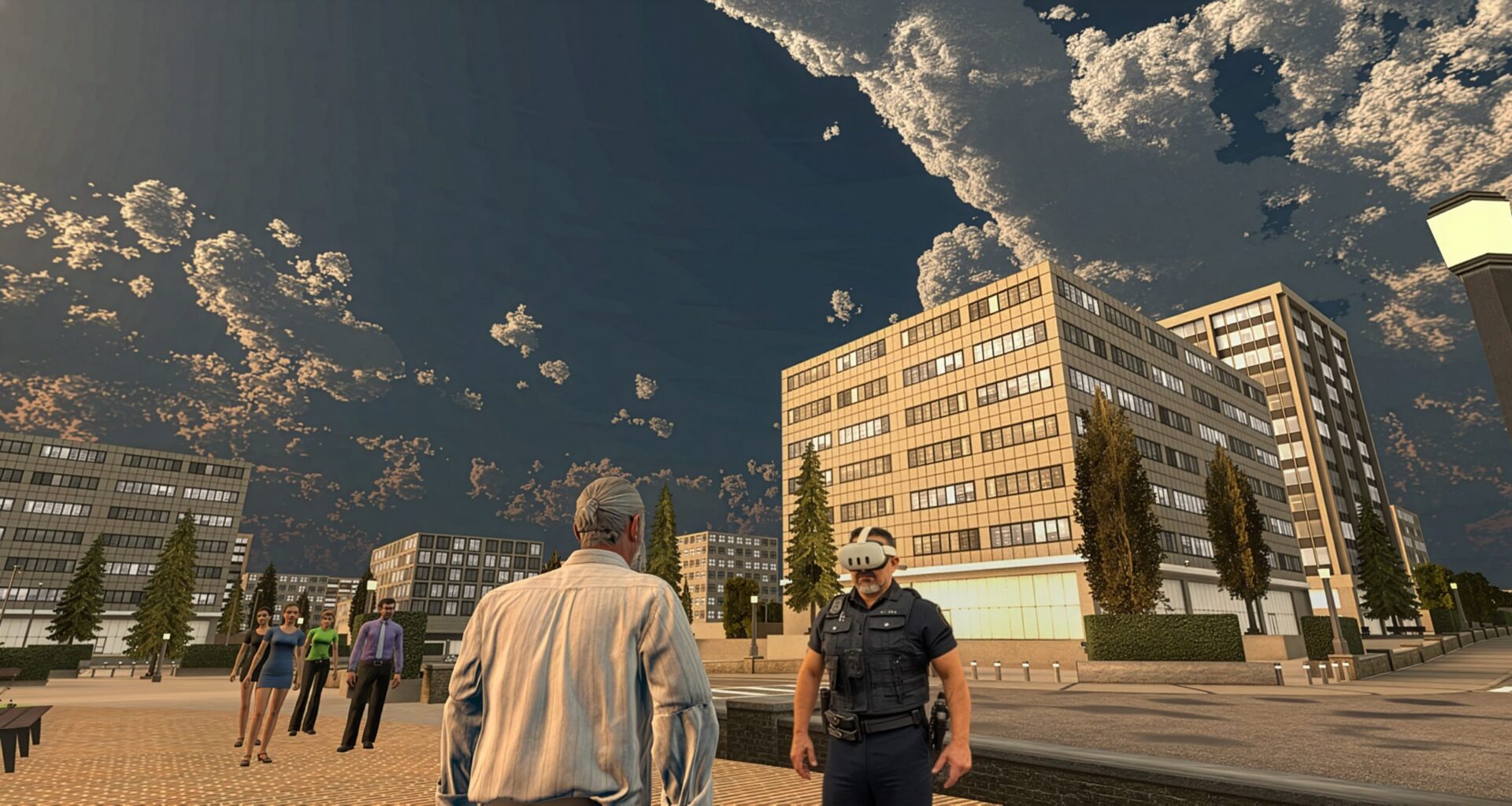
A collaboration between the Fort Worth Police Department and the University of Texas at Arlington is utilizing virtual reality and artificial intelligence to enhance de-escalation training for police officers.
Through a Department of Justice grant called the Virtual Reality De-escalation Site-Based Initiative, the partnership supplements traditional police training role-play with an AI-driven system to provide unpredictable, scalable and safe de-escalation training.
Officer Jorge Lopez serves as the instructor for the police department. He said this program provides training in a safe manner, using repetitions in a controlled environment to help police officers make better decisions under stressful conditions.
“We want well-trained professional officers,” Lopez said. “Anything that we can drive towards that, to do it safely and efficiently and as close to realistic as possible, is always going to benefit the community because you’re going to have better trained officers.”
The more than $750,000 grant was awarded in October 2024 and the program will end in September 2027.
De-escalation training is typically a weeklong exercise that involves real people who are given a scripted scenario to work through. The process teaches officers how to communicate with a person in crisis and helps develop the skill set to reduce the need for use of force in critical incidents.
The AI training lasts an hour and will replace human role players with a Meta Quest 3 headset system.
Software development took a year to properly convert audio to text, enable the computer to read it and respond back from text to speech to the user.
The system can simulate multiple situations from mental health breakdowns or domestic violence. The difficulty of the situation can change, said Shuchi Deb, associate professor at UT Arlington’s Department of Industrial, Manufacturing and Systems Engineering, while preventing liability.
Data collection started this summer with 27 volunteers from the police department, My Health My Resources healthcare providers and UT Arlington students who participated in recorded simulated situations.
Deb says the system utilizes the Meta headsets for immersion, the Unity game engine for scenario creation, and Gemma for conversational AI with rapid response time.
The training provides real-time feedback during the scenario and a summarized constructive feedback after a module is completed for trainees to review.
While AI has been confronted with resistance from communities, Deb sees it as an opportunity for the police department to bring forth change.
“If you see what we have created, and if you see that officers are trying to make a change, it will make people convinced that ‘OK, something good is happening,’” Deb said.
Virtual reality training has limitations. While good for procedural tasks, the system can’t teach conceptual knowledge, which will have to come from the classroom, Deb explained. She and Lopez hope to expand the technology with multiuser scenarios for team training and introduce stress to better mimic hard-to-replicate real-world tension.
Lopez said law enforcement shouldn’t invest time and money into every new technology, but instead take time to ensure its capabilities.
“We want it to be tested and tried and evaluated well, and then supported by the community as well,” Lopez said.
The program is currently in an implementation phase as the police department is procuring all the needed logistics for their police academy.
Kamal Morgan is a government accountability reporter for the Fort Worth Report. Contact him at kamal@fortworthreport.org.
At the Fort Worth Report, news decisions are made independently of our board members and financial supporters. Read more about our editorial independence policy here.
This <a target=”_blank” href=”https://fortworthreport.org/2026/09/20/fort-worth-police-uta-partner-on-ai-driven-de-escalation-training/”>article</a> first appeared on <a target=”_blank” href=”https://fortworthreport.org”>Fort Worth Report</a> and is republished here under a <a target=”_blank” href=”https://creativecommons.org/licenses/by-nd/4.0/”>Creative Commons Attribution-NoDerivatives 4.0 International License</a>.<img src=”https://i0.wp.com/fortworthreport.org/wp-content/uploads/2021/04/cropped-favicon.png?resize=150%2C150&ssl=1″ style=”width:1em;height:1em;margin-left:10px;”>
<img id=”republication-tracker-tool-source” src=”https://fortworthreport.org/?republication-pixel=true&post=783197&ga4=2820184429″ style=”width:1px;height:1px;”><script> PARSELY = { autotrack: false, onload: function() { PARSELY.beacon.trackPageView({ url: “https://fortworthreport.org/2026/09/20/fort-worth-police-uta-partner-on-ai-driven-de-escalation-training/”, urlref: window.location.href }); } } </script> <script id=”parsely-cfg” src=”//cdn.parsely.com/keys/fortworthreport.org/p.js”></script>