
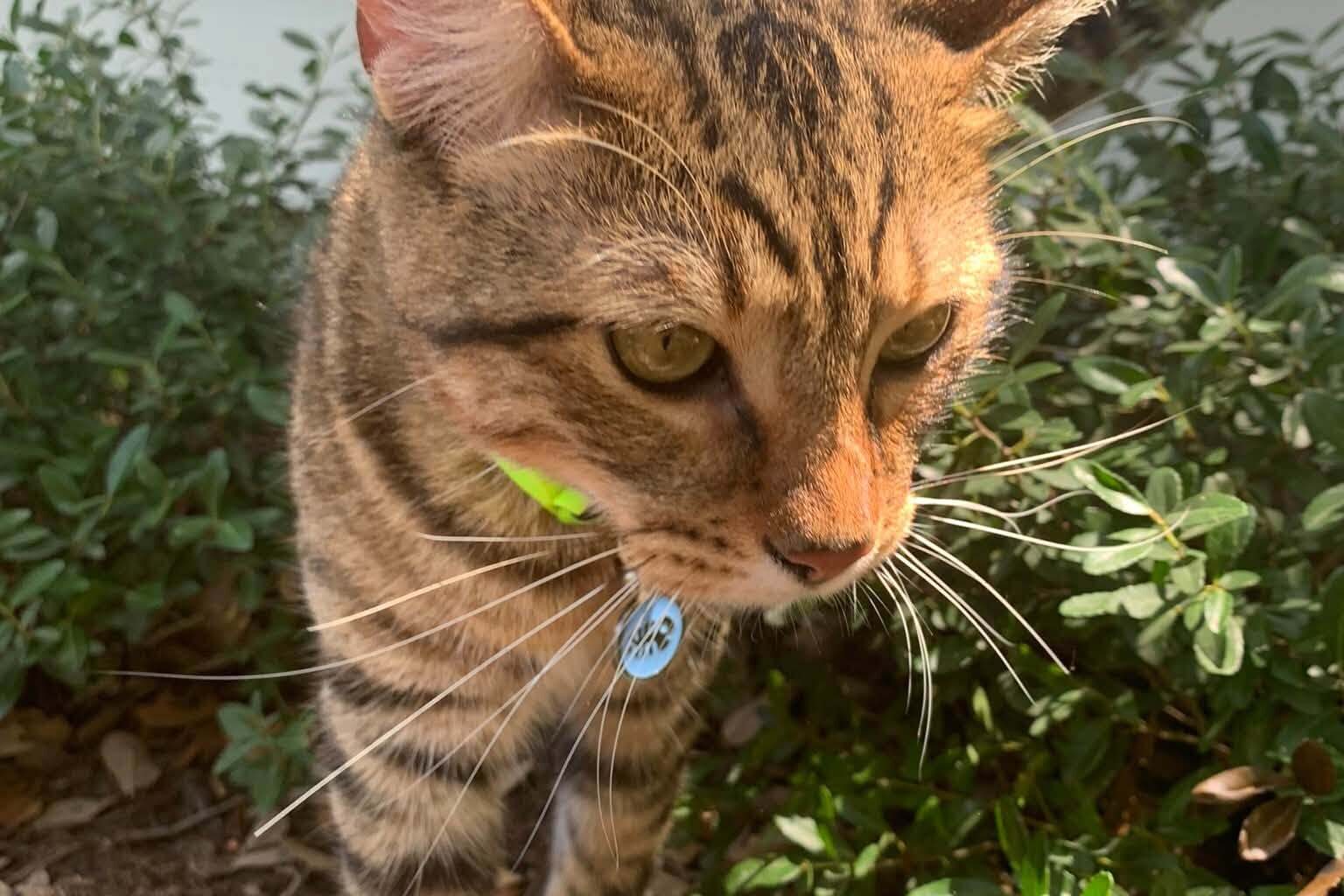
Tommy, the Caputo family’s cat. He died after he was struck by a Waymo autonomous vehicle Sept. 6 in Central Austin.
Courtesy of Anton Caputo
An Austin family is mourning after an autonomous Waymo vehicle struck and killed their beloved cat, Tommy, over Labor Day weekend near their home.

The accident occurred Sept. 6 on Brackenridge Street near East Monroe Street, just east of South Congress Avenue in Central Austin’s Travis Heights neighborhood, according to Anton Caputo, who along with his wife and two adult children, owned Tommy for about five years.
Article continues below this ad
The Caputos weren’t home at the time, but their neighbors William Lehner and Abbey Simpson were driving behind the Waymo and witnessed the situation unfold.
Lehner said the cat suddenly ran into the road and was immediately hit by the Waymo vehicle. The cat screamed and ran into some shrubbery, where Simpson found him. According to Lehner, the vehicle pulled over briefly to let out its two passengers before driving off.
“It knew it hit something because it stopped, and then the guys got out, and then the Waymo just drove away,” Lehner said. “The whole thing was probably less than a minute.”
Lehner said it’s unlikely the vehicle could have stopped in time to avoid the collision. But what happened afterward raises questions about robotaxi operators’ role in protecting animals on the road, and who should be responsible when one is injured or killed by an autonomous vehicle.
Article continues below this ad
Tommy the cat died after he was hit by a Waymo autonomous vehicle Sept. 6 in Central Austin.
Courtesy of Anton Caputo
‘A badass cat’
Tommy’s injuries were “horrific,” Simpson said. His back was broken, and he had suffered severe trauma to a limb. The pair took him to an emergency veterinary clinic, where he was euthanized.
Caputo said Tommy, an indoor-outdoor cat raised by the family’s dog, was unusually “chill” for a cat and popular with the neighbors.
Article continues below this ad
“Tommy was a badass cat,” Caputo said. “My daughter found him in an H-E-B bag as a kitten in the church parking lot, and we took him in and raised him from there.”
Tommy’s loss hit the family hard, and Caputo wanted to know what happened. That same day, he contacted Waymo’s customer support. But Waymo did not respond until more than a week later, hours after the American-Statesman reached out to the company for comment.
“Our mission for trust and safety extends to all road users, including the domestic pets and wildlife in our communities. We are in touch with the cat’s owners and have shared our sincere condolences,” Waymo spokesman Chris Bonelli said in a statement.
The Caputo family owned Tommy for about five years before he was struck by a Waymo autonomous vehicle Sept. 6.
Courtesy of Anton Caputo
Bonelli told the American-Statesman the Waymo vehicle braked but was not able to avoid the collision, which Lehner corroborated. But according to Simpson, the Waymo vehicle shouldn’t have driven away from the scene.
Article continues below this ad
“I feel like a representative should have to come out,” Simpson said. “People are going to hit animals, but there is just a different level of accountability.”
Had she and Lehner not stopped, Simpson added, the Caputos may never have found Tommy or known who or what had hit him.
“If a person did it, we wouldn’t think that the acceptable reaction to hitting an animal is to drive on,” Caputo said. “So I don’t know why it should be for a corporate robot car.”
Caputo said he would like Waymo, which is owned by Google’s parent company, Alphabet Inc., to donate to an animal rescue in Tommy’s name, as the company has done in past instances. Lehner said Waymo should also pay for the $1,000 vet bill the family is now stuck with.
Article continues below this ad
“Waymo should absolutely be accountable for that. That’s just the right thing to do,” Lehner said. “Waymo is a well-funded company that should have more than enough reserves on hand to pay for these types of things.”
Bonelli said Waymo is working through an insurance claim with the Caputos.
Data scarce
In the last year, robotaxi operators have reported five collisions with animals in Austin and Del Valle to federal regulators.
Article continues below this ad
Most recently, a vehicle belonging to Austin-based autonomous vehicle company Avride struck and killed a duck near Mueller Lake Park. The late-March incident drew widespread backlash online after witnesses said the vehicle ran a stop sign before hitting the duck, which was sitting still in the middle of the road, despite having a safety driver behind the wheel.
In January, a Waymo vehicle hit a raccoon that darted into traffic during testing on a Del Valle highway, according to the company’s report to the National Highway Traffic Safety Administration. The car sustained enough damage that it was towed from the scene.
A Waymo autonomous vehicle travels along East Oltorf Street in Austin on July 1, 2025. The company said one of its vehicles braked but was unable to avoid striking Tommy, a cat that ran into the road Sept. 6.
Jay Janner/Austin American-Statesman
The three remaining incidents all occurred in September 2025 and each involved a domestic animal. Two involved Waymo, with one injuring what appeared to be a cat and the other an animal not identified in the report. In the third September incident, a self-driving Tesla hit a dog.
Article continues below this ad
There were no animal incidents documented prior to September last year.
The city of Austin also collects data about autonomous vehicle incidents, but because companies are not required to report incidents to the city, it can only collect complaints from 311 callers and first responders. As a result, animal collisions are likely underreported, the city said.
In one April incident, Waymo operators called 911 and a police officer had to move a robotaxi that was blocking a South Austin thoroughfare after it hit a squirrel. That incident did not show up in NHTSA’s database.
The limited data means it’s tough to judge robotaxis’ safety performance regarding animals, said Michael Brooks, executive director of the nonprofit Center for Auto Safety. Brooks said that before the Statesman contacted him, he was only aware of the now-infamous story of KitKit, a beloved bodega cat in San Francisco who was killed by a Waymo car in October last year.
Article continues below this ad
“It’s impossible to say at this point whether Waymo is safer (or) less safe around animals than human drivers,” Brooks said. “I would suggest that if Waymo wants to achieve public confidence in their safety operations, avoiding pets and other animals is up there on the list of things they should be doing.”
Regulating autonomous vehicles’ protections for animals is also tough, Brooks said.
“There is no regulation and very little if any guidance on these issues at the federal safety level because the authority granted to the (U.S. Department of Transportation) to protect humans on roads doesn’t extend to animals,” Brooks said.
In Texas and other states, robotaxis are regulated at the state level, and municipalities don’t typically have the authority to set their own rules.
Article continues below this ad
As for Caputo, he just hopes Tommy’s death can push the autonomous vehicle industry to do better.
“If this mistake can happen with a cat with no stopping or rendering of aid, what would stop it from happening with a small child?” Caputo said. “We know exactly what (Waymo’s public relations response) will be from it, so I just want to see them live up to it to some little inkling. But we’ll see.”