
Starting in the 1960s, recordings, broadcasts and tours by English cathedral and collegiate choirs came as a revelation to many American choral directors. The clear, more open sonorities of those men-and-boys choirs, as they were then, were quite a change from American approaches that welcomed vibrato in choirs.
Boys, of course, don’t naturally sing with vibrato, but with relatively “straight” tone. Today, with boys’ voices changing earlier, and with more resistance to ensembles perceived as sexist, formerly all-male English choirs increasingly mix in girls, or use adult women for top parts. But the minimal-vibrato approach has prevailed, and it’s adopted by many American choirs.
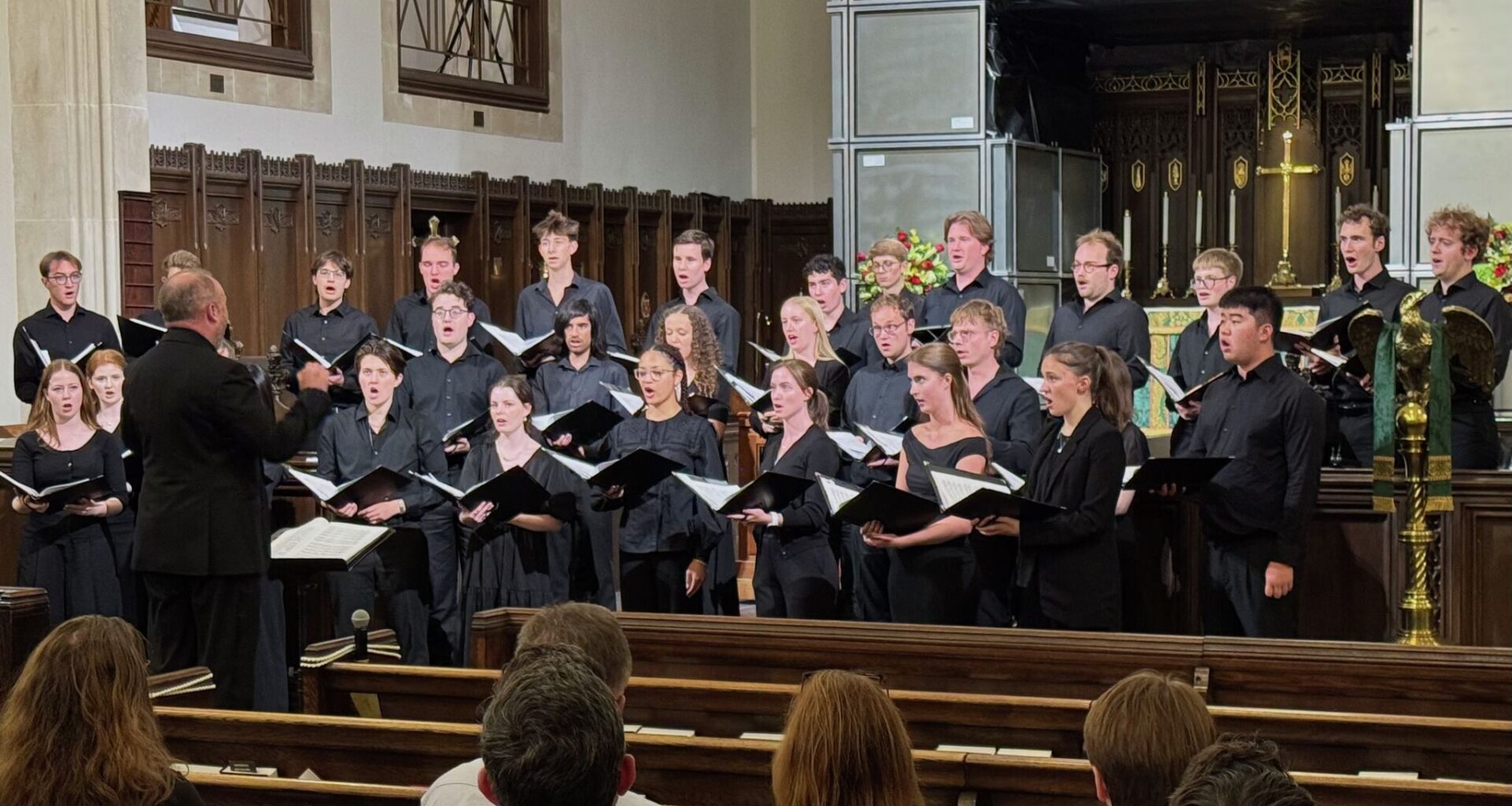
The Choir of Trinity College Cambridge, which presented a concert Sunday evening at Church of the Incarnation, was a men-and-boys outfit until 1982 — several years after the college first admitted female students. Conducted by director Steven Grahl, the mixed-voice ensemble of 32 now on a U.S. tour proved its professional bona fides in a program including some very challenging repertory. Mostly English, it ranged from the 16th century to the 21st.
Judith Weir’s 2003 setting of the e.e. cummings poem “a blue true dream of sky” deftly contrasted a soprano and two altos in the church’s rear balcony with the balance of the choir at the crossing. Her “Love bade me welcome,” to the George Herbert poem, answered higher-voiced self doubts with assurance from lower voices.
Kenneth Leighton’s 1957 “God’s Grandeur” underlined the ambiguities of Gerard Manley Hopkins’ poem in dramatic harmonic stresses and contrapuntal complexities. Jonathan Harvey’s “I love the Lord,” from 1976, challenged an insistent G major chord with harmonic crunches of pain and death.
The Dallas connection to Herbert Howells’ “Take him, earth, for cherishing” went unmentioned. Commissioned as a tribute to President John F. Kennedy, it was first performed at a Washington memorial service a year after the assassination. Exquisite words by Helen Waddell, based on the fifth-century Prudentius, are evoked and vivified in music no less exquisite.
More standard English cathedral repertory was represented by richly voiced motets by Tudor-period composers John Taverner, Thomas Tallis and Richard Dering. Rounding out the English fare were William Henry Harris’ 1925 “Faire is the heaven,” a double-choir evocation of heavenly bliss, to words by Edmund Spenser, and Gustav Holst’s renaissance-influenced 1915 “Nunc dimittis.”
As customary in original performances, if rarely today, the early English works and Bach’s motet “Komm, Jesu, komm” were accompanied, with organ scholar Thomas Simpson discreetly playing a small chamber organ. On the church’s substantial Noack organ, Simpson performed solo pieces by William Byrd and Dietrich Buxtehude, and three of Joanna Marsh’s pleasantly quirky Four Musical Clocks, from 2009.
Apart from key relationships, connections between wildly different pieces performed without pause were anything but obvious. And while the choir securely negotiated formidable harmonic challenges, some of the singing was louder than necessary for this repertory and a church that’s not that large. Like orchestras, choirs seem to be getting louder these days.