
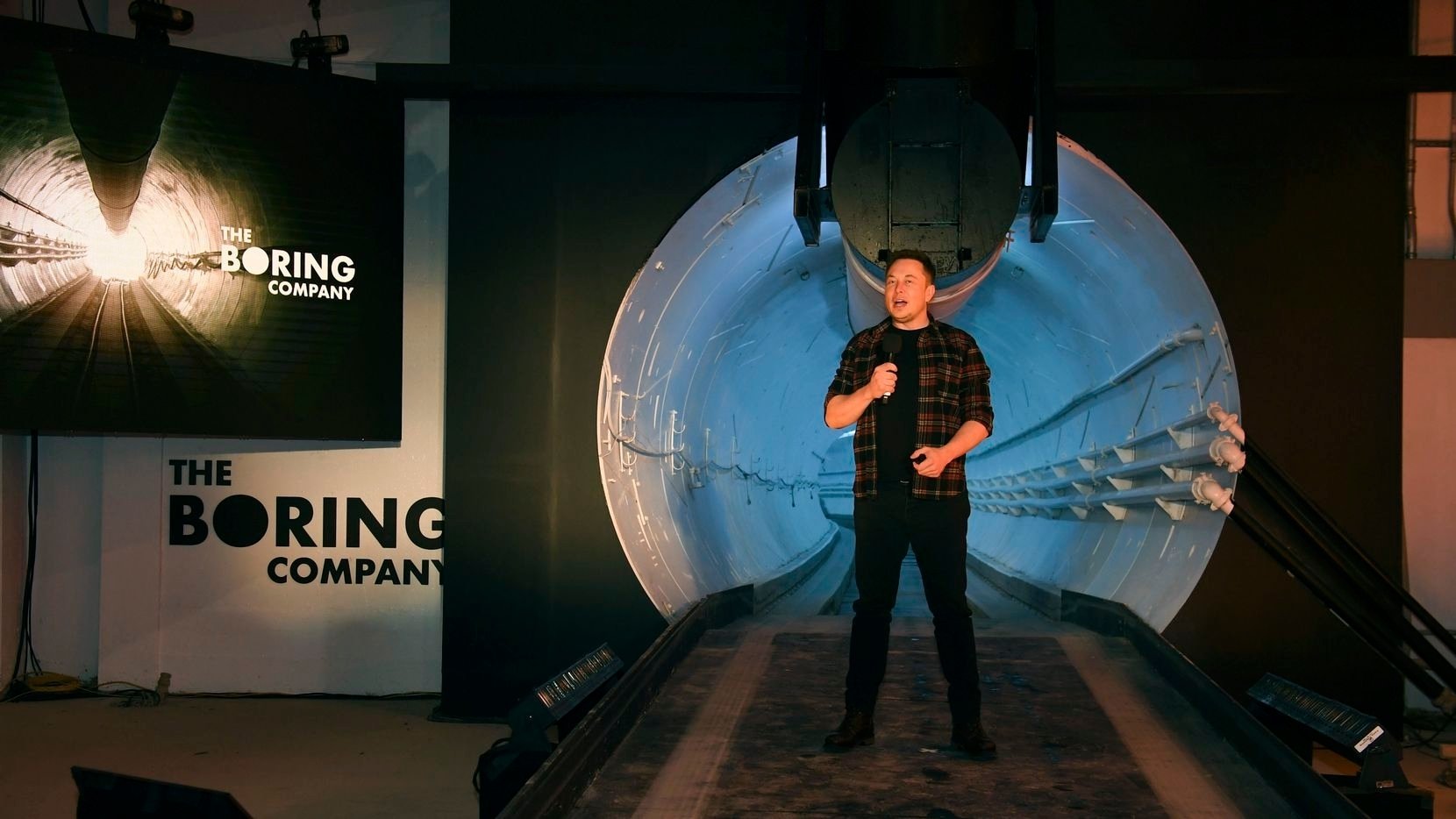
Elon Musk speaks during a 2018 unveiling event for the Boring Co.’s test tunnel in Hawthorne, Calif. It since has built a tunnel in Las Vegas that carries passengers in Tesla cars, but Musk now says it will build a hyperloop tunnel between Austin and San Antonio.
Robyn Beck/Associated Press file photo
In this Nov. 15, 2019 photo, a tunnel boring machine sits at the bottom of a construction site during a media tour at the Las Vegas Convention Center in Las Vegas. Elon Musk’s Boring Company, nearing completion of a short underground motorway for electric cars at the expanded Las Vegas Convention Center, wants to widen its scope to build a people mover tunnel system generally beneath the Las Vegas Strip.
John Locher/AP
The Boring Co., Elon Musk’s tunneling company that runs an underground Las Vegas transportation system using Tesla vehicles, has more ambitious projects in mind.

It is working on what Musk called a “simple, precursor Hyperloop tunnel between Austin and San Antonio” that would carry passengers at more than 200 mph.
Article continues below this ad
“Due to traffic congestion, that journey can currently take up to 2.5 hours,” Musk said in a post on X, claiming that the project could reduce that to a consistent half-hour ride.
Responding to Musk’s post, the tunneling company said it “would be excited and honored to build this massive infrastructure project.”
It added that riders could someday travel from an Austin parking lot to a favorite San Antonio restaurant in about 30 minutes, as long as they both have loop stations.
It would the world’s first hyperloop. Since 2013, Musk has talked up his idea for such a tunnel, which would carry passengers in pods traveling through low-pressure or near-vacuum tubes underground.
Article continues below this ad
Jori Liu, director of communications for the Central Texas Regional Mobility Authority, said the agency was not aware of the idea before Musk’s post.
“It remains unclear whether the ‘precursor’ system would rely on conventional electric vehicles, such as the Teslas used in Las Vegas traveling at higher speeds, or whether it would incorporate true Hyperloop architecture, with passenger pods traveling through low-pressure vacuum tubes,” she said in an email.
Liu pointed to The Boring Co.’s earlier proposal for a tunnel system connecting San Antonio International Airport to downtown, noting that project has stalled. She said the new proposal would be even more difficult to pull off.
“An 80-mile intercity tunnel would face significant hurdles, including regulatory approvals, environmental considerations, and land-rights issues,” she said. “At the same time, Mr. Musk has achieved notable successes in several ventures by pursuing approaches that departed from conventional industry practices.”
Article continues below this ad
Austin and San Antonio residents have long sought an easier way of traveling between the two cities.
A recent study from the Texas Department of Transportation found that passenger trains could make as many as eight round trips daily between Austin and San Antonio if improvements were made to existing rail tracks, transporting thousands of commuters. The study predicted that a two-hour passenger rail service between San Antonio and Austin could attract 2,337 daily riders.
Currently, commuters make about 113,000 trips between Bexar and Travis counties on a typical weekday, according to the study.
Travis County has commissioned a separate study exploring whether a new passenger rail line could be built beside Interstate 10 and Texas 130 that could then take commuters between downtown San Antonio and Austin-Bergstrom International Airport.
Article continues below this ad
Now, Musk has thrown his tunneling company’s hat in the ring to build an alternative to driving or a conventional rail system.
But after years of promising traffic solutions, Boring Co.’s realized partnerships have been scarce. Projects proposed in San Antonio and elsewhere in Texas, as well as in Maryland, Chicago and Los Angeles, have not moved forward.
The company has previously proposed building tunnels near the Austin Convention Center, along Cesar Chavez Street or between downtown Austin and Gigafactory Texas. More recently, Tesla has touted the so-called Cybertunnel that moves finished Cybertrucks from the production line to staging at the Austin factory. Earlier this month, Tesla filed a permit for a “Tesla Colorado River Tunnel,” described as a single lane connector tunnel. The Boring Co.’s involvement on the Colorado River tunnel is unknown.
Article continues below this ad
It’s newest tunneling machine, which the company calls Prufrock-5, is now finishing a test tunnel in Bastrop, where Boring Co. has operations. The 900,000-pound machine is expected to re-launch in November. It said last month workers at the Bastrop facility were preparing a variant of the machine, known as Prufrock-MB3, to ship to Nashville this month.
Elsewhere in Texas, Boring Co. selected a southern Dallas site as one of three winners in its tunneling project competition. Last year, an investigation by The Texas Newsroom and Hearst Newspapers found that Musk, in partnership with Houston-area Rep. Wesley Hunt, pushed state and local officials to hire Boring Co. to build two tunnels around a major watershed in Houston.